




Reach in Closet System | Custom by DBM Factory


Reach-In Closet System
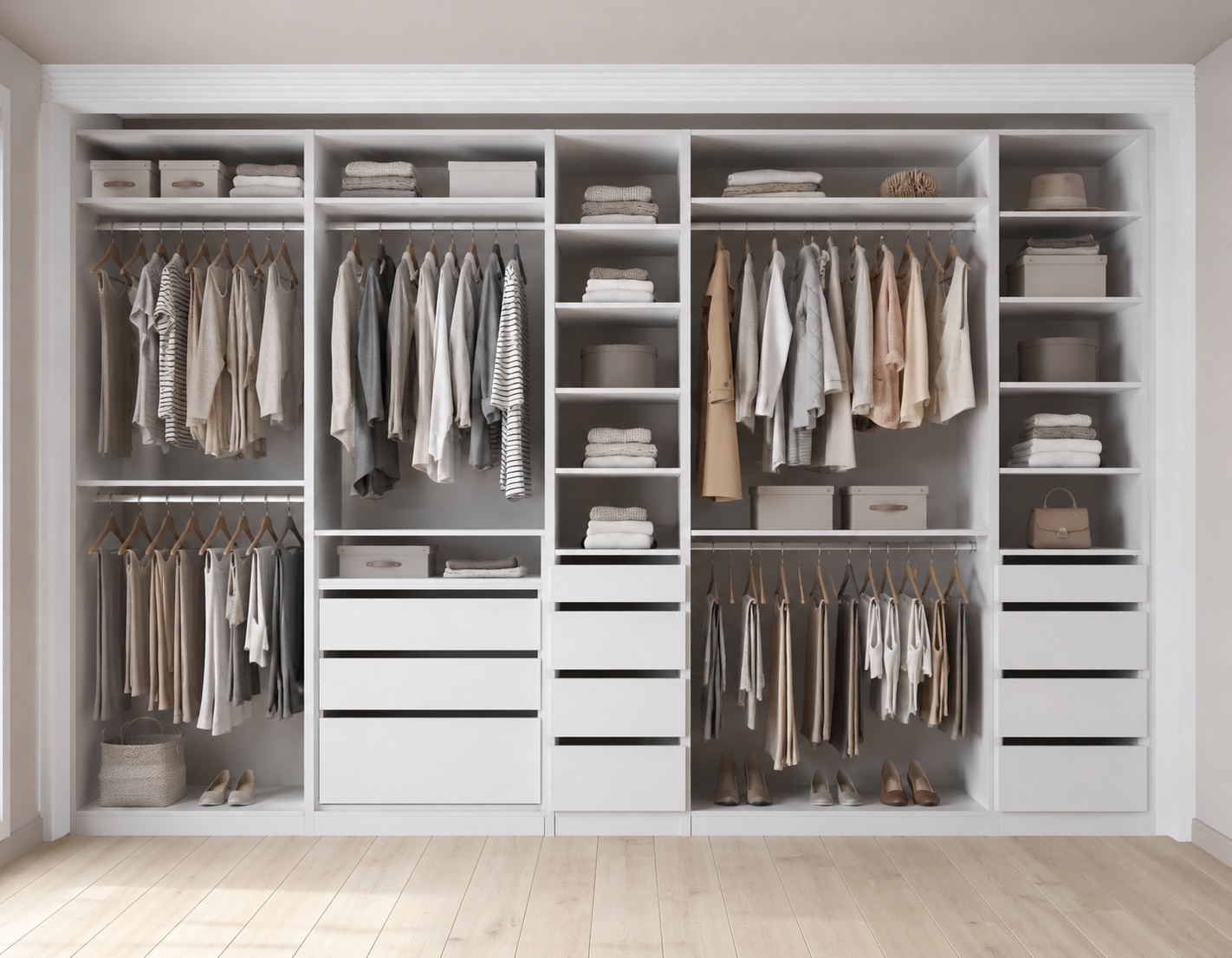
A reach-in closet has to do a lot inside a shallow recess. Hanging at the top, drawers at the bottom, shelves above the rod. Done well, the inside feels considered rather than crammed — doors close cleanly, drawers glide quietly, and the morning routine flows. It’s the everyday closet most apartments and secondary bedrooms still need.
We design and produce each reach-in closet around your project. Share the opening width, depth, and a designer reference. We turn it into a working drawing and build each module ready for shipment.
Fit More Into a Tight Recess
Wood Species — Oak / Veneer / Painted MDF
Oak veneer over engineered cores keeps doors and panels stable in narrow openings. Painted MDF is the common pick where the closet should match the wall and read as a single quiet plane.
Hanging Layout — Single / Double Rod
A single long-hang rod for dresses and coats. A double-hang stack — shirts above, trousers below — for owners who want capacity over hanging length. Final mix set on the working drawing.
Shelves & Drawers — Adjustable / Soft-Close
Adjustable shelves above the rod for hat boxes and folded jumpers. Soft-close drawers at the base for foldables, socks, and accessories. Shelf pins pre-drilled for re-set without re-drilling.
Door Style — Hinged / Bi-Fold / Mirror
Standard hinged doors where swing space allows. Bi-fold panels for narrower bedrooms. A full-height mirror insert on the door face for apartments and secondary bedrooms that double as dressing space.
Where It Fits — Four Common Project Types
Apartment Bedroom
The reach-in is often the only closet in the room, so capacity matters. Double-hang stacks with drawers below tend to win the floor-area fight. Painted finishes keep the room feeling open.
New Home Secondary Bedroom
Drawn into the plan as the children’s or guest bedroom closet. Bi-fold doors save swing space; an adjustable shelf-and-rod layout lets the closet grow with whoever uses the room next.
Renovation Refresh
The original closet stripped out, the opening squared up, the new reach-in fitted to the actual wall dimensions. Doors and finishes chosen to match the refreshed bedroom palette.
Vacation Residence
Lighter use than a primary home, but the closet still has to look right when guests open it. Mirror-fronted doors brighten the room and remove the need for a separate stand-up mirror.
From Sketch to Site — Three Stages
Share the opening width, depth, and a designer reference — that’s enough to start. We turn it into a working drawing for the reach-in. It covers the rod and shelf layout, drawer positions, and the door swing or bi-fold direction your contractor will need.
Every module is fully assembled and photographed in our Guangdong workshop before being taken apart for shipping. Each panel, drawer, and hardware kit comes labeled, so on-site assembly is straightforward — typically bolt-and-cam, not site-cutting.
Wooden crates built for ocean freight, packed in the order your installer will assemble. Shipped to 60+ countries — including the USA, Australia, the EU, and across Asia.
After delivery, your contractor or installer handles fitting. We provide an assembly guide and a step-by-step video. Where local installation is available in your region, we can help you find a vetted installer.
Reach-In Closet System
When the Opening Is Fixed — Matching the Internals to What You Actually Own.
A reach-in opening rarely moves. The recess sits where the builder framed it, shallow and a fixed width, and the wall cannot give an inch more. So the room for improvement is not the box itself. It is the layout of rods, shelves, and drawers packed inside that fixed shell.
Owners reach us with one familiar frustration: a single rail and one shelf, with most of the height wasted above and below. The solution begins with an inventory, not a measurement. What you hang long, what you hang short, what you fold, and how many shoes you keep all shape the layout inside. The opening stays the same; the fit-out within it changes completely.
Why the Inventory Decides the Internals.
A fixed recess holds a fixed volume, so the interior is really a budgeting problem. Every rail, drawer, and shelf competes for the same finite cube, and adding one means giving up another. That is why the inventory matters more than any catalogue layout: it tells us where the volume is worth spending. A wardrobe heavy in one kind of item should spend its limited height there, not on a balanced grid that half-fits everything.
This is why we start with the wardrobe and not the wall. A nicely fitted interior that ignores your real mix simply wastes the recess in a tidier way. A layout drawn around the stock-take utilises the same opening far harder, because every component answers something you genuinely own.
The trade-offs stay honest, as always. A shallow recess limits drawer depth, and a very narrow opening may carry one rail rather than two. Where the wardrobe leans toward folded items, drawers win the space; where it leans toward dresses and coats, long-hang takes the lead. We work the balance through against your real numbers, well before any panel is cut.
How the Same Recess Carries a Different Mix.
The Hanging Split Comes First.
An owner with many dresses and coats needs a clear long-hang zone, so we keep one tall section open from rail to floor. An owner of mostly shirts and folded trousers gains far more from a double-hang layout, two shorter rails stacked within the same height. The recess size never changes; the split inside it does.
The Folded and Drawer Balance Comes Next.
Folded jumpers, denim, and gym wear belong on shelves or in soft-close drawers, and the right ratio depends on the count. We set a drawer stack at the base for socks, belts, and smaller items, then place shelves above so the layout can be re-pinned as the wardrobe grows. The shelf pins come pre-drilled, so nothing needs re-drilling later.
The Shoes and Accessories Come Last.
Shoe storage is the detail most fixed closets ignore, yet it governs the lower specification. A flat-heel collection suits a shallow angled shelf, while boots and heels need a taller clearance. We allocate the shoe zone to the heel-height variety you describe, and reserve a slim drawer for belts, ties, or jewellery where the inventory calls for it.
What Coordination Looks Like for a Fitted Interior.
Drawing-First Coordination begins with your opening dimensions and your inventory together. We confirm the recess width, depth, and height, then translate your storage counts into a module layout before anyone cuts a panel. A fixed opening leaves no tolerance for a guess, so the working drawing settles every rod, shelf, and drawer position on paper first. We return it for you to check against the recess and the wardrobe it has to hold.
Trial Assembly Before Packing then builds the complete interior upright on our Guangdong workshop floor. We verify each drawer extends fully within the depth, confirm the rod heights, and review the shelf spacing against the drawing. Then we dismantle the carcasses, label every panel and hardware kit, and record the sequence the interior follows back together under your roof.
Export-Ready Crating packs the components in the order your installer will set them inside the recess. Drawer boxes travel pre-assembled with slides attached, and the finished faces are protected for the long ocean passage. The shipment lands sorted, ready to lift, position, and assemble straight against the drawing.
What to Send Us About the Recess and Your Wardrobe.
The opening dimensions tell us the shell: width, height, and the depth from the wall to the front of the frame. A photo straight into the recess shows us the existing rail, the shelf, and any awkward return at the side. Note the door type the room can take, whether hinged, bi-fold, or a mirror front.
Then comes the part that matters most. Give us rough counts of your long-hanging and short-hanging items, your folded stacks, and your shoes, with a note on heel heights. From those numbers we turn the recess into a working drawing and a fitted interior ready to ship.
After delivery, fitting is on your side. On site, your contractor or installer handled fitting directly from our drawings, with our assembly guide and step-by-step video to follow — or use your own local installer where needed.
Chat on WhatsApp →Compare the Built In Wardrobe → · see the Sliding Door Wardrobe → · browse the full Closet & Wardrobe range → · or explore all our cabinetry →