

Kitchen Cabinet
Custom Kitchen Cabinets, Drawn to Your Kitchen LayoutBuilt from the core board up in our own factory in Foshan, China
We are a kitchen cabinet manufacturer, not a showroom. Send the kitchen cabinet layout or your wall measurements; we return shop drawings, then build, trial-assemble and crate the whole run for your home in the USA.
Every cabinet starts with a board decision. Plywood, particleboard, MDF and solid wood behave differently beside a sink, under a stone top and behind a lacquered door, so each part of your kitchen gets the board that suits it before we talk about colors. Shaker, flat panel and slab doors; white oak, walnut, maple, oak and ash; white, black, sage green and navy blue. Panels are TSCA Title VI certified for formaldehyde.
Shop drawings · factory quote
Send your kitchen layout. We reply with shop drawings.
The Core Board Decides What the Door Can Do
A kitchen cabinet is three layers of decisions: the core board, the edge that seals it, and the face you see. The face can only stay as flat, as tight and as dry as the board underneath it.
Plywood, Particleboard, MDF or Solid Wood: What Each One Decides
We build with all four, and none of them is best everywhere. The descriptions follow the US Forest Products Laboratory's Wood Handbook; the last line of each card is where that board earns its place in a kitchen.
Plywood
Thin wood veneers glued in an odd number of layers, the grain of each layer turned 90° to the next. That cross-grain build gives excellent dimensional stability and minimal swelling at the edge, and it resists splitting, so screws can sit close to an edge.
Particleboard
Wood particles bonded under heat and pressure, usually in three layers: fine particles on both faces, coarser ones in the core. The fine faces give a very flat surface for melamine; a tighter core gives a cleaner edge. An open edge that meets water is its weak point.
MDF
Wood fibers refined and pressed into one even panel, with no grain, knots or voids. Its edges can be shaped and finished like the face, so a lacquer coat wraps the edge in one piece and no band is needed.
Solid wood
Sawn oak, white oak, walnut, maple or ash: real grain that can be refinished. Wood moves with humidity across the grain and hardly along it, so a solid wood door is built as a frame around a floating panel that can move without cracking the finish.
Board descriptions: USDA Forest Products Laboratory, Wood Handbook (FPL-GTR-282), chapters 4 and 11.
Edge Banding Chosen by Where the Cabinet Stands
Most cabinet failures start at an edge, not on the face: water, steam and heat find the glue line first. So the edge is specified by location, cabinet by cabinet.
Formaldehyde: TSCA Title VI Certified Panels
In the USA, the EPA's TSCA Title VI rule caps formaldehyde emissions from the three composite boards found in cabinets: hardwood plywood, particleboard and MDF. The panels in our US kitchens are TSCA Title VI / CARB Phase 2 certified; finished cabinets we ship to the US carry the TSCA Title VI label, and the certificates come with your quote on request. Solid wood is not a composite board and falls outside these limits.
Face-Frame or Frameless: We Build Both
The two US construction styles differ at the front of the box. The board and edge choices above apply to both.
Frameless (European)
The box edges are banded and the doors cover them completely. No frame sits in the opening, so drawers run wider and the front reads as one clean plane: the usual build behind flat panel kitchen cabinets and slab kitchen cabinets.
Face-frame (American)
A solid wood frame is fixed to the front of the box, and the doors sit on the frame. It is the traditional American look, and the classic partner for white shaker style kitchen cabinets.
Shaker, Flat Panel or Slab, in the Wood or Color You Choose
Each door style, wood and color below has its own page, and every one is built on the boards and edges described above.
Shaker Kitchen Cabinets
Frame-and-panel doors. White shaker kitchen cabinets remain the classic; shaker style kitchen cabinets in sage or navy give the same profile a new color.
View shaker →Flat Panel Kitchen Cabinets
Flat panel kitchen cabinets and slab kitchen cabinets: one plane, no profile, laser-edged when the finish is matte.
View flat panel →Solid Wood Kitchen Cabinets
Solid wood kitchen cabinets and natural wood kitchen cabinets in oak, white oak, walnut, maple or ash.
View solid wood →White Kitchen Cabinets
White kitchen cabinets in lacquer over MDF or in white melamine, shaker or slab.
View white →Black Kitchen Cabinets
Black kitchen cabinets in lacquer or black melamine, often paired with walnut or white oak.
View black →White Oak Kitchen Cabinets
White oak kitchen cabinets in solid white oak shaker or white oak veneer slab, for a pale, natural wood kitchen.
View white oak →Walnut Kitchen Cabinets
Walnut kitchen cabinets with walnut veneer on stable cores, as in our Florida kitchen.
View walnut →Green Kitchen Cabinets
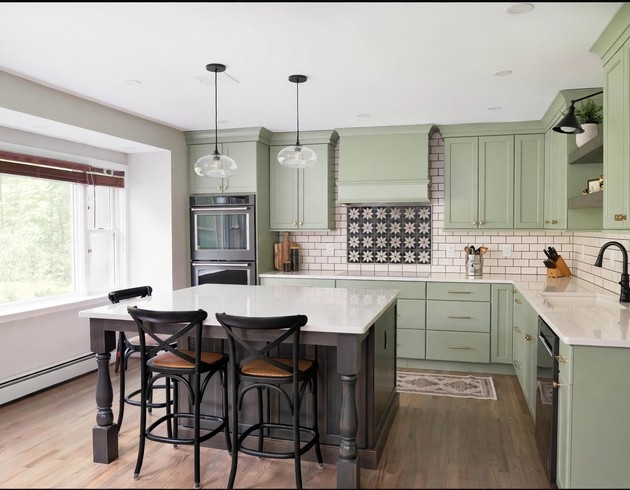
Green and sage green kitchen cabinets, lacquered over MDF so the color wraps every edge.
View green →White oak kitchen cabinets and walnut kitchen cabinets suit the warm, modern look; oak kitchen cabinets, maple kitchen cabinets and ash kitchen cabinets complete the range. Wide, flat doors take the wood as veneer on a stable board; frames and shaker doors are solid wood.
Color goes on as lacquer over MDF, so it wraps the edge. Green kitchen cabinets run from soft sage kitchen cabinets to deeper greens; sage green kitchen cabinets pair well with white oak. Navy kitchen cabinets and navy blue kitchen cabinets suit brass or black accents, and a green or navy island can be the one accent in a white or wood kitchen.
Standard Sizes Are Where Stock Cabinets Stop
Stock cabinet lines come in 3-inch width steps and close the gaps with filler strips. A custom kitchen cabinet is drawn to the wall you actually have. The common US starting points, in inches:
Your drawings follow your measured walls, appliances and ceiling height instead of these steps. Our standard kitchen cabinet sizes guide has the full chart, in inches and millimeters.
What Decides the Cost of Custom Kitchen Cabinets
We do not publish a price list, because every kitchen is drawn first. These are the choices that move a quote:
Drawing First, Then the Factory
Drawing-first coordination
Boxes, doors and panels drawn to your kitchen cabinet layout and measured walls, for your approval.
Built in Foshan
Boards cut, edge-banded and finished in our own 4,500 m² workshop.
Trial assembly before packing
Boxes and fronts put together on our floor, doors aligned and checked, then labelled by wall.
Export-ready crating
Crated for ocean freight, ready for our US crews or your own installer.
Kitchen Cabinets and Island, Drawn as One Run
Four common starting points. The drawings change; the board and edge rules do not.
Villa and large kitchens
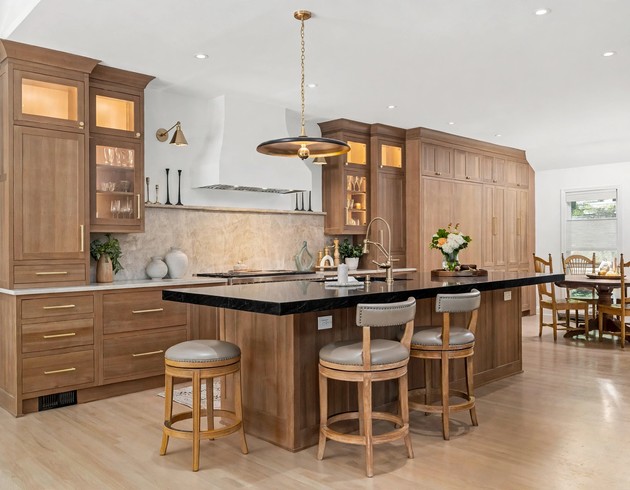
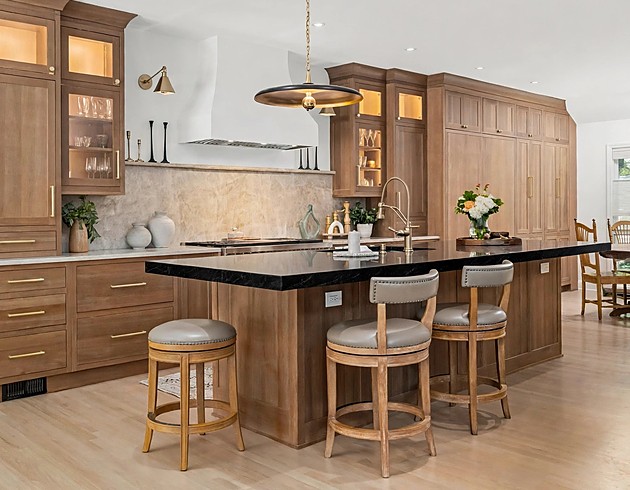
Tall walls of cabinets with a refrigerator niche and open shelves, plus island kitchen cabinets in the same wood, so grain and gaps line up across the room.
New home build
Send the architect's kitchen cabinet layout early; boxes are drawn to the finished wall dimensions.
Kitchen remodel
New boxes drawn to the existing openings: measure the old run or send the old plan with photos.
Apartment and condo
Galley and L-shaped runs, often frameless to gain interior width. Planning a kitchen cabinet with island? Send both on one layout.
Whole-Home Cabinetry in Florida
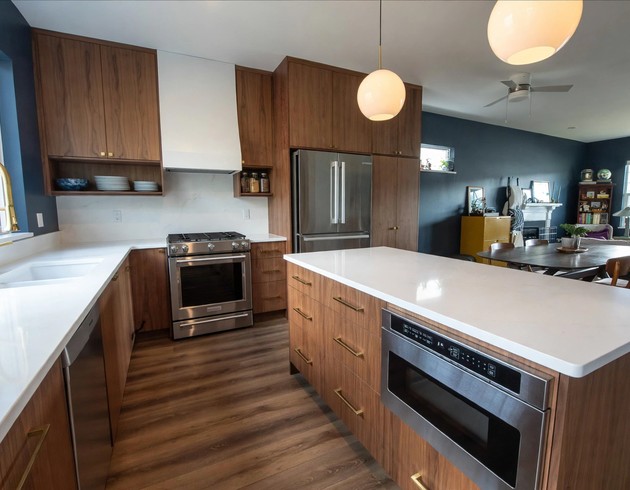
Kitchen, storage wall and pantry for a house in Florida: a full-height wall of walnut-grain flat panel doors with a refrigerator niche and open shelves, an island in the same walnut grain, light matte slab doors on the cooking wall, and a tall coffee-station cabinet with drawers inside. Read the full Florida kitchen case. The same factory builds outdoor kitchens: outdoor kitchen cabinets in sintered stone and stainless steel for a home in Virginia.
Custom Kitchen Cabinets: Frequent Questions
How much do custom kitchen cabinets cost?
We quote from drawings, not from a price list. The board, the door finish, the number of boxes and drawers, the wood, the island and freight set the number. Send a kitchen cabinet layout and you receive shop drawings and a factory quote for that exact run.
Are kitchen cabinets from China good quality?
It depends on the factory, not the country. Ask any supplier of Chinese kitchen cabinets the same four things: which board is in each box, how the edges are sealed near water, whether the panels are TSCA Title VI certified, and whether the run is trial-assembled before it ships. We answer all four with the quote.
Plywood or MDF: which is better for kitchen cabinets?
For boxes near water and for screws close to an edge, plywood. For lacquered doors, MDF. A well-specified kitchen often has both, with particleboard for dry interiors. Our plywood vs MDF guide compares the boards part by part.
Do you install kitchen cabinets in the USA?
Yes. Our US crews and partner installers cover the whole country, quoted separately; or your own installer fits the run from the shop drawings and the wall labels. On-site measurement and design is also available in the USA.
Can you replace the cabinets in an existing kitchen?
Yes. Measure the existing openings, or send the old plan with photos; new boxes are drawn to those openings, in inches.
Do you ship to the USA?
Yes. We have shipped to 60+ countries. Every kitchen is crated for ocean freight to your port, and freight terms are agreed with the quote.
What do you need for a quote?
A kitchen cabinet layout or wall measurements, the ceiling height, your appliance list, the door style and finish, and the ship-to city.
Where are your cabinets made?
In our own 4,500 m² factory in Foshan, Guangdong, China, the same factory that builds our staircases and railings.
Explore related