

Manual Louvered Pergola | Custom by DBM Factory


Manual Louvered Pergola
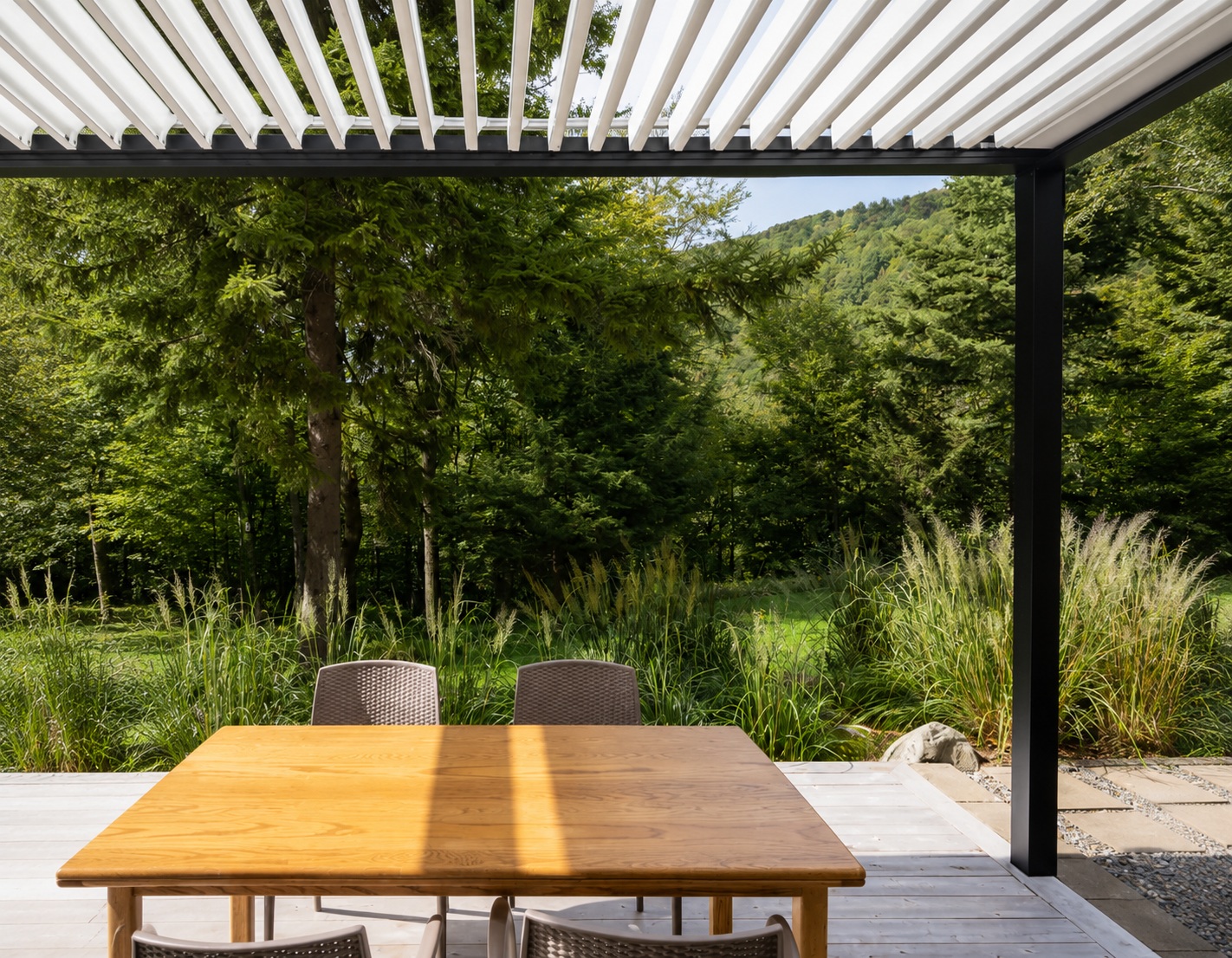
A manual louvered pergola gives the same control over sun and shelter without the motor. A turn of a hand-crank, or a pull on the rod, rotates the louvers across the bay. Fewer moving parts to worry about across seasons — a quiet match for cottages, cabin retreats, and properties where the owner prefers the simpler build.
We design and produce each manual louvered pergola around your project. Share a sketch, a site photo, or a design reference. We turn it into a working drawing, fabricate the frame, louvers, and crank mechanism, and prepare everything for shipment.
Choose the Right Build for Your Setting
Crank or Hand-Adjust — Operator Choice
Side-mounted hand crank lets the owner stand at the edge of the patio and turn the louvers smoothly across the bay. Rod-pull works on smaller spans where the simpler mechanism fits the cottage feel.
Frame Finish — Powder-Coat Palette
Matte black anchors a garden setting. Bronze warms a timber or stone palette. White lifts the look on a cottage residence. Custom RAL on request when the property has set its exterior colors.
Span Options — Per Drawing
Single bay over a dining setting, or several bays chained across a patio. Final span, post layout, and crank position are set on the working drawing so the operator side falls where it feels natural.
Louver Material — Extruded Aluminum
Extruded aluminum blades hold their line across the bay without sag. Finished to match the frame so the closed roof reads as one continuous surface from below.
Where It Fits — Four Common Project Types
Villa Garden
A defined gathering place out in the garden, with a hand-crank set within reach of the dining table. Matte black or bronze finishes anchor the pergola in the landscape without competing with the planting.
Cottage Residence
Smaller homes where the owner prefers a simpler build with fewer powered systems to maintain. A side crank or rod-pull sits within reach beside the patio — the louvers move in seconds and stay where they are set.
Cabin Retreat
Second homes in the woods or on the lake where weeks pass between visits. The manual mechanism is the right call where the property doesn't always have consistent power, and where the owner wants nothing to fault between trips.
Vacation Entertaining
Holiday properties where the outdoor area hosts evening gatherings. A turn of the crank closes the louvers before the dew sets in — without anyone reaching for a phone or a switch.
From Sketch to Site — Three Stages
Share a sketch, site photo, or design reference — that’s enough to start. We turn it into a working drawing for the pergola, covering the bay layout, louver direction, crank position, and the connections your installer will need.
We assemble the frame, louvers, crank or rod, and hardware in full. The team runs the open-and-close cycle, then photographs the unit in our Guangdong workshop before taking it apart for shipping. Each component ships labeled, so on-site assembly stays straightforward — typically bolt-together, not field-welding.
Wooden crates built for ocean freight, packed in the order your installer will assemble. Shipped to 60+ countries — including the USA, Australia, the EU, and across Asia.
After delivery, your contractor or installer handles fitting. We provide an assembly guide and a step-by-step video. Where local installation is available in your region, we can help you find a vetted installer.
Manual Louvered Pergola
At the Off-Grid Cabin — A Roof You Can Trust With No Power and No One Watching.
A cabin in the woods or beside a lake runs on different rules. The power may come from a generator or a solar panel, and weeks can pass between visits. The owner still wants adjustable shade over the deck, yet anything that leans on steady power becomes a weak point in that setting.
Owners usually reach us once they weigh the ease of a motor against the truth of the site. A powered roof needs a steady supply and a controller that lasts long idle months. A remote retreat rarely offers either with confidence. So the brief turns toward trust. They want a roof that works every time, whatever the power, with nothing to fault between trips.
Why the Hand-Crank Wins the Remote Site.
The shaky power supply is the whole reason, and the manual roof is the reliable answer to it. A motorised build brings in electronics that expect steady power and the odd service visit. A hand-cranked roof drops that need entirely, so the louvres turn on a simple geared mechanism that needs no power at all. The owner turns a handle, and the blades respond the same way every season.
Fewer moving parts is the quiet strength of the remote retreat. A manual mechanism has no motor to seize, no controller to fail, and no sensor to drift after a long winter standing idle. That plainness matters most exactly where a service call is hardest to arrange. The roof stays usable through years of on-and-off visits, because there is so little on it that can break.
The trade-offs stay honest, as ever. A manual roof asks the owner to be there and to turn the crank by hand, so it cannot close itself when the cabin sits empty. Where the place runs without steady power and the owner values a setup that simply works, though, that manual build typically suits the retreat better than a powered one.
How the Remote Cabin Shapes the Build.
Where the Crank Sits.
The operating side matters when the owner uses the roof by hand. We place the crank on the side that falls within easy reach of the deck, so a turn of the handle moves the louvres across the bay without anyone leaving the seating. The crank position is fixed on the working drawing against the layout, so the handle lands where it feels comfortable rather than wherever the frame allows.
Closing Up for the Season.
A retreat left through the off-season needs a roof that settles into a safe position and stays there. The owner cranks the louvres closed before locking up, so the deck sheds rain and snow across the empty months. The mechanism holds the blades at the chosen angle on its own, so the roof keeps its setting through a long winter without power or attention.
The Exposure of the Plot.
A woodland clearing and an open lakeshore carry very different wind exposure. We size the frame profile against the conditions the cabin really faces, so the frame stands steady whether sheltered by trees or open to the water. The manual mechanism stays the same across both, while the frame profile underneath it matches the site.
What Coordination Looks Like for a Cabin Roof.
Drawing-First Coordination begins with the deck and the operating side. We establish the post positions, the blade direction, and the crank location before anyone cuts metal, so the mechanism falls within easy reach of the seating. A cabin deck rarely sits perfectly level, so the working drawing resolves the post heights and the structural profile early, and prevents an awkward fit on site later.
Trial Assembly Before Packing then stands the complete frame upright on our Guangdong workshop floor. We fit the louvres and the crank, operate the open-and-close cycle by hand, and confirm the mechanism turns smoothly before disassembly. Then we label each component as it comes apart, so the build at your cabin becomes an ordered bolt-together operation, not field welding in the woods.
Export-Ready Crating packs the parts in the order your installer will raise them on site. We seat the heaviest beams low and protect the finish for the long ocean leg ahead. The crate lands ready to open and sort, with the mechanism components marked clearly for assembly.
What to Send Us About Your Cabin.
A rough sketch or a quick phone photo of the deck gives us plenty to begin with. Tell us which side you would prefer to reach the crank from, and how exposed the plot is, whether sheltered by woodland or open to a lake. Then note the area you want covered, and the height you have to the underside of the frame.
One more line of detail completes the picture. Give us your nearest large town so we can check the local wind zone, and tell us whether the retreat sees snow through the winter. From there we turn your notes into a working drawing and a structure ready to ship.
After delivery, fitting is on your side. On site, your contractor or installer handled fitting directly from our drawings, with our assembly guide and step-by-step video to follow — or use your own local installer where needed.
Chat on WhatsApp →Compare the Motorized Pergola → · see the Aluminum Freestanding Pergola → · or browse the full Pergola range →