

Motorized Pergola | Custom by DBM Factory


Motorized Pergola
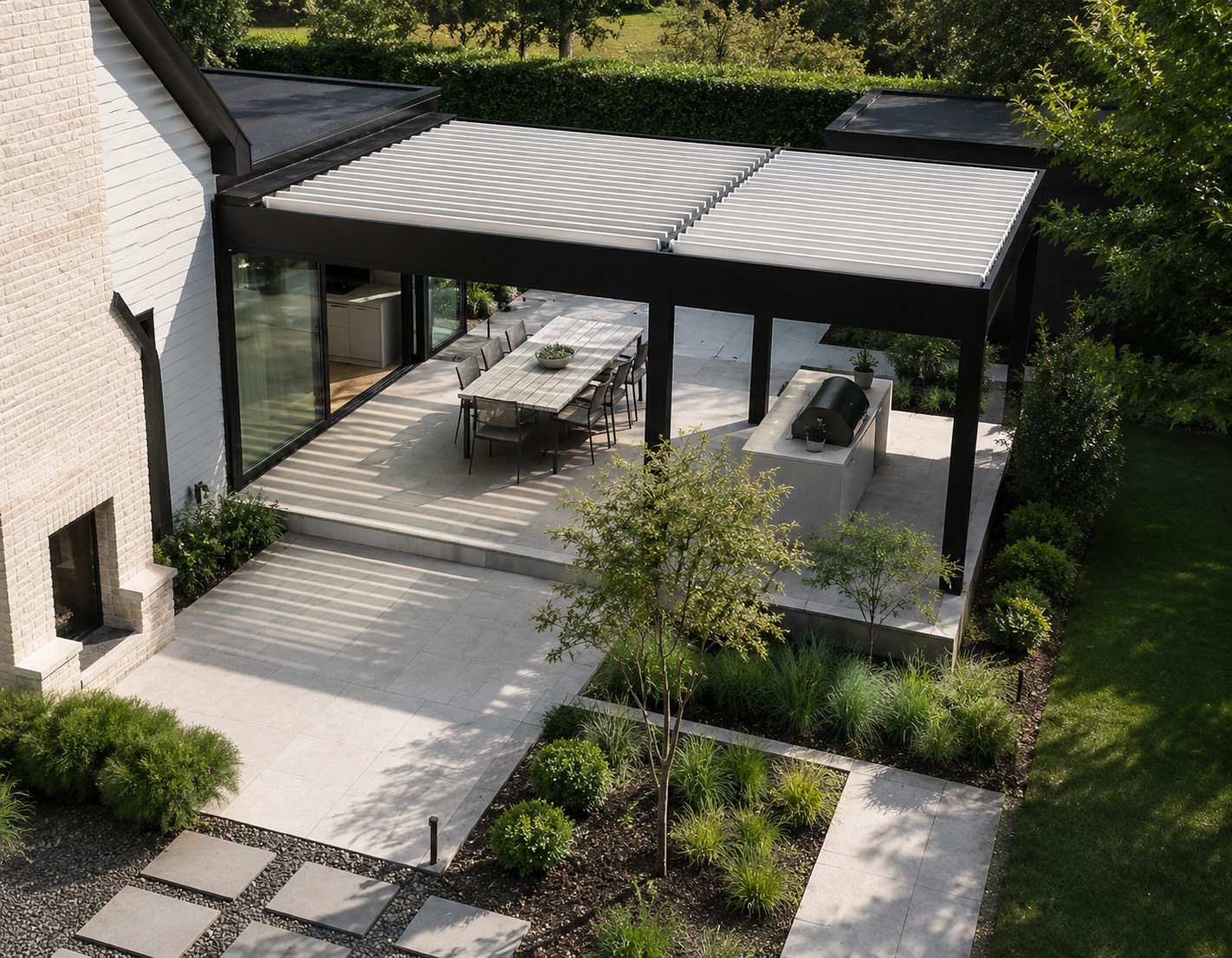
A motorized pergola lets the louvers move at the touch of a button. Open at breakfast, angle at midday, close when the rain comes — without anyone leaving the dining table. The aluminum frame keeps the look clean while the drive sits hidden inside the beam. A common pick where the outdoor area is part of how the owner lives, not just where they go on the weekend.
We design and produce each motorized pergola around your project. Share a sketch, a site photo, or a design reference. We turn it into a working drawing, fabricate the frame, louvers and drive assembly, and prepare everything for shipment.
Choose the Right Build for Your Setting
Motor Type — In-Beam Drive
The motor sits inside the perimeter beam so nothing reads as visible hardware from below. Quiet rotation, sealed against weather. Drive details are set on the working drawing for the bay layout.
Control Panel Options — Switch / Remote / App
Wall-mounted switch beside the slider for the classic feel. Handheld remote when the owner moves between lounge and dining. Smart-home integration where the project already runs on an app-based system.
Frame Finish — Powder-Coat Palette
Matte black is the modern villa default. Bronze warms a stone or timber elevation. White lifts a coastal residence. Custom RAL where the architect has set the cladding.
Louver Material — Extruded Aluminum
Extruded aluminum blades hold their line over wide bays without sag. Finished to match the frame so the closed roof reads as one continuous surface from below.
Where It Fits — Four Common Project Types
Villa Pool
The pergola sits at the lounge end of the pool deck, louvers angled to follow the sun across the afternoon. A wall switch near the slider or a remote on the side-table keeps the owner in control without leaving the lounger.
Modern New Home
Drawn into the architect's plan as a defined outdoor room off the great-room. Smart-home integration is a common ask — the pergola behaves like another scene in the same app that runs the lights and the blinds.
Coastal Residence
Aluminum handles salt-air exposure that timber and steel struggle with on seaside lots. The motorized roof matters here — coastal weather changes fast, and the louvers can close before anyone runs out to grab cushions.
Boutique Vacation Rental
Owner-operated short-stay properties where the outdoor area is part of the guest experience. A remote on the side-table makes the pergola feel like a hotel amenity rather than a contraption to figure out.
From Sketch to Site — Three Stages
Share a sketch, site photo, or design reference — that’s enough to start. We turn it into a working drawing for the pergola. The drawing covers bay layout, louver direction, motor and control routing, and the connections your installer will need.
We assemble the frame, louvers, drive assembly, and controls in full. The team runs the open-and-close cycle, then photographs the unit in our Guangdong workshop before taking it apart for shipping. Each component ships labeled, so on-site assembly stays straightforward — typically bolt-together, not field-welding.
Wooden crates built for ocean freight, packed in the order your installer will assemble. Shipped to 60+ countries — including the USA, Australia, the EU, and across Asia.
After delivery, your contractor or installer handles fitting. We provide an assembly guide and a step-by-step video. Where local installation is available in your region, we can help you find a vetted installer.
Motorized Pergola
A Rooftop Terrace That Closes Itself — When the Storm Arrives and Nobody Is Home.
A rooftop terrace sits high and open, with weather that can change in minutes. The morning starts clear, the cushions stay out, and then a sudden shower rolls across the city skyline. By the time anyone reaches the roof, the seating is already soaked. The owner wants the roof to react before they do.
Owners usually approach us once they have learned that lesson the hard way. A terrace used through the week is rarely watched every hour, and a roof opened for the morning sun stays open when the rain comes. So the brief shifts away from comfort alone. It asks for a roof that protects the space automatically, without anyone standing by to manage it.
Why an Automatic Roof Suits the Unattended Deck.
The unattended terrace is the whole reason, and the powered roof is the practical answer to it. A hand-cranked roof depends on someone being present and willing to operate it at the right moment. A motorised roof drives the louvres on a switch instead, so the same closing action takes a button rather than a climb to the roof and a turn of a handle.
Adding a rain sensor takes the last step away from the owner. A small detector reads the first drops and tells the controller to close the roof on its own. The louvres seal before the shower settles in, so the cushions and the dining table stay dry even when the terrace stands empty. The roof becomes a setup that watches the weather while the owner is away.
The trade-offs stay honest, as ever. A motor, a controller, and a sensor carry wiring and electronics that a manual roof avoids, so the configuration costs more and depends on a power supply. Where the terrace gets daily use and cannot be watched through every passing cloud, though, that automatic specification typically justifies the difference.
How the Rooftop Shapes the Build.
Where the Power and Control Run.
A motorised roof needs power routed to the drive and a path for the control wiring. We position the cable run through a hollow post and into the perimeter beam, so nothing reads as exposed wiring from below. The drive details and the routing are fixed on the working drawing for the bay layout, so your electrician knows where the supply lands before the structure goes up.
How the Owner Drives It.
The same powered roof takes more than one control method. A wall switch beside the doorway suits the owner who steps out to the terrace, while a handheld remote follows them between the lounge and the dining end. Where the building already runs on a smart-home app, the roof can join that system as another scene. We set the control choice to the way the terrace will really be used.
What the Sensor Reacts To.
A rain sensor reacts to water, and an exposed rooftop can face more than rain alone. On a high terrace open to the weather, a strong gust is a reason to bring the louvres down to a flatter, more sheltered angle. The owner can do that from the same switch or remote that drives the roof. We set the sensor position and the control reach to the exposure of the one roof, so the response suits a sheltered courtyard or an open skyline alike.
What Coordination Looks Like for a Motorised Roof.
Drawing-First Coordination begins with the terrace and the wiring. We establish the post positions, the drive location, and the cable routing before anyone cuts metal, because a motorised roof leaves no room for an afterthought in the power path. A roof slab rarely sits perfectly level, so the working drawing resolves the post heights and the control routing early, and prevents a scramble on the roof later.
Trial Assembly Before Packing then stands the complete frame upright on our Guangdong workshop floor. We fit the louvres, connect the drive, and operate the open-and-close cycle under power before disassembly. Then we label each component as it comes apart, so the build on your terrace becomes an ordered bolt-together operation, not improvised wiring on an exposed roof.
Export-Ready Crating packs the frame, the louvres, and the controller in the order your installer will raise them on site. We seat the heaviest beams low, protect the finish, and box the electronics separately for the long ocean leg ahead. The crate lands ready to open and sort, with the drive components marked clearly for assembly.
What to Send Us About Your Terrace.
A rough sketch or a quick phone photo of the rooftop gives us plenty to begin with. Tell us where the power supply reaches the terrace, and how you would prefer to drive the roof, by wall switch, remote, or an existing smart-home system. Then note the area you want covered, and the height you have to the underside of the frame.
One more line of detail helps us read the conditions around your site. Give us your nearest large town so we can check the local wind zone, and tell us whether you want a rain sensor on the controller. From there we turn your notes into a working drawing and a structure ready to ship.
After delivery, fitting is on your side. On site, your contractor or installer handled fitting directly from our drawings, with our assembly guide and step-by-step video to follow — or use your own local installer where needed.
Chat on WhatsApp →Compare the Manual Louvered Pergola → · see the Aluminum Louvered Pergola → · or browse the full Pergola range →