




Curved Helical Staircase for a Suriname Home | DBM Case
Project DBM21011305 · Suriname, South America · Private Home
A Curved Helical Staircase for a Suriname Home, Built Against a Full-Height Glass Wall
We engineered the steel helix and drew the curved geometry for this Suriname home, so the stair could sweep up beside a glass facade with no straight line in sight.
By Double Building Materials — the staircase & railing manufacturer in Guangdong, China that engineered, trial-assembled and shipped the steel helical structure for this project. Written from our own shop drawings and workshop records. Published June 2026.
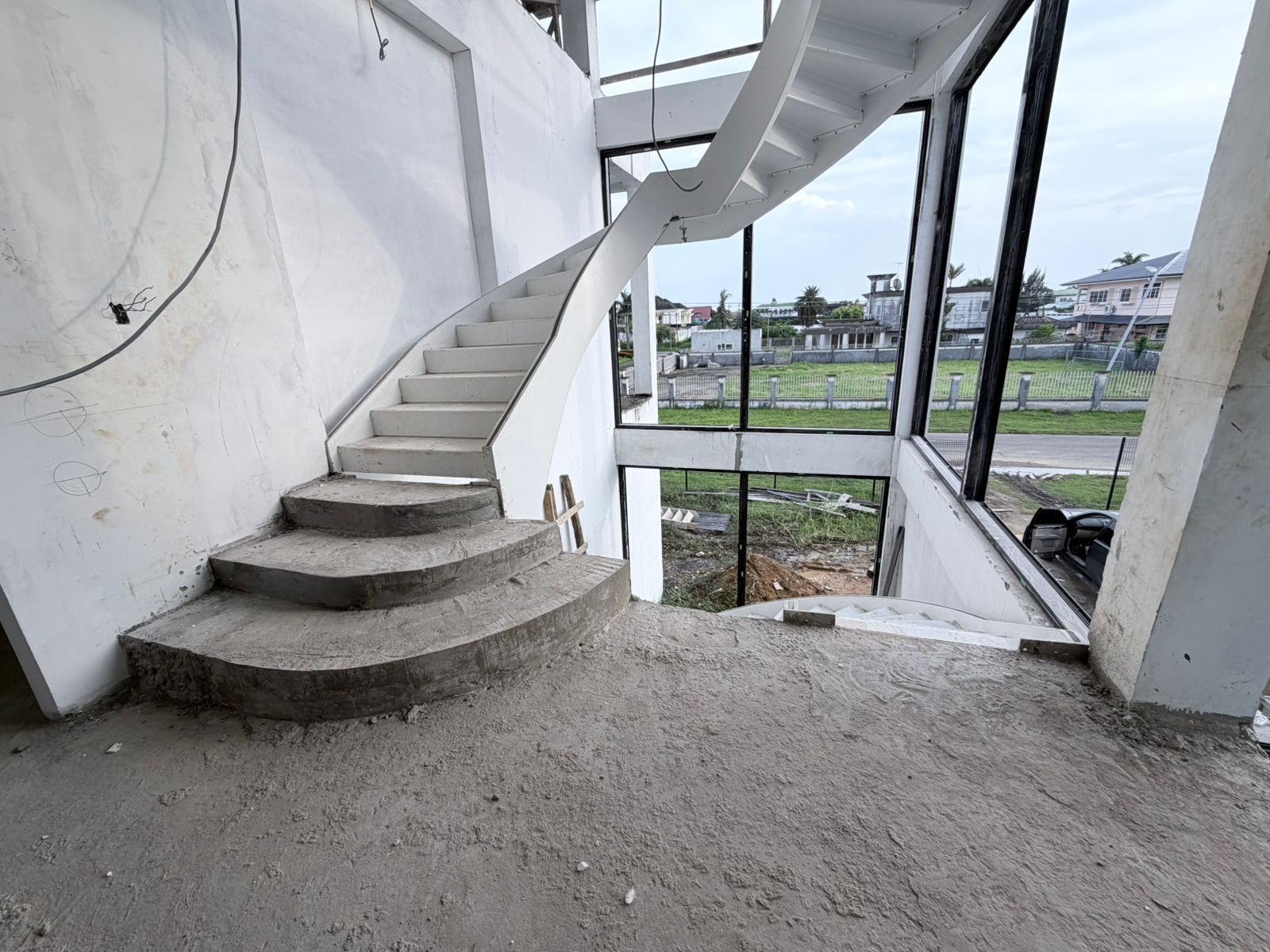
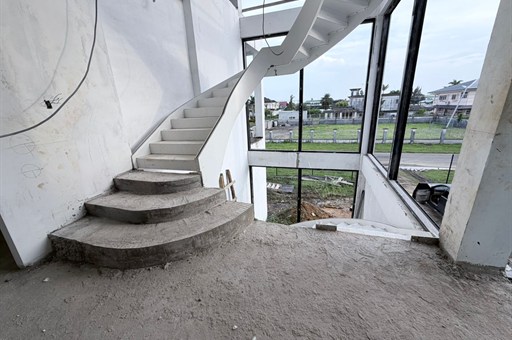
The curved flight taking shape beside the glass facade, mid-build — a private home in Suriname.
The Project at a Glance
Double Building Materials engineered and made the curved helical staircase for a private home in Suriname. The design pairs a steel helix with a full-height glass facade. We drew the geometry, fabricated the steel, trial-assembled it, and crated it in our Guangdong workshop, then shipped it for the homeowner’s builder to set and finish on site.
The Homeowner
The homeowner was building a private house in Suriname with a tall, open core and a glass wall along one side. They wanted the staircase to be the moving part of that space — a curve that climbs past the glass rather than a plain flight tucked against a wall. The plan put the stair on full view from the ground floor and the level above. The homeowner worked with us directly, from China to the building site.
The Challenge
A curved stair is hard in a way a straight one is not. Every tread sits at a slightly different angle, and the whole flight has to wind around a true arc. The steel spine bends in two directions at once. Get one radius wrong and the curve looks bent, not smooth. So the geometry has to be set before any steel is cut.
The glass wall raised the stakes. With a full-height facade on one side, the stair is lit from behind through most of the day. Hard light shows every edge. A flight that reads as a clean spiral in shade can look uneven once the sun sits behind it.
And the stair is the centre of the room. It is the first thing you meet at the door and the shape you see from the floor above. There was no quiet corner to hide a rough joint or a step that sat proud of its neighbour.
The Brief
The brief was short. The homeowner wanted a staircase that curved — one continuous helix that swept up beside the glass, with no straight runs and no sharp corners. It had to feel like a single gesture, smooth from the bottom step to the top landing. The glass wall would stay open to the view, so the stair had to earn its place as the sculpture in the room. We took that intent and turned it into a steel structure we could draw, build and prove before it ever left the workshop.
Why These Materials
The steel helix
A helix is a curve that climbs as it turns, like a spring drawn out. For this stair, that shape lives in two curved steel plates — the stringers — that run the full sweep on each side. Steel is the right material here because it can be rolled to an exact arc and still carry the load across a long, unsupported curve. Timber cannot bend this way and hold its line. We cut, roll and weld the steel so the curve is built in, not forced on site.
A facade of glass
The glass facade was the homeowner’s choice, and it shapes how the stair is read. A wall of glass keeps the core open to the garden and floods the flight with daylight. It also means the stair is on show from outside as well as in. That is why we held the steel to a true curve — against a glass backdrop, the eye has nothing to forgive a wobble.
Engineering & Code
The structure under the curve
The white steel helix is the part that does the work. The two curved stringers carry the flight, and bolted flange joints tie the sections together where the curve changes plane. We size the steel for the dead weight of the stair plus the live load of people climbing it. Then we weld, bolt and check the frame in the workshop before it ships.
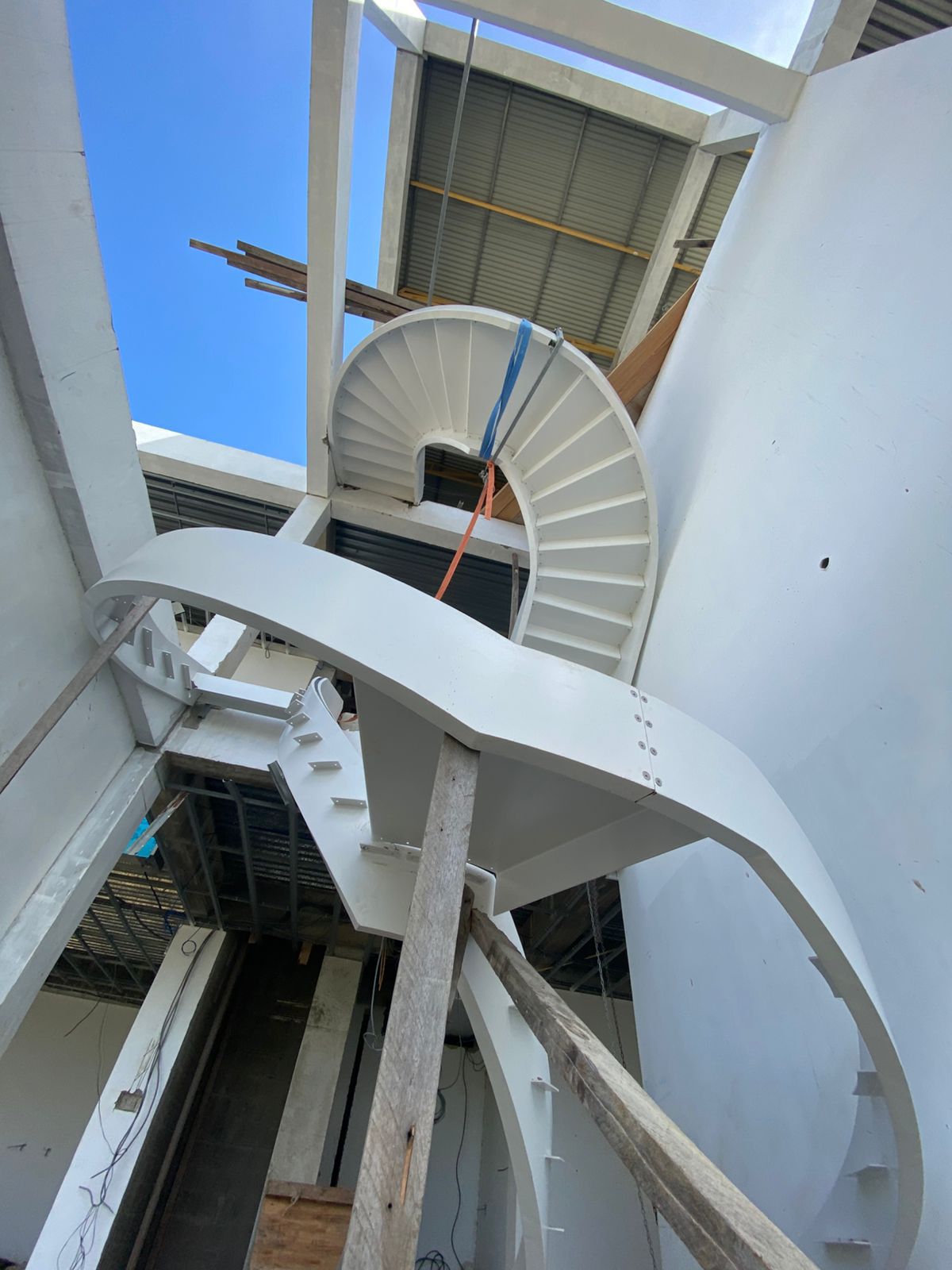
Looking up at the steel helix — curved stringers and bolted flange joints carry the flight.
Code references for your engineer
Local rules govern the final approval, and they differ from one country to the next. So we prepare the shop drawings to your engineer’s specified loadings and local code, so your engineer can review and sign off. We make and document the steel; the local approval stays with your team.
From Drawing to Site
Drawing-First Coordination
Drawing-First Coordination means we draw the whole stair before we cut a single plate. The homeowner shared the plans and the look they wanted. We turned that into shop drawings for the curved stringers, the tread layout and the bolted joints — then sent them back for sign-off. A curve leaves no room to guess, so nothing reached the workshop floor until the drawings were agreed.
Trial Assembly Before Packing
Trial Assembly Before Packing means we stand the helix up in our own workshop before it ships. We bolt the curved sections together, check the rise step to step, and sight down the arc to confirm it reads as one smooth sweep. Any tight joint or off radius gets corrected in Guangdong, where we have the jigs and the tools — not on a building site across an ocean.
Export-Ready Crating
Export-Ready Crating means we pack the steel to survive the sea. The curved sections travel in braced timber crates, edges protected, marked to the assembly order so the builder can rebuild the helix in the right sequence. We label each crate to the drawing, so the section that goes up first comes out of the box first.
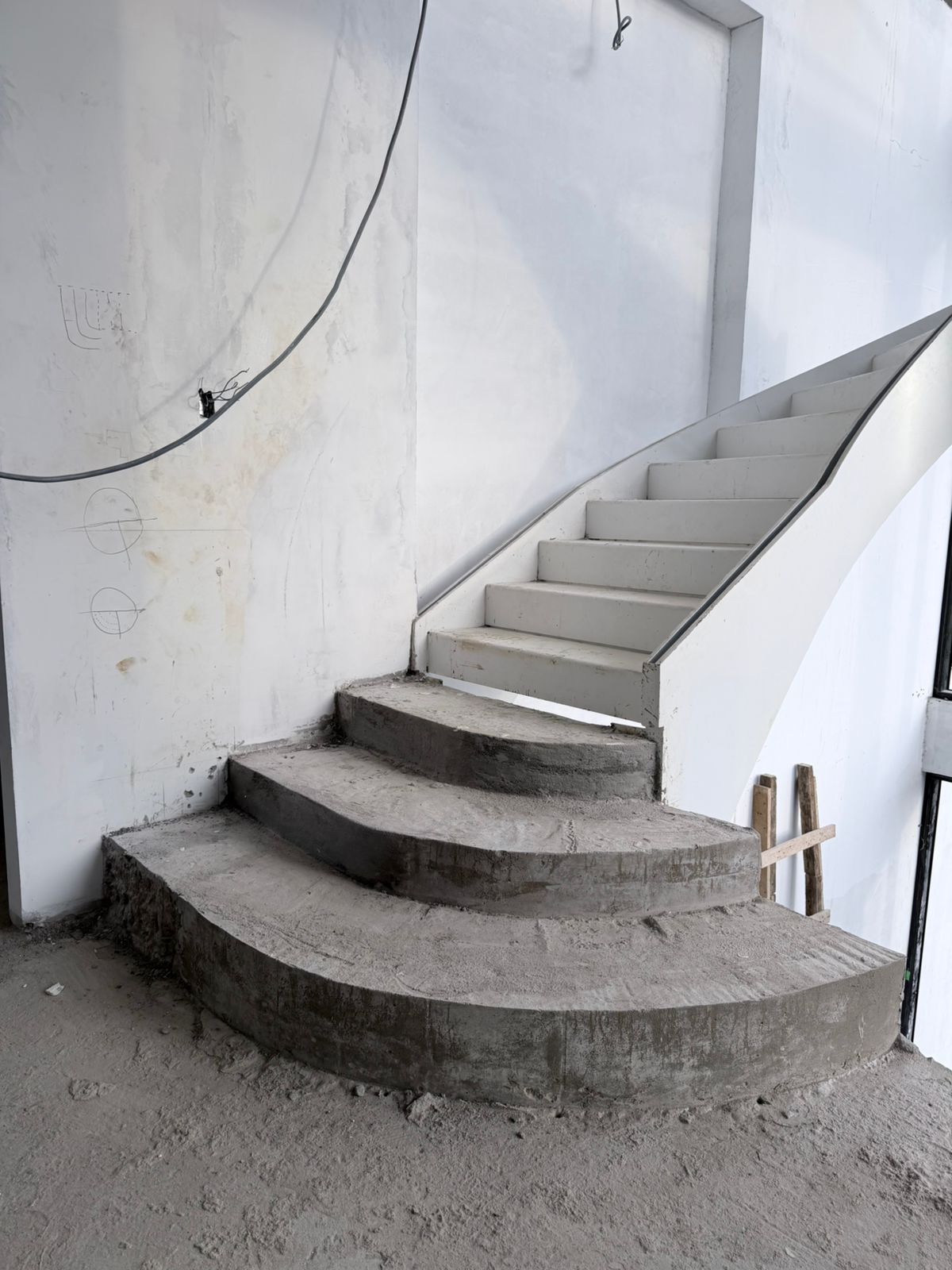
On site during the build — the fan-shaped lower treads being formed where the curve meets the floor.
Double Building Materials engineers, makes, trial-assembles, crates and ships. On this project the homeowner’s own builder set the stair and handled the finishing on site. We supply assembly drawings and a step-by-step guide, and where local installation is available we can help you find a vetted installer.
Taking Shape on Site
On site, the curve delivers what the homeowner pictured. The flight winds up beside the glass wall, and the lower treads fan out where the stair meets the floor, each one a little wider than the last. With daylight pouring through the facade, the edge of every step traces a clean line along the arc.
From the doorway, your eye climbs the curve before it settles on anything else, drawn up toward the light and the garden behind the glass. From the level above, the helix doubles back on itself in one continuous turn — the move that lifts a tall, plain stair core into the heart of the home.
And the parts fit. Because we drew the geometry and trial-built the helix together before it shipped, the curved sections meet on site the way they met in our workshop. The smooth line the homeowner pictured is the line that landed.
Specifications
| Project | Private home, curved staircase |
| Stair type | Curved helical flight |
| Structure | Twin curved steel stringers, bolted flange joints |
| Steel finish | Painted, to homeowner’s drawing |
| Facade | Full-height glass wall alongside the flight |
| Geometry | Continuous arc, fan-shaped lower treads |
| Loadings & code | Drawn to your engineer’s specified loadings and local code |
| Made in | DBM, Guangdong, China |
| Set on site by | Homeowner’s local builder |
Frequently Asked Questions
Can you make a curved or helical staircase, not just a straight one?
Yes. This Suriname stair is a curved helical flight on twin rolled-steel stringers. We draw the arc, roll and weld the steel to that curve, then trial-assemble the helix in our workshop so the sweep is proven before it ships.
Will the staircase meet building rules in my country?
Local rules differ by country, so we prepare the shop drawings to your engineer’s specified loadings and local code. Your engineer then reviews and signs off. We make and document the steel; the local approval stays with your team.
Who sets the staircase when the crate arrives?
Your own builder or installer sets it on site, as the homeowner’s builder did here. We send assembly drawings and a step-by-step guide, with crates labelled to the build order. Where local installers are available, we can help you find one.
Planning a curved or helical staircase for your project?
Send Us Your Plans for a Drawing Review →Related Products
Other Products
More from the same factory — drawn, trial-assembled and export-crated the same way.