

Cast Aluminum Deck Railing: Complete Owners Guide -Railing Guides
Aluminum Railing Guides · Deck Systems
Cast Aluminum Deck Railing: The Complete Owner's Guide
A cast aluminum deck railing is an outdoor barrier whose posts, balusters, and decorative castings are molded from molten aluminum, then assembled into rigid panels. The metal resists rust and rot, carries a baked powder-coat finish, and stays lightweight. That combination makes a cast aluminum deck railing a low-maintenance choice for elevated decks, balconies, and stairs.
Aluminum rules modern deck railing for one simple reason: it does not rust. This guide shows how a cast rail differs from an extruded one, how the rail holds up outdoors, what shapes the price, and where the code rules sit. Where a topic runs deep, we link to a focused guide so you can read on.
What a Cast Aluminum Deck Railing Is
A cast aluminum deck railing is a guard rail built from aluminum that has been melted and poured into molds. The hot metal sets into solid shapes such as posts, scrolled bars, and finials, and those parts are then joined into finished panels. Aluminum carries no iron, so the whole rail shrugs off rust, which is the main reason it rules on open decks and balconies by the sea.
Casting is what sets this rail apart from its plainer cousins. Pour the metal into a mold and you can copy the look of old ironwork while losing both the weight and the rust. The finished rail resembles wrought iron from a few feet away, yet it stays light enough for one person to carry a full section. That rich, sculpted look is what draws owners to cast aluminum for a feature deck.
It helps to settle the language early, because the term "cast" names the way the metal is made, not a whole new product category. Many rails mix cast parts, such as scrolled finials and brackets, with straight extruded rails and bars. So a real cast aluminum deck railing is often a blend, joining the rich look of casting with the clean lines of the straight extruded parts.
Cast vs Extruded Aluminum Railing
Casting and extrusion are two ways to shape the same metal, and knowing the difference helps you pick the right system. Casting pours liquid aluminum into a mold, so it is great at fine, three-part ornament such as scrolls, baskets, and collars. Extrusion pushes softened aluminum through a die, which makes long, even profiles such as a top rail, a bottom rail, or a square bar.
| Method | Character and where it suits a deck railing |
|---|---|
| Cast aluminum | Molten metal poured into a mold. Reproduces ornamental detail, finials, and sculpted posts. The decorative, traditional-looking choice for a feature deck. |
| Extruded aluminum | Softened metal forced through a die into long profiles. Produces clean, straight rails and pickets efficiently. The minimalist, contemporary choice. |
| Hybrid system | Cast ornament on extruded rails. The most common real-world configuration, blending decorative castings with structural efficiency. |
Neither way wins on its own; each fits a different look. If your deck wants an ornate, almost period style, cast aluminum gives you that classic shape without the upkeep of real iron. If you favor a clean modern line, an extruded rail reads sharper and tends to cost less. A blended system captures both traits, which is why most fine deck rails join the two ways of making the metal.
Why Owners Choose It Outdoors
The strongest case for aluminum on a deck is its resistance to corrosion. Aluminum grows a thin oxide skin that heals itself and guards the metal below, so it never rusts the way iron and bare steel do. A raised deck takes rain, hose spray, and damp air all year, and that one property sets how the rail ages. Salt air by the sea attacks iron quickly, yet aluminum simply carries on.
Low maintenance follows straight from that durability. A powder-coated aluminum rail needs little more than an occasional rinse to stay presentable, with no sanding, no rust treatment, and no yearly repaint. Owners who once lived with gray, weathered wood or pitted iron prize this freedom, because a deck rail should frame the view rather than eat your weekends.
Weight is the quiet third advantage. Aluminum weighs about a third of what steel does, so a full rail section stays easy to lift and it leans less on the deck frame. That lightness makes a raised balcony simpler to fit and reduces the load at each post connection. For owners weighing the older metal, our aluminum vs cast iron railing guide lays out the full trade-off.
The Parts of a Deck Railing System
A deck rail is an assembly, not one single object, and knowing its parts makes it easier to specify. The posts are the upright anchors that carry the load to the deck frame, and they set the rhythm of the whole run. The top rail is the part you actually grip, while the bottom rail closes the panel along the deck and locates the bars between the two.
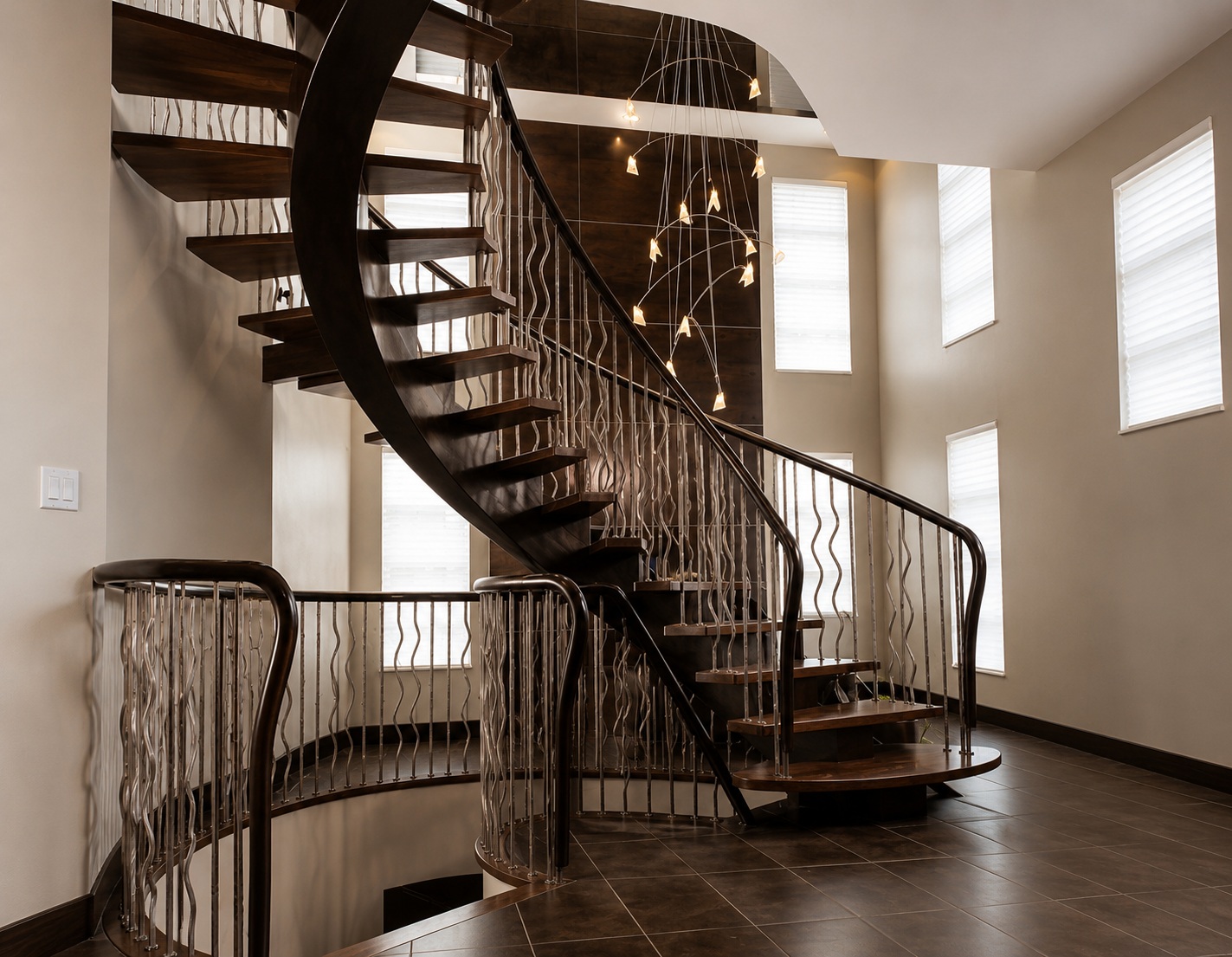
Those balusters fill the gap and form the pattern you see, and on a cast system this is where the decorative style lives. They can be plain square bars, twisted bars, or basket-and-scroll ornament. Brackets join the rails to the posts, and a base plate or a core-set fitting then anchors each post to the deck. The infill, the baluster spacing, and the post spacing together set both the look and the safety performance.
A cast aluminum deck railing also adapts to stairs, where the same panels rake to follow the slope and the posts grow shorter as the steps descend. Matching the deck run to the stair run keeps a project visually tidy. Owners who run a rail down a flight often pair it with matching lines around the home, which is where our cast aluminum porch railings guide is a useful next read.
Finishes, Colors, and Styles
The finish is what you see and touch each day, and on aluminum it is almost always a powder coat. Powder coating bonds a dry color to the metal, then bakes it in an oven into a hard, even shell. That shell outlasts wet paint by a wide margin and resists chips and fading, which is why a good aluminum rail holds its color through years of sun and weather.
Color choice is broad, though a few tones dominate home decks. Matte black grounds a modern home and recedes against a view, while bronze and dark gray suit warmer, classic homes, and white remains a coastal and colonial favorite. The style runs from plain square bars for a clean modern deck to scrolled cast balusters for a period or estate look, so the same metal can read either plain or ornate.
| Style | Character and typical setting |
|---|---|
| Square picket | Clean vertical bars on straight rails. The contemporary default, unobtrusive against a landscape view. |
| Ornamental cast | Scrolls, baskets, and decorative collars molded into the balusters. A traditional, estate-style statement. |
| Glass infill | Tempered glass panels framed in aluminum posts. Preserves the view and blocks wind on an exposed deck. |
| Cable infill | Horizontal stainless cable inside aluminum frames. A near-invisible, airy line for a modern deck. |
Deck Railing Code and Safety
A deck rail is a life-safety barrier, so it answers to building code rather than to taste alone. Common US home references ask for a guard once a deck sits more than thirty inches above grade. The guard height is often thirty-six inches at home, rising to forty-two inches on many shops and shared decks. The infill gaps are kept small too, so a four-inch ball cannot pass through, which keeps small children safe.
| Common reference (confirm locally) | Typical figure |
|---|---|
| When a guard is required (IRC) | Deck more than ~30 in above grade |
| Residential guard height (IRC) | Commonly 36 in |
| Commercial guard height (IBC) | Commonly 42 in |
| Baluster opening limit | No 4 in sphere passes |
| Graspable handrail (ADA / IBC stairs) | 34–38 in above stair nosing |
Those numbers are common reference values, and your local adopted code edition is what truly governs, so confirm the current version with your local team. A rail must also hold a concentrated load applied at the top rail, which is why post spacing and the post-to-deck connection matter as much as the visible bars. A well-built aluminum rail meets these structural loads with ease; the code simply keeps the geometry and the anchors honest. For the deeper picture, see the cluster pillar on cast aluminum railing systems and code.
Our coastal railing materials compared, including aluminum — Double Building Materials. Tap to play.
What Shapes the Cost
Price spans a wide range here, and the ornamentation is the single biggest reason. A plain square-bar extruded system sits at the affordable end, because straight profiles are quick to make and join. A richly cast design with scrolled balusters and ornate posts sits considerably higher, because each component is molded, finished, and fitted on its own. Every run is made to measure, so there is no single price tag; there are drivers.
The main drivers are the length of the run, the style of infill, the finish color, and the number of stair and corner transitions. Glass or cable panels add cost above plain bars, and a custom powder-coat color can carry a premium over a stock tone. Stairs raise the labor, since each section rakes to a different angle. More corners and changes in level multiply the post count, and posts are where the structural cost concentrates.
Any dollar figure you read online is a third-party market estimate, not our quote, and it shifts with metal pricing, freight, and region. As a made-to-order manufacturer, Double Building Materials prices each project from its drawing rather than from a published list. To see how the same drivers behave across a whole run, the pillar guide on cast aluminum railing breaks down each cost lever in detail.
How a Custom Run Is Made
At Double Building Materials, a cast aluminum deck railing starts as a drawing, not a catalog page. We take your deck dimensions, your post layout, your stair transitions, and your chosen style, then turn them into a working shop drawing. That drawing fixes every post location, the panel lengths, and the infill before any metal is cast or cut. We make nothing until you approve it, because tight post spacing leaves little room to improvise on site.
From there we fabricate the castings and the rails, apply the powder-coat finish, and trial-assemble the run on our 4,500 square-meter Guangdong floor. That trial build is where we confirm the panel fit, the rake of the stair sections, and the alignment of every post before anything ships. Once it passes, we crate the rail for export in the sequence your installer will need it, a practice honed across 800-plus projects in 60-plus countries over 25-plus years.
Your own contractor installs the rail on site from our drawings, and we can help you find a local installer where that service is available. We do not install on site or sign off local code; that responsibility stays with your local team and the authority having jurisdiction. When you are ready to specify a system, browse the full range on our aluminum balustrade and deck railing page.
Cast Aluminum Deck Railing FAQ
Is cast aluminum railing good for a deck?
Yes, it is one of the most popular outdoor choices, and the reason is durability. A cast aluminum deck railing never rusts, holds a powder-coat finish for years, and stays light enough to handle on a raised deck. It needs only an occasional rinse, which is why owners who once lived with weathered wood or pitted iron so often switch to aluminum.
What is the difference between cast and extruded aluminum railing?
Casting pours hot aluminum into a mold, which copies fine detail such as scrolls and finials, so it suits a rich, classic look. Extrusion pushes softened metal through a die into long, straight profiles, which suits clean modern rails and bars. Many fine systems are blends that pair cast ornament with extruded rails, joining decorative style with structural strength.
Does aluminum deck railing rust?
No, aluminum does not rust, because it contains no iron. It grows a thin oxide skin that heals itself and guards the metal below, and a baked powder coat adds a second barrier against the weather. That is precisely why aluminum performs so well on coastal decks and balconies, where salt air would soon attack ferrous metals such as steel or iron.
How tall does a deck railing need to be?
A home guard is often thirty-six inches tall, while many shops and shared decks need forty-two inches, and a guard is usually needed once the deck sits more than thirty inches above grade. These are common reference figures only; your local adopted code edition governs the exact requirement, so confirm the current version with your local building office before you finalize a height.
How long does a cast aluminum deck railing last?
A good powder-coated aluminum rail is built to last for decades outdoors, far longer than wood and with none of the rust cycle of iron. Its lifespan depends mostly on the finish quality and the installation rather than on the metal corroding away. A routine rinse and an occasional check of the fasteners keep it looking and performing well for many years.
Read more in this cluster: the pillar guide to cast aluminum railing systems, our cast aluminum porch railings guide, and the aluminum vs cast iron railing comparison. Ready to specify a system? Browse our aluminum balustrade range.
Double Building Materials draws, manufactures, trial-assembles, crates, and ships your cast aluminum deck railing. Your own contractor or installer handles on-site installation and local code sign-off — we can help you find one where available. Code figures above are common US references (IRC / IBC / ADA); your local adopted edition governs, so confirm the current version with your local team. Any cost figures are third-party market estimates, not our quote.
Talk to us on WhatsApp →