

The Complete Guide to Outdoor Staircases: Metal, Steel & Weatherproofing-Staircase Guides
Outdoor Staircase · Complete Guide
The Complete Guide to Outdoor Staircases: Metal, Steel & Weatherproofing
An outdoor staircase is a stair built to live outside, so weather drives every choice. Material and finish are the central decisions, because rain, sun, and frost attack an exterior stair daily. Galvanised or powder-coated steel is the most common build, paired with drainage, slip resistance, and corrosion protection at every joint.
That single fact, that the stair lives outdoors, shapes this whole guide. We walk through the materials that survive weather, why metal and steel lead, and how drainage, slip resistance, and corrosion control keep a stair safe for years. We cover structure, exterior versus interior differences, cost drivers, and how to match a stair to a deck, terrace, garden, or roof. Where a topic runs deep, a focused guide takes it further.
What an Outdoor Staircase Is
An outdoor staircase is simply a stair that lives in the weather, not inside a heated, sheltered room. People also call it an exterior staircase, exterior metal stairs, or outdoor stairs. The names all point to the same thing: a flight that joins two outdoor levels and faces rain, sun, and frost daily. That exposure is the one fact that sets it apart from an indoor stair, and it shapes every choice that follows.
Because the stair sits outside, the surface it shows to weather becomes the heart of the design. An indoor stair can be almost any material you like, since it never gets wet and never freezes. An outdoor staircase must drain water, hold its grip when the treads are damp, and fight rust at every fixing for years. Those three demands push the material and the finish to the front, ahead of looks.
None of that makes an exterior stair plain or merely useful. A well-made outdoor staircase is a striking object. It can frame an entrance, climb to a roof terrace, or thread down a sloping garden with real presence. The point is only that the material and finish carry a heavier job outside than they ever do indoors, so they deserve the first and most careful look.
Materials That Survive Weather
The material is the first real decision on any outdoor staircase, because it sets how the stair will age, how often you maintain it, and how it looks against the building. Each option carries the weather differently, so it helps to see the candidates side by side before you narrow the field. The table below sketches the common materials and the character each one brings outdoors.
| Material | Character outdoors |
|---|---|
| Galvanised steel | The workhorse of exterior stairs. A hot-dip zinc coating resists rust with very little upkeep, which is why so many outdoor steel staircases use it. |
| Powder-coated steel | Steel finished in a baked colour coat. It offers a huge palette and a clean look, and it resists rust well, though it asks for more attention than galvanising over the long run. |
| Aluminium | Naturally corrosion-resistant and light, so it suits coastal sites and lighter structures. It costs more per pound and is less stiff than steel. |
| Stone | Heavy, permanent, and beautiful for an entrance or a garden flight. It needs a solid base and a slip-resistant surface where it gets wet. |
| Concrete | Durable and flexible in shape, often cast on site or precast. The surface should be textured for grip when damp. |
| Treated timber | Warm and natural for a deck or garden, but it needs treatment and periodic resealing to hold up against rot and weather. |
Each material trades durability against looks, cost, and upkeep, and no single one wins on every site. A coastal home leans toward aluminium or hot-dip galvanised steel. A formal entrance might call for stone, while a relaxed deck often suits treated timber. We compare every option in depth, with the upkeep picture for each, in our guide to outdoor stair materials compared.
Why a Metal Staircase Outdoor Leads the Field
Across most projects, a metal staircase outdoor is the default answer, and the reasons are practical. Metal carries a long, open flight on a slim structure, so an exterior metal stair can span a tall rise or float along a wall without bulky supports. It also takes a protective finish cleanly, which lets it shrug off weather for years. Stone and concrete are superb where weight and permanence suit the setting, but they are heavy and far less flexible in shape.
Within metal, the usual contest is galvanised versus powder-coated steel. Galvanising bonds a zinc layer to the steel and fights rust with almost no upkeep. That makes it the durable, low-care choice. Powder coating bakes on a coloured finish that looks crisp and comes in any shade, though it needs more attention over a long life. Aluminium sits alongside both as a lighter, rust-resistant option. It earns its place on coastal and weight-sensitive sites.
The right metal depends on your climate, your look, and how much maintenance you want to sign up for. A salt-air coast rewards aluminium or heavy galvanising; an architectural entrance may justify a powder-coated colour that matches the joinery. We weigh the two leading steel finishes against each other, with the trade-offs spelled out, in metal vs steel outdoor staircase.
Drainage, Slip Resistance, and Corrosion Control
Three weather problems decide whether an outdoor staircase stays safe and sound: water that pools, treads that turn slick, and metal that corrodes. Drainage comes first, because standing water is the root of both rust and ice. Open grating treads let rain fall straight through, while solid treads should slope very slightly so water runs off rather than sitting in a puddle and freezing overnight into a hazard.
Slip resistance is the second concern, since a wet exterior stair is a real fall risk. Common code asks an outdoor stair to give a slip-resistant walking surface. The design delivers that through textured treads, a grating pattern, raised nosings, or grip inserts at the step edge. Rust control is the third, and it lives in the details. The structure takes a galvanised or powder-coated finish, and the fixings are hot-dip galvanised or stainless, so the joints never rust first.
Get those three right and an outdoor staircase will serve safely for decades; neglect any one and the stair ages fast. The same principles also govern any roof or canopy you add to shelter the flight. We work through drainage falls, anti-slip surfaces, corrosion-resistant fixings, and enclosure choices in detail in our guide to weatherproofing and enclosing an outdoor staircase.
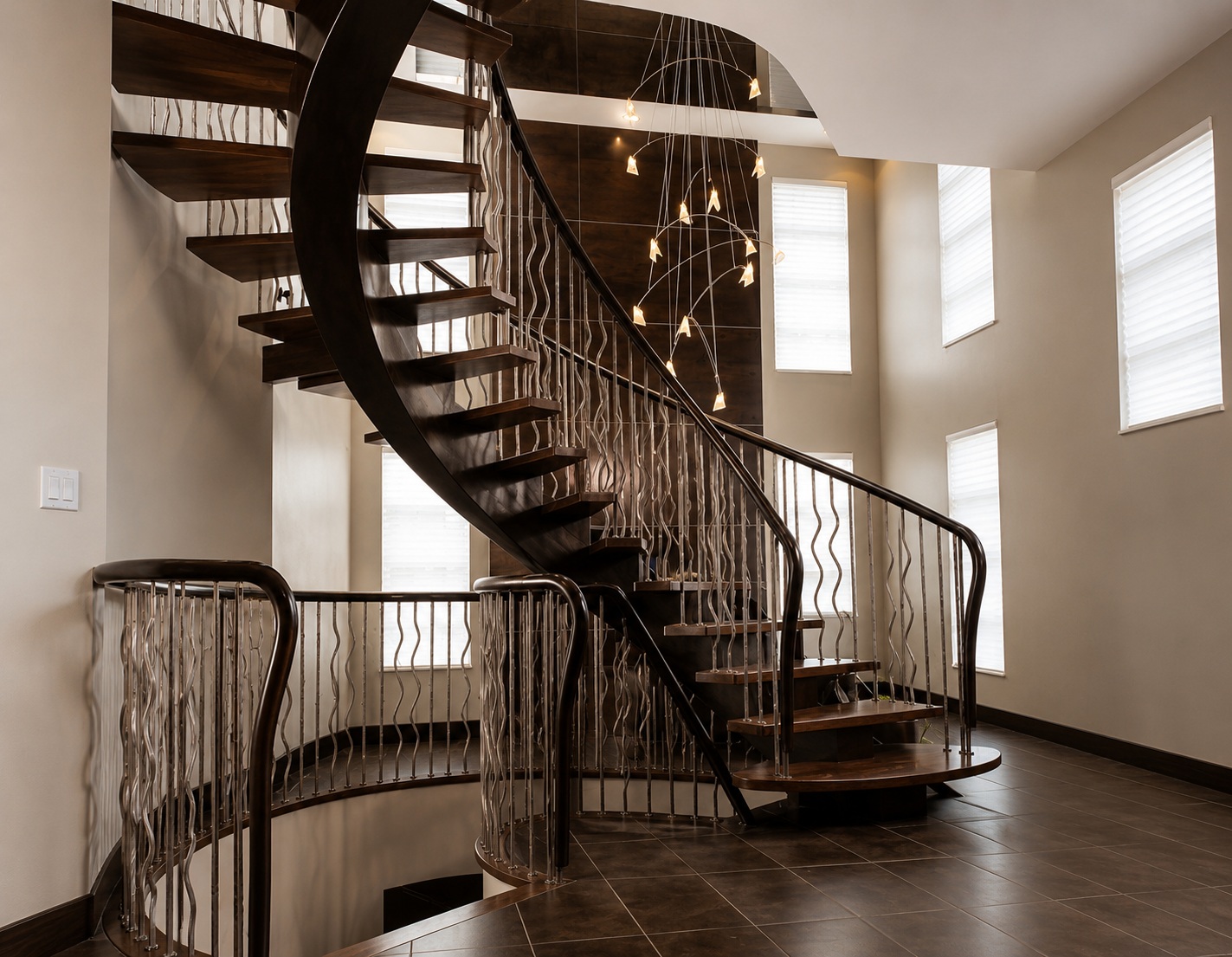
An ornamental iron railing for an outdoor terrace and indoor staircase — client feedback.
Structure Options for an Exterior Staircase
Once the material is settled, the structure decides how the stair carries its load and how it looks against the building. The choice depends on the rise, the space you have, and the style you want, and a few configurations cover most exterior projects. Each one suits a particular situation, which the table makes plain.
| Structure | How it works and where it suits |
|---|---|
| Straight flight | The simplest run, easy to walk and to build. It needs the most floor length, so it suits a generous yard, a deck, or a clear wall. |
| Straight with landing | A flight broken by a mid landing to turn a corner or break a tall rise. It fits an L-shaped wall and gives a resting point. |
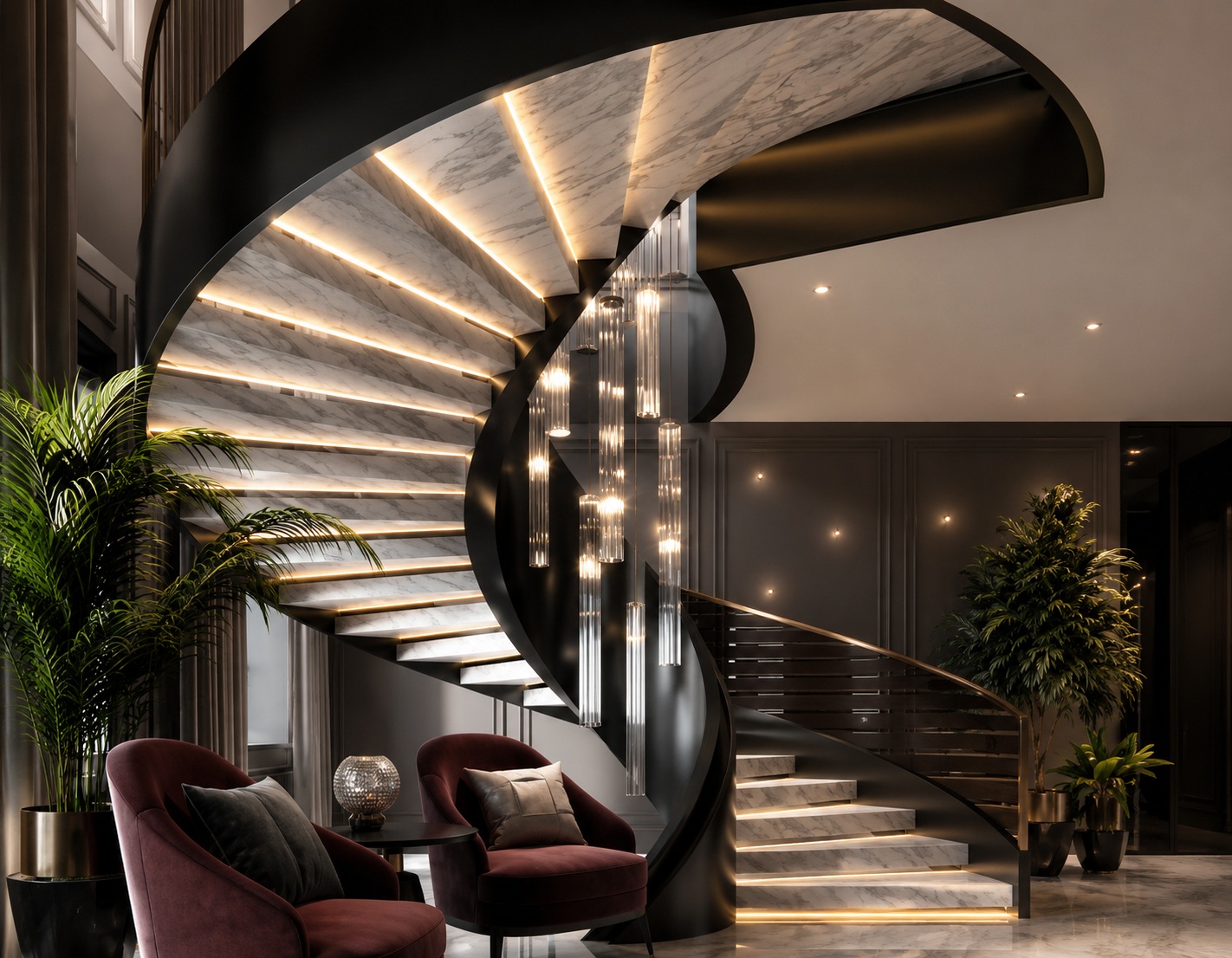
| Outdoor spiral | A compact coil around a central column, often with open grating treads. It gives a small-footprint route to a roof terrace or a raised deck. |
| Stringer-supported | Treads carried on one or two steel stringers, giving a clean modern profile. It works for decks, terraces, and contemporary facades. |
A straight steel flight is the everyday choice where length is available, while an outdoor spiral wins when the footprint is tight, such as a roof access in a small courtyard. A stringer-supported stair gives the cleanest modern line for a deck or a sharp facade. We engineer each of these as a weatherproofed exterior version, and you can see the range on our outdoor staircase page.
How an Exterior Staircase Differs From an Interior One
An exterior staircase and an interior stair can share the same shape, yet they are built very differently because of where they live. Indoors, a stair stays dry and warm. So designers focus mainly on the look, the comfort of the climb, and the railing. None of the weather problems that rule an outdoor stair apply. That frees the indoor stair to use almost any material and finish.
Outdoors, the same flight must manage water, grip, and rust as its first job. That changes the treads, which favour open or textured surfaces over smooth timber. It changes the finish, which must be galvanised, powder-coated, or naturally rust-resistant. And it changes the fixings, which have to be galvanised or stainless. Heat movement matters more outside too, since a long metal stair grows and shrinks as the seasons swing.
For owners, the takeaway is simple: an indoor design does not just move outside without rework. A stair you admired in a hallway needs its materials, surfaces, and fixings rethought first. Only then can it stand up to the weather. That is the very logic we apply when we adapt a design for outdoor use, so the finished stair looks right and lasts.
Matching the Stair to a Deck, Terrace, Garden, or Roof
A successful outdoor staircase belongs to its setting, so the deck, terrace, garden, or roof it serves should steer the design. A deck stair often runs as a short straight flight in treated timber or steel, sized to meet the deck boards cleanly and to land on a firm pad below. A terrace stair, by contrast, frequently reads as a more architectural piece, finished to match the facade and the paving so it feels part of the building.
A garden flight tends to follow the slope and the planting, where stone or textured concrete settles into the landscape and weathers gracefully over the years. A roof stair is usually about compact, weatherproof access, which is where an outdoor spiral or a tight stringer flight in galvanised steel earns its keep. In every case the railing, the tread surface, and the finish are tuned to the spot, so the stair looks deliberate rather than bolted on.
Reading the setting first also keeps the proportions honest, because a stair scaled to its surroundings always sits more comfortably than one chosen from a brochure. We begin every exterior project by understanding where the stair lands and what it connects, then shape the structure, the material, and the finish around that. The result is a flight that suits its garden, deck, terrace, or roof rather than fighting it.
What an Outdoor Staircase Costs
An outdoor staircase spans a wide price range, and the material is the largest single reason. A plain galvanised steel flight sits at the affordable end of custom exterior stairs, because the structure is efficient and the finish is straightforward. A stone staircase, an aluminium build for a coastal site, or a powder-coated colour finish all add to the figure. Since every stair is made to order, there is no single price tag; there are drivers.
The main drivers are the material, the finish, the structure, and the rise. Galvanised steel is generally the most economical, while aluminium and stone cost more, and a powder-coated colour adds a finishing step. An outdoor spiral or a long stringer flight involves more fabrication than a short straight run, and a taller rise adds treads and structure. Drainage details, anti-slip surfaces, and corrosion-resistant fixings are small line items that nonetheless belong in the budget.
Because the stair is custom, we price each project from its drawing rather than from a list, and we never publish a flat number. We break each driver down, with attributed third-party market ranges rather than a quote, in the outdoor staircase cost guide. As a made-to-order manufacturer, that is the most honest way we can talk about price before we see your project.
Code and Safety for Outdoor Stairs
Outdoor stairs follow the same core dimensional rules as indoor stairs, plus a few weather-specific ones. Under common US residential references, the riser height is commonly capped around 7¾ inches and the tread depth set near 10 to 11 inches, with a guardrail on open sides and a graspable handrail along the flight. Those figures keep the climb safe and predictable whether the stair is inside or out.
The weather-specific rules are what set an exterior stair apart. Code commonly calls for a slip-resistant walking surface, and surfaces that collect rain or snow are expected to drain rather than pond. Fixings used outdoors are typically required to be hot-dip galvanised or stainless steel, so the joints resist corrosion as long as the structure does. These are widely used reference values, and your local adopted code edition is what actually governs, so confirm the current version with your local team.
A well-built outdoor staircase is a safe, comfortable stair; the rules simply keep the rise honest, the surface grippy, and the metal protected. Following them from the drawing stage is far easier than retrofitting them later. We design to common residential references and note them on the shop drawing, but the final code sign-off always sits with your local team, since they hold the adopted edition for your jurisdiction.
Outdoor Staircase FAQ
Which material suits an outdoor staircase?
No single material wins every time, because the right choice depends on your climate, look, and maintenance appetite. Galvanised steel is the common all-rounder for its durability and low upkeep. Aluminium suits coastal and weight-sensitive sites, and stone or concrete suit a permanent garden or entrance. Treated timber works on a relaxed deck where you accept periodic resealing.
Is a metal staircase outdoor better than wood?
For most exterior projects a metal staircase outdoor lasts longer and asks for less upkeep than wood, especially when galvanised or powder-coated. Treated timber is warmer underfoot and often cheaper, but it needs resealing and is prone to rot if water sits on it. Many owners pick metal for the structure and add timber treads where they want warmth.
How do you stop an outdoor staircase from getting slippery?
You design grip into the treads and keep water off them. Open grating, textured surfaces, raised nosings, or anti-slip inserts all give a foot something to hold when the stair is wet. Good drainage helps too, since treads that shed water dry faster and are far less likely to ice over in cold weather.
Do outdoor stairs need to follow building code?
Yes. Outdoor stairs follow the same core rise, run, handrail, and guardrail rules as indoor stairs, plus weather points such as a slip-resistant surface and corrosion-resistant fixings. The exact numbers come from the code edition your jurisdiction has adopted, so confirm the current version with your local team before you build or order.
Can an indoor staircase design be used outdoors?
Not without rework. An indoor design has to be reconsidered for an outdoor staircase, because the treads, finish, and fixings all change to manage water, grip, and corrosion. The shape and proportions can carry over, but the materials and detailing must be adapted before the stair can stand up to the weather safely.
Go deeper into the cluster: outdoor stair materials compared, metal vs steel, weatherproofing and enclosing, and cost drivers. Or browse the full outdoor staircase range we manufacture.
Double Building Materials draws, manufactures, trial-assembles, crates, and ships your outdoor staircase. Your own contractor or installer handles on-site installation and local code sign-off — we can help you find one where available. Dimensions above are common references and code values are typical US residential figures; your local adopted edition governs, so confirm the current version with your local team.
Talk to us on WhatsApp →