

Aluminum Stair Railings: When Extruded Aluminum Fits, and When Steel Is Still Needed
Railing Guides · Extruded Dies, Stiffness & Span Limits
An extruded aluminum stair railing shines on outdoor decks, beach steps, and crisp modern straight runs where light weight and zero red rust lead the wish list. Yet because light alloy flexes nearly three times more than steel of equal size and softens right beside welds, steel is still needed for slim bars, tight curves, and side-welded stringers.
Stand three feet back from two matte-black stair samples—one in coated light alloy and one in coated carbon steel—and nobody can tell them apart by eye. Rap your knuckles on the posts or push hard at mid-span, though, and two very different structural metals show their character right away.
Because our Foshan workshop builds custom extruded guards alongside welded steel and stainless stairs under one roof, we never force one metal into the wrong job. Weigh extruded profiles against our cast railing guide and custom balustrade range below.
The 3-to-1 Flex Rule Between Light Alloy and Steel
Every honest trade-off between these two metals starts with one fixed number from physics: elastic modulus—how far a bar bends under a push before springing back.
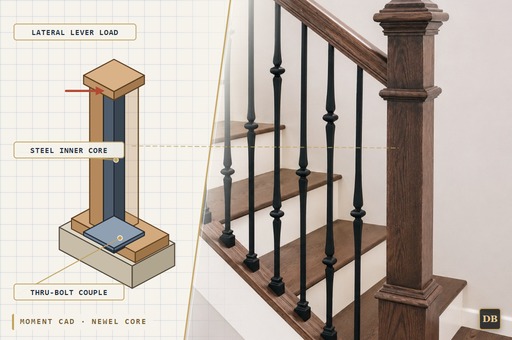
Two structural rules: (A) steel is ~2.9x stiffer than an identical light-alloy tube; (B) arc welding softens T6 temper at post bases unless inner stems or sockets carry the load.
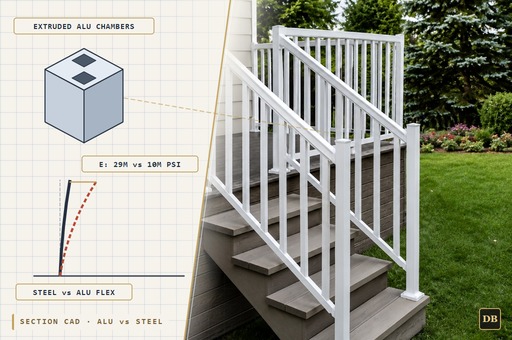
Carbon steel and stainless steel both sit near 29 million psi (200 GPa). Architectural 6000-series extrusions—whether you order 6063 or higher-strength 6061—sit near 10 million psi (69 GPa). Put the exact same 1.5-inch hollow square tube in both metals under a 200-pound push, and the light-alloy tube flexes nearly three times farther.
Notice what that rule means on your shop drawing. Stepping up from 6063 to 6061 raises yield load before permanent bend, yet does not change elastic flex by one bit. Only smart post shape stops a stair guard from feeling springy under your hand.
How 6063-T6 and 6061-T6 Dies Build Stiffness Inside the Post
That flex gap is why custom extrusions beat plain hollow square pipe in clever ways. Pressing heated billet through a steel die lets engineers put internal cross-ribs, screw tracks, gasket slots, and thick load walls inside a 2.5-inch or 3-inch post with clean outside lines.
3D section view: (A) extruded posts beat flex with internal cross-ribs and heavy base sockets; (B) steel posts stay stiff in ultra-slim welded bars.
In our shop runs, 6063-T6 serves for smooth top caps, slotted glass rails, pickets, and ribbed posts because it leaves the die with crisp faces for powder coat and anodizing. Heavy base shoes, anchor stems, and thick brackets move up to 6061-T6 where extra yield strength pays off. You can see custom sheet and standoff work in our perforated railing spotlight.
Why Post-Base Welding Softens T6 Temper—and How Inner Stems Fix It
Here is the second shop truth that separates real guard engineers from casual weld stalls. Both 6063-T6 and 6061-T6 gain their strength from heat treatment and controlled oven aging.
Run a hot MIG or TIG weld bead around the foot of a T6 post to attach a flat base plate and weld heat partially softens about one inch of metal around the bead. Engineers call that softened band the Heat-Affected Zone (HAZ). Inside that 1-inch band, T6 yield strength drops roughly in half—right where prying force peaks at step level!
To keep full T6 post strength on stairs, smart extruded systems skip thin unbraced butt welds at the floor line. Instead, our shop pairs ribbed posts with internal steel or solid alloy stems bolted into deck framing, thick gusseted base sockets, or hidden mechanical post anchors.
Four Places Where an Aluminum Stair Railing Leads
Where does an aluminum stair railing beat steel in real homes? Four everyday jobs put extruded systems out in front:
- Beach, bayfront, and pool deck stairs. Non-ferrous alloy never bleeds red rust onto pale stone, stucco, or composite deck boards in salt air—see our coastal climate railing guide.
- Raised wood decks and roof terraces with weight limits: at one-third the weight of steel, light sections trim dead load along balcony edges and carry up walk-ups with ease.
- Straight picket, glass-panel, and top-cap flights: multi-chamber posts with snap-in spacers hide screw heads from top step to bottom landing.
- Multi-balcony townhome projects: oven batch coating seals every pre-cut post and rail in matched matte black, bronze, or crisp white.
Five Stair Layouts Where Steel Is Still Needed
Even thick multi-ribbed extrusions have clear structural limits. Step back to carbon steel or 304/316 stainless steel whenever your staircase hits any of these five layouts:
- Pencil-slim indoor modern bars. When a room calls for half-inch solid flat-bar posts or 16 mm round spindles without 3-inch square posts, only steel's 29-million-psi stiffness feels rock solid.
- Side-welded mono-stringer or floating stairs. On open flights from our custom steel staircase line where posts weld straight onto a slim stringer plate with zero room for wide base sockets, full-strength steel welds win.
- Tight 3D spiral or curved stairs. Rolling thin multi-chamber extrusions into tight rising 3D curves risks wall ripples or cracks, while steel plate and round stainless tube roll smooth (see our curved staircase railing guide).
- Wide open spans past 5 to 6 feet between posts. Long post-free stair spans call for steel's low deflection.
- Busy public stairwells. Heavy crowd push loads in schools, hotels, and offices favor thick-wall welded steel or stainless.
Hand Feel, Door Weight, and Sound on Indoor Flights
Indoors, weight and sound shape how a main staircase feels under your palm too. Light hollow extrusions can sound slightly brighter if tapped unless paired with snug rubber picket grommets, thick wall gauges, or glass infill panels that add quiet mass.
Many custom homes blend both metals smartly across one order. Inside the living room, slim welded steel posts carry glass or oak rails up an open mono-stringer flight. Step out through sliding patio doors onto the pool deck, and matching matte-black extruded posts take over down the yard steps—coated to the same RAL color and sheen in our shop.
Extruded Alloy vs Carbon Steel vs Stainless Stair Table
Weigh extruded 6063/6061 builds against coated carbon steel and 304/316 stainless across stiffness, weight, curve limits, and coastal care.
| Check Point | Extruded 6063 / 6061 | Carbon Steel (HDG / Coated) | 304 / 316 Stainless |
|---|---|---|---|
| Stiffness (E) | ~10M psi (uses wider ribbed post) | ~29M psi (stiff in slim bars) | ~28-29M psi (stiff in slim bars) |
| Frame Weight | Light (~1/3 of steel weight) | Heavy solid mass | Heavy solid mass |
| Post Foot Joint | Inner core stem or cast socket | Full-strength structural weld | Full-strength TIG weld or plate |
| 3D Tight Curves | Suited to straight or gentle arcs | Great for tight rolled 3D spirals | Great for rolled round curves |
| Salt Rust Risk | Zero red rust (AAMA 2604/2605) | Needs hot-dip galvanizing + coat | Use 316 marine grade near surf |
Oven Powder Coating, Salt Rinsing, and Clean Joints
Good pretreatment locks in twenty-year finish life outdoors. Compare baked powder coats against anodizing in our powder-coated vs anodized finish guide. Super-durable AAMA 2604 and AAMA 2605 coats hold deep black and bronze tones in strong sun, while simple hose rinses per our railing cleaning routine wash salt off joints.
Long exterior runs exposed to wide daily temperature swings also need smart expansion planning on your shop drawing. Light-alloy extrusions expand and contract roughly twice as much per degree as carbon steel from hot noon sun to cold nights. Over twenty-foot runs, continuous top caps use internal slip pins instead of rigid end-to-end butt welds.
Infill pairing also guides whether an extruded frame or a welded steel frame fits your staircase cleaner. Framed tempered glass lites and vertical square pickets sit neatly inside extruded gasket tracks with zero weld marks. High-pull long-bay horizontal cables or forged iron scrolls anchor better into heavy-wall welded steel or stainless end posts.
Before our Foshan team packs any custom stair balustrade order, every post, raked top cap, base socket, and corner elbow goes through full trial assembly against your exact step rise-and-run geometry. Checking each joint upright on the shop floor verifies that miter angles, fastener clearances, and internal stems fit cleanly before export crating.
When comparing two supplier quotes side by side, always ask for exact post wall thickness in millimeters alongside alloy temper and base-stem material on the drawing. Knowing whether an aluminum stair railing uses thin 1.5 mm retail walls or heavy 3.0-to-5.0 mm structural chambers with steel floor stems explains both price differences and real-world handrail solidity.
Send your floor-to-floor rise, stair width, indoor or coastal exposure, and one reference photo so our drawing desk can match your flight to ribbed 6063/6061 extrusions, galvanized carbon steel, or brushed 304/316 stainless with company quality.
Whichever metal holds your flight, factory coats baked in one batch keep upstairs gallery guards, sloped stair runs, and coastal balcony openings matched with cabinet-grade company quality across the whole home.
When you weigh a light rust-free outdoor frame against slim indoor welded bars, let span length, post base space, curve radius, and salt air make the call. Matching the metal to the job gives every balcony and gallery staircase on your property the exact structural quality it needs.
From first sketch review through full factory trial assembly and export-ready crating, matching frame stiffness to stair geometry keeps handrails feeling quiet and firm. Every gallery landing and coastal balcony opening stays rattle-free across decades of daily family footsteps.
Pairing company factory quality with honest metal selection gives indoor gallery stairs and outdoor balcony openings crisp lines, steady grip, and dependable structural poise.
Counter-Questions: Avoiding Springy Spans and Mixed-Metal Pits
Run three quick counter-questions before locking your stair guard metal.
- Can an aluminum stair railing bolt onto a steel staircase? Yes—beach homes do this often—as long as nylon or EPDM pads separate light-alloy bases from steel stringers and 316 bolts prevent galvanic pitting.
- When not to chop pre-coated coastal rails on site? Raw saw cuts near ocean surf leave bare metal edges open to under-film creep; let our shop cut, drill, and bake every slant angle first.
- Why skip thin retail box kits on long flights? Thin 0.050-inch store walls rattle when adults lean mid-stair; ask for heavy architectural wall thickness and inner post stems.
Extruded vs Steel Stair Railing Ordering FAQ
Is extruded 6063 or 6061 strong enough for a main home staircase?
Yes, when built with thick walls, internal chamber ribs, and proper inner-stem or socket floor anchors. Engineered 6063-T6 and 6061-T6 guards hold home and commercial push loads on straight and L-turn stairs.
How does extruded railing differ from cast railing on stairs?
Extruded systems press heated metal through dies to make crisp hollow modern posts and channels. Cast systems pour molten metal into molds to make solid scroll panels and classic ornate spindles.
Why do many extruded stair posts slide over a steel stem at the floor?
Sliding a ribbed outer post over a bolted steel base stem blends steel's high floor stiffness and un-softened base strength with a rust-free outer skin above.
Can one order pair slim steel stairs indoors with matching black extrusions outside?
Yes. Building both indoor steel guards and outdoor deck stairs in our Foshan plant lets us match powder-coat color and low-gloss sheen right across your patio doors.
Scope note: Double Building Materials prepares project shop drawings, builds custom extruded and welded steel/stainless railings, trial-assembles before crating, and ships worldwide. Optional fitting is available across the USA, Australia, and Canada (quoted separately).