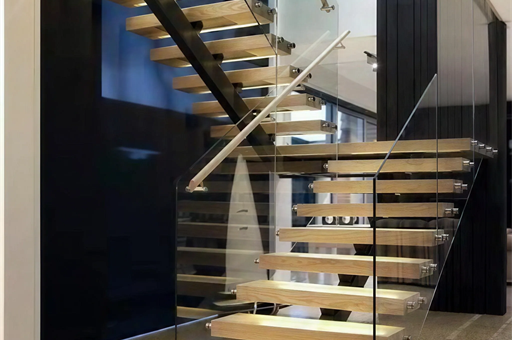





Cable Railing for Stairs: Materials, Code & Cost-Railing Guides
Cable Railing Guides · Stair Scene
Cable Railing for Stairs: The Owner’s Guide to a Clean, Open Staircase
Cable railing for stairs uses thin horizontal stainless steel cables, raked to follow the staircase slope, in place of vertical balusters. The taut cables almost disappear, so the staircase keeps an open, uninterrupted look while the posts and top rail carry the load. The result feels modern and airy, and it needs careful angled tensioning plus corrosion-resistant hardware to stay crisp.
A staircase is the one railing you touch every day. So the way it looks and feels matters more than almost anywhere in the house. That is the whole case for cable railing on a stair. This guide explains how cable railing for stairs works on a slope. It covers the materials that last, how the spacing rules behave on an angled run, what drives the cost, and how a made-to-order system reaches your site. Where a topic runs deep, we link to a focused guide.
What Cable Railing for Stairs Is
Cable railing for stairs is a stair guardrail built from thin stainless steel cables instead of vertical balusters or solid glass. The cables run parallel to the stair slope, threaded through the intermediate posts and tensioned firmly at the top and bottom newel posts. A continuous handrail caps the whole run, giving you a solid line to grip on every step. From a short distance the cables read as faint diagonal lines, so the barrier nearly melts away and the space behind it stays in full view.
The system has three working parts to understand before you choose one. The newel posts and the frame carry the load, resisting the outward pressure that a railing must take. The cables are the infill that closes the gaps and stops a person, or a small child, from slipping through. The tensioning hardware at each cable end holds the pull, so the angled lines stay tight and straight for years rather than sagging into loose curves. When all three parts are detailed correctly, a cable stair looks effortless, and that clean raked line is the whole point in an open-plan home.
Why a Staircase Suits Cable So Well
A staircase is usually the visual spine of a home, the first thing a guest sees from the door and the line that ties two floors together. A traditional baluster railing slices that view into a picket fence of bars, while solid glass can glare and show every fingerprint. Cable railing threads the gap between those two, holding the edge safely without crowding the eye. The slim raked lines pull the gaze along the flight, so the stair reads as one flowing sculptural shape rather than a barrier.
There is a practical gain alongside the look. Thin cables let daylight pass straight through the stairwell, so a stair tucked against a wall never feels dim or boxed in. The minimal profile flatters a wide range of homes, from a crisp contemporary loft to a softened farmhouse renovation. Owners building open-plan great rooms reach for cable most often, because the railing guards the flight while surrendering as little of the open volume as a guardrail can. That balance of safety and clear sight is why cable suits a feature stair so well.
The Raked-Cable Challenge
Running cable down a stair is genuinely harder than running it along a level deck, and knowing why protects your result. On the flat, every cable is level and the hardware sits square to the post. On a stair the cables travel at the rake of the stringer, so the fittings must meet the post at that exact diagonal angle. Specialised angled fittings, or posts drilled to the precise slope, solve this, and the layout has to be drawn with care before any metal is cut.
Tension on a slope behaves differently too, which is the second reason raked cable needs precision. A cable pulled at an angle pushes both outward and downward on the posts, so the top and bottom newel posts take a heavier, more complex load than the intermediate posts. Those end posts must be stout and anchored firmly into the stair structure, while the intermediate posts simply guide and space the cables. Where the flight meets a level landing or balcony, the cables shift from raked back to horizontal, and that junction is a detail a careful fabricator solves in the drawing rather than on site.
Materials for an Indoor Stair
Material choice decides how a staircase ages and how it feels under the hand. The cables are stainless steel, and even indoors the grade is worth a thought, since a hallway sees humidity and the cable sits in daylight for decades. The posts and handrail are where the personality lives, and they are the parts you actually touch, so the combination of metal, timber, and finish does most of the design work.
| Component | Common interior choice and why |
|---|---|
| 304 stainless cable | A capable, economical grade for most interior staircases, where the conditioned air keeps corrosion exposure low and the polish stays bright. |
| 316 stainless cable | The marine-grade alloy, sometimes specified indoors near a pool, a coastal opening, or simply for the highest corrosion margin. |
| Wood handrail, metal posts | A warm timber handrail over slim stainless posts and cables, the most popular interior pairing, matching the staircase to a wooden floor. |
| Powder-coated steel frame | A monochrome contemporary look, with the posts and handrail finished in a single colour for a graphic, minimal staircase. |
The honest rule indoors is to match the polish and the hardware to the setting. You need not chase a marine grade you may not use. A heated indoor stair commonly works in 304 stainless and looks the part for years. The handrail decides the character. A warm walnut or oak rail softens the metal. A matching powder-coated rail keeps the whole flight graphic and minimal. Whatever the grade, every cable end still needs rust-resistant tensioning hardware. That small fitting carries the entire line, and it sits in plain sight on a feature stair.
Spacing, Height, and Code on a Staircase
A stair railing is a safety barrier first. So the code rules shape the design before the look does. Under common US home references, a stair needs two things. It needs a graspable handrail at a set height above the nosings. And it needs a guard that stops a fall to the side. The infill, your cables, must be spaced so a set sphere cannot pass between them. For cable on a slope that means tight, even lines. Slack cables can spread under weight and open the gap right where a child might lean.
| Common reference point | Typical US residential value |
|---|---|
| Handrail height (above nosings) | Commonly 34 to 38 inches measured from the stair tread nosings under the IRC reference. |
| Guard height (open side of flight) | Around 36 inches for a residential stair under common code; taller for commercial or IBC work. |
| Maximum infill gap | A 4-inch sphere must not pass between the cables, which the spacing and tension together must satisfy. |
| Graspable handrail profile (ADA / IBC) | A rounded handrail roughly 1¼ to 2 inches across is the common graspable reference in accessible settings. |
Treat those numbers as widely used reference figures. Your local adopted code edition is what really governs, so confirm the current version with your local team. On a stair the inspector tests the assembled gap along the rake, not the cable on its own. So the cable spacing and the post spacing are decided together. We unpack the angled geometry in full in the cable railing spacing and code guide.
Our comparison of railing materials for coastal homes — how stainless steel cable stacks up against the alternatives. Tap to play.
What Drives the Cost of a Cable Staircase Railing
Cable railing for stairs covers a broad price range, and the spread comes from the angled details you cannot see at a glance. Because every staircase system is manufactured to order, there is no single price tag; there are drivers. Understanding the drivers lets you shape a railing that fits your budget rather than chasing a headline number that never matches the actual flight. The explanations below describe what moves the price, not a quote.
The grade of stainless is the first driver. Marine-grade 316 hardware costs more than the standard 304 grade, though most indoor stairs sit happily in 304. The number and complexity of posts is the second. The heavily loaded top and bottom newel posts need robust hardware and precise angled drilling. A stair that turns at a landing simply needs more of them. The raked fittings, the cable run length, the handrail material, and the finish all move the figure too. A single straight flight is the most economical layout, while a stair that turns, switches back, or runs onto a balcony brings more posts and far more angled tensioning hardware. We break each driver down, with attributed third-party market ranges rather than our quote, in the cable railing cost guide. As a made-to-order maker, we price each project from its drawing.
How a Stair System Is Made
At Double Building Materials, a cable stair railing starts as a drawing, not a box of generic parts. We take your stair rise and run, the rake angle, the landing and turn points, and the handrail height you need. We turn them into a working shop drawing. That drawing fixes every post position, the raked cable runs, and the angled hardware before any metal is cut. We cut nothing until you approve it. The rake angle and the post spacing have to be right the first time on a stair, where a wrong angle is hard to undo.
From there we make the newel posts, the middle posts, and the angled fittings. Then we trial-assemble the system on our Guangdong floor. That trial build is where we confirm the rake, the fit, and the way the hardware lands at each turn before anything ships. Once it passes, we crate the system for export in the order your installer will need. The posts, cables, and fittings are grouped in a logical way for the climb. Your own contractor fits and tensions it on site from our drawings. We can help you find one where local installation is available. We do not install on site or sign off local code; that stays with your local team. You can see the cable systems we make on our stainless steel cable balustrade page. With 25+ years of factory work across 800+ projects in 60+ countries, we treat a stair railing as a precise, made-to-order build rather than a stock kit.
Cable Stair Railing FAQ
Is cable railing good for stairs?
Cable railing is a popular staircase choice because the thin raked lines preserve the open sightline while still guarding the flight safely. It suits modern open-plan residences especially well, where the staircase becomes an architectural feature rather than a hidden service stair. The essential detail is drawing the rake angle accurately and tensioning the angled cables firmly, since a carefully engineered system remains crisp and taut for many years indoors.
How far apart should cable railing posts be on stairs?
Posts on a staircase are typically spaced closely enough to prevent the angled cables from bowing when someone leans on them, which usually means runs are kept relatively short between sturdy intermediate posts. Longer unsupported runs deflect more significantly on a slope and can open the gap between cables. The exact spacing depends on the cable diameter, the rake angle, the applied tension, and your local regulations, so confirm it with your installer and local team.
Does cable railing meet stair code requirements?
A correctly designed cable system can satisfy common staircase regulations, but the assembled flight is what gets evaluated, not the individual cable. The infill must prevent a defined sphere from passing through, the handrail must sit at the required height and remain graspable, and the cables must stay tight along the rake. Your local adopted code edition governs the exact figures, so confirm the current version with your local team before you begin construction.
Do you need a wood or metal top rail with cable stair railing?
A staircase requires a continuous graspable handrail regardless of the infill, so a cable stair railing always incorporates a top rail you can hold. Owners choose between a warm timber handrail and a matching metal one purely for appearance, since both configurations can satisfy the graspable profile. The cables handle the guarding below the rail, while the handrail handles the grip along the climb.
Can cable railing run from stairs onto a deck or balcony?
Yes, cable runs from a raked staircase onto a level deck or balcony as a continuous line, transitioning from angled back to horizontal at the landing. That junction is a detail the shop drawing resolves beforehand, so the cables stay perfectly aligned and the overall appearance remains seamless. We cover the level configuration in the cable railing for decks guide.
This is one chapter of the wider complete guide to cable railing. From here, see the cable railing for decks ideas for level runs, and the cable railing spacing and code rules for the geometry on a slope. Or browse our full stainless steel cable railing systems.
Double Building Materials draws, manufactures, trial-assembles, crates, and ships your cable staircase railing. Your own contractor or installer handles on-site installation, cable tensioning, and local code sign-off — we can help you find one where available. Dimensions and code values above are common US references; your local adopted edition governs, so confirm the current version with your local team. Every system is made to order, so any cost figures describe drivers, not a quote.
Talk to us on WhatsApp →