




Cable Railing Guide: Design, Materials, Code & Cost -Railing Guides
Cable Railing · Complete Guide
Cable Railing: The Complete Guide to Design, Materials, Code & Cost
A cable railing is a guardrail that uses thin, horizontal stainless steel cables stretched tight between sturdy end posts instead of solid balusters or glass. The slim lines almost disappear, which preserves the view while still enclosing a deck, stair, or balcony. It is prized for its modern, see-through look and its strength outdoors.
That near-invisible quality is the entire reason a cable railing exists. This guide walks through how the system works and where it suits your home. It covers materials, layout, the spacing and tension rules that matter, and an honest picture of cost. Where a topic runs deep, we link to a focused guide so you can read further.
What a Cable Railing Is
A cable railing fills the guardrail opening with rows of thin stainless steel cable rather than vertical pickets, glass panels, or a solid screen. The cables run horizontally between strong end posts, and they sit under tension so they read as crisp, taut lines rather than loose wires. People also call it a cable rail, a wire rail, or a cable balustrade, and the terms all describe the same horizontal-cable approach.
The appeal is almost all about the view. Each cable is only a few millimetres thick. So from a few steps back the railing seems to melt away, and your eye travels straight through to the land beyond. That makes cable railing the natural pick on a deck above water, a hillside terrace, or any spot where the view is the point. It has a clean, modern look that suits new homes well.
It is worth being clear on one trade-off early. A cable railing leans on correct tension and on solid, well-fixed posts. Loose cables sag and feel unsafe, so the system rewards careful design and strong end framing. None of that makes it a hard choice. It just means a cable railing is an engineered system, not a casual add-on. That is where a factory approach earns its keep.
How a Cable Railing Works
A cable railing works by turning tension into a barrier. Stainless steel cables thread through a run of posts and anchor at each end into a stout terminal post or wall. A threaded fitting at one end lets you tighten every cable until it is firm, and that tension is what keeps the horizontal lines from sagging or spreading apart. The top rail caps the assembly, ties the posts together, and gives a hand something comfortable to hold.
The two ends of a run do the heavy lifting. Those terminal posts resist the pull of every taut cable. So they are built stronger and fixed deeper than the slim posts in between. The middle posts simply guide the cables and stop them being pushed apart. That is why their spacing matters so much to the look and the safety of the run.
| Component | What it does in the system |
|---|---|
| Terminal post | The strong end post that anchors and resists the combined tension of every cable. Built heavier and fixed deeper than the rest. |
| Intermediate post | A slim post the cables pass through. It keeps the cables aligned and stops them spreading apart under a push. |
| Top rail | The cap that ties the posts together, adds rigidity, and serves as the graspable handrail along the run. |
| Tensioning fitting | The threaded hardware that draws each cable taut and lets it be retuned later if it relaxes over time. |
Understanding those four parts explains nearly every cable railing decision that follows. The terminal posts govern how long a straight run can be before you need an extra brace. The intermediate spacing and the cable spacing govern the look and the code result. The tensioning fitting governs how easily the railing can be kept firm over the years.
The Parts of the System
Beyond the four headline components, a cable railing is defined by a handful of choices that shape both its character and its budget. The first is the post material, which is usually stainless steel or powder-coated aluminium, and which sets the overall durability. The second is the cable diameter, because a thicker cable reads as a slightly heavier line and resists deflection more firmly, while a finer cable disappears more completely against the view.
The third choice is how the cables terminate and tension. Some systems hide the tensioning hardware inside the posts for a cleaner face; others expose neat turnbuckle-style fittings as a deliberate, technical detail. The fourth is the top rail itself, which can be a slim metal cap, a broad timber handrail, or even a glass-topped profile. It changes the warmth of the finished railing more than any other single element. We assemble these into one coordinated package rather than a bag of loose parts.
Because every part pulls against every other under tension, the parts are best specified together as one engineered system. A post chosen for looks but undersized for the cable load will flex; a beautiful timber cap fixed to weak posts will not hold its line. Treating the railing as a complete assembly, drawn and proven before it ships, is what keeps the slim, taut appearance honest in real life.
Materials and Finishes
The material decides how a cable railing looks, how it ages, and how much it costs. Stainless steel dominates the category because it resists corrosion, holds its tension well, and finishes to a clean industrial sheen. For demanding coastal and poolside settings, a higher marine grade of stainless resists salt far better than the standard grade, which is the single most important specification on a waterfront project.
| Material | Character |
|---|---|
| 316 stainless cable | The marine-grade choice for coastal, poolside, and high-humidity sites. Best corrosion resistance, and the standard for salt-air durability. |
| 304 stainless cable | A common general-purpose grade for inland and sheltered settings, with strong everyday corrosion resistance at a lower cost. |
| Stainless posts | Durable, modern, and matched to the cable finish. Brushed satin hides marks; mirror polish gives a sharper, reflective look. |
| Powder-coated aluminium posts | Lighter and available in many colours, so the frame can match dark window joinery or a black-trim exterior scheme. |
| Timber top rail | A warm hardwood cap over a metal cable system, blending the modern lines with a softer, tactile handrail. |
A marine-grade stainless system suits a waterfront deck or a poolside terrace, where salt is the real enemy. A powder-coated aluminium frame with stainless cable suits an owner who wants a dark, contemporary frame against pale decking. A timber-capped run warms the whole assembly for an interior stair or a sheltered porch. The full material comparison sits in our railing materials guide.
Where Cable Railing Suits Best
A cable railing earns its place wherever a view is the prize and a solid barrier would spoil it. The classic application is an elevated deck or a balcony that looks out over water, trees, or a valley, because the thin horizontal lines let the panorama read uninterrupted. It also performs well on a hillside terrace, where a glass panel might collect dust and a picket rail would clutter the outlook.
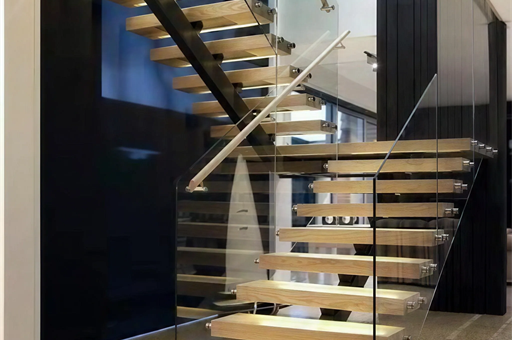
Indoors, the same near-invisible quality opens up a stair or a mezzanine without walling off the room. That is why cable systems have become a signature of open-plan, contemporary interiors. The look pairs naturally with steel, glass, and pale timber. We cover the indoor angle in detail in our guide to interior cable railing. The two most common outdoor uses get their own guides to cable railing for decks and cable railing for stairs.
There are settings where another material serves better, and saying so plainly is only fair. Homes with very young children sometimes prefer a tighter or solid infill, because horizontal cables can tempt a determined climber. A windy, exposed coastal balustrade that needs a windbreak may favour glass instead. Choosing well means matching the railing to how the space is actually used, not only to how it looks in a photograph.
Spacing, Tension and Code
Spacing is the rule that defines a safe cable railing, because the gaps between the cables are what a building inspector measures. Under common US residential references, a guardrail must reject the passage of a four-inch sphere. That means the vertical gap between adjacent cables has to stay under that limit once the cables are tensioned. Builders typically space the cables around three inches apart so that, even under a push, the opening never grows beyond what the rule allows.
| Common reference (confirm local edition) | Typical value cited |
|---|---|
| Maximum opening (IRC / IBC, residential guard) | A 4-inch sphere must not pass through the gaps; cables are often set near 3 inches apart. |
| Guard height (residential, IRC) | Commonly cited at 36 inches; commercial guards under IBC are often higher. |
| Intermediate post spacing | Closer spacing limits cable deflection between posts and helps the gaps stay within the rule. |
| Cable tension & deflection | Cables must stay taut enough that a push does not open the gap beyond the limit; periodic retuning helps. |
Those figures are widely used reference values. Your local adopted code edition is what actually governs, so confirm the current version with your local team. Commercial settings, public stairs, and accessibility routes carry their own added rules under IBC, ADA, and OSHA. Any project that is not a private home should be checked against the rules for its building type. The full breakdown lives in our cable railing spacing and code guide.
How a Cable Railing Is Made
At Double Building Materials, a cable railing starts as a drawing, not a box of fittings. We take your run lengths, your corner and stair geometry, the guard height you need, and your chosen materials, then turn them into a working shop drawing. That drawing fixes every post position, the cable spacing, and the terminal details before any steel is cut. We cut nothing until you approve it, because the post layout and the tension path have to be right the first time.
From there we fabricate the posts, the rails, and the terminal fittings, then trial-assemble the system on our 4,500 square-metre Guangdong floor. That trial build is where we confirm the post positions, the cable runs, and the fit of every fitting before anything ships. Once it passes, we crate the railing for export in the order your installer will need it, with the components labelled to match the drawing. Your own contractor fits and tensions it on site from our drawings, and we can help you find a local installer where that service is available. We do not install on site or sign off local code; that stays with your local team.
This drawing-first, trial-assembled approach is what keeps a cable railing looking taut and precise once it is up. Over 25 years and more than 800 projects across 60-plus countries, the pattern that serves owners best stays the same. We prove the fit in the factory, so the only work left on site is mounting and tensioning. You can see the cable systems we build on our stainless steel cable balustrade page.
Our comparison of railing materials for coastal homes, including where stainless cable fits — tap to play.
What a Cable Railing Costs
A cable railing sits in the mid-to-upper band of railing budgets, and the reason is the hardware. Each cable needs its own anchor and its own tensioning fitting, and those small stainless components add up across a long run. The posts also work harder than ordinary balusters because they carry tension, so they are heavier and more carefully engineered. Because every railing is made to order, there is no single price tag; there are drivers.
The main drivers are the run length, the number of cables, the post material and grade, and the top rail. A marine-grade stainless system costs more than a standard grade, and it is the right call near the sea. Long straight runs need fewer terminal posts per metre, which can be more economical than many short corners. A timber or glass-topped cap adds cost over a plain metal rail. We break each driver down, with third-party market ranges rather than a quote, in the cable railing cost guide. As a made-to-order manufacturer, we price each project from its drawing.
Living With and Maintaining It
A cable railing asks for very little once it is up, which is part of its quiet appeal. Stainless cable and posts shrug off rain and sun, so day-to-day care is mostly an occasional wipe to keep the metal bright. Near the coast, a fresh-water rinse now and then clears the salt film that would otherwise dull even marine-grade stainless. That simple habit does more for longevity than any product you can buy.
The one task unique to cable systems is checking the tension. Over the first season or two, brand-new cables settle and may relax a little, so a light retune brings them back to a crisp, taut line. After that, an occasional check is usually all it takes. The fittings are made to be turned by hand or with a simple tool. So keeping the railing firm is a quick job, and it holds both the look and the safety right where they should be.
Cable Railing FAQ
Is cable railing safe for children?
It can be, provided the cables are spaced and tensioned so a four-inch sphere cannot pass between them, which is the common code measure. The honest caveat is that horizontal cables can tempt a determined climber, so families with very young children sometimes prefer a tighter or solid infill. Discuss the layout with your local team and confirm it against your local adopted edition.
How far apart should cable railing cables be?
Builders commonly set the cables around three inches apart, so that even under a firm push the gap never opens past the four-inch limit cited in common residential references. Closer intermediate post spacing helps the cables stay taut between supports. Your local adopted code edition governs the exact figure, so confirm it before you finalise the layout.
Does cable railing rust over time?
Quality stainless steel resists rust well, which is why it dominates the category. Near salt water, a marine grade resists corrosion far better than a standard grade, and an occasional fresh-water rinse keeps it bright. Choosing the right grade for your environment is the single most important step toward a railing that stays clean for many years.
Do cable railings need retensioning?
New cables settle a little in their first season, so a light retune brings them back to a firm, straight line. After that, an occasional check is usually enough. The tensioning fittings are made to be adjusted easily, so keeping the railing taut is a quick task that protects both the look and the safety of the run.
Is cable railing cheaper than glass?
It depends on the project, because both sit in the upper band of railing budgets. Cable cost is driven by the hardware on every cable and the heavier terminal posts; glass cost is driven by the panels and their mounting. For an unobstructed view with airflow, cable often wins; for a windbreak, glass may suit better. See the cost guide for the full breakdown.
Go deeper into the cluster: cable railing for decks, interior cable railing, cable railing for stairs, spacing and code, and cost drivers. Or browse the full stainless steel cable balustrade range.
Double Building Materials draws, manufactures, trial-assembles, crates, and ships your cable railing. Your own contractor or installer handles on-site installation, tensioning, and local code sign-off — we can help you find one where available. Dimensions and code figures above are common US references; your local adopted edition governs, so confirm the current version with your local team.
Talk to us on WhatsApp →