

Cable Railing Cost: What Actually Drives the Price -Railing Guides
Cable Railing Guides · Cost & Budgeting
Cable Railing Cost: What Actually Drives the Price of a Stainless Cable System
Cable railing cost is governed by drivers rather than one fixed figure, because every run is made to order. The major variables are the post material and finish, the number of cable lines and their tensioning hardware, the total run length, the corner and stair geometry, and the installation difficulty of the site.
Understanding cable railing cost begins with what you are actually paying for, because the headline price hides several independent decisions. This guide walks through each driver in plain language, shows where the money concentrates, and explains why a quote varies so widely between projects. We label every market band as a third-party estimate, never as our own quote, because each system we build is priced from its drawing.
What Drives Cable Railing Cost
A stainless cable balustrade is never a shelf product with one price tag. So the honest answer to its cost is a set of drivers, not a single number. Five drivers move the figure most. They are the posts, the cable and tensioning hardware, the run length, the corner and stair shape, and how hard the site is to fit. Each one is a separate choice, and each one builds on the others. That is why two runs of equal length can quote at very different totals.
A cable railing looks effortless. Yet it is a tensioned system that hides its engineering inside the posts. The horizontal cables must hold back a person who leans on them, so the posts have to anchor real tension without flexing. That tension work, more than the slim cable itself, explains the cost gap between a decorative wire screen and a guardrail you can trust at a balcony edge. Owners often look at the cable and forget the posts. The sections below take each driver in turn, so nothing surprises your budget.
The Posts and the Frame
The biggest surprise in cable railing cost is that the posts, not the cable, carry most of the money. The posts anchor the tension, so they must be strong and spaced correctly. Three things set their price: the metal, the finish, and the post size. Marine-grade stainless steel resists salt and reads as the premium choice. Powder-coated aluminium is kinder on the budget and suits a dry, inland setting. Painted or galvanised steel sits between the two on price and on how well it lasts.
| Post specification | Relative cost and why |
|---|---|
| Powder-coated aluminium | The budget post. Light, durable inland, and available in many colours, though it asks for closer post spacing. |
| 304 stainless steel | A middle tier. Strong and corrosion-resistant for typical interior and sheltered exterior projects. |
| 316 marine stainless | The premium tier. Resists salt corrosion for coastal and poolside runs, with a refined brushed or mirror finish. |
| Timber or composite posts | A warm look that pairs metal cable hardware with wooden posts, common on decks, with its own maintenance trade-off. |
Post spacing is the quiet driver hiding inside this choice. The cables run flat between posts. The closer those posts sit, the less the cable can flex when someone pushes on it. A taller, springier post asks for either extra mid supports or thicker stock, and both add cost. The finish then sits on top of that choice. We explain how posts and tension work together in the cluster complete cable railing guide, and the choice you make there is the same one that moves your budget here.
Cable, Fittings, and Tensioning Hardware
The cable and its fittings are the second major driver, and they add up faster than people expect. Each line needs a run of stainless cable plus a tensioner and an end fitting at the ends. A guardrail usually carries many parallel lines from floor to handrail, because the gap between cables is limited for safety. More lines mean more cable, more fittings, and more tensioning hardware. So the fittings, counted across every line and every post, often rival the cost of the cable itself.
The hardware also varies in how it is finished and how it tensions. Swageless fittings let the cable be cut and tensioned on site. That is forgiving, but it adds a fitting at every end. Pre-swaged cable comes cut to length and finished in the factory. That reads cleaner and tensions faster, yet it asks for exact measurements up front. The end finish, the threaded or quick-connect style, and how visible the fittings are all nudge the figure. The metal grade matters here too. Matching 316 stainless cable and fittings to a coastal post keeps the whole system rust-free near salt air, and that is worth the premium.
Run Length, Corners, and Stairs
The shape of the run is where two projects of equal length split sharply on cost. A long, straight, unbroken line is the most economical layout, because the cable carries through with the fewest end points. Every corner, though, adds a corner post and a fresh set of end fittings for every cable line, since cable does not bend around a corner under tension. So a railing with several corners costs more than a straight run of the same length. Sometimes it costs a good deal more.
| Layout | Budget character |
|---|---|
| Long straight run | The most economical. Fewest terminations, so the cable and hardware cost is concentrated at just two ends. |
| Multiple corners | Higher. Each corner adds a post and a full set of fittings for every cable line, because cable cannot turn under tension. |
| Stair flights | Higher again. Raking cable and angled fittings follow the pitch of the stair, which is more fabrication and setting out. |
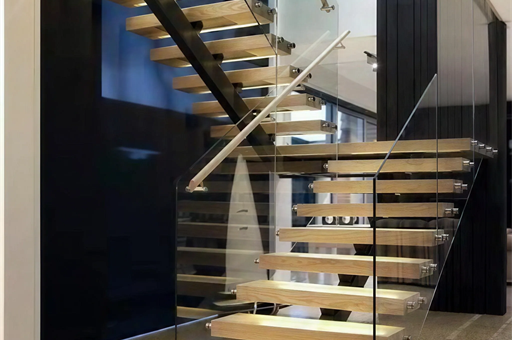
Stairs add their own premium because the cable runs on the rake, following the pitch of the flight. The end fittings then meet the posts at an angle rather than square, which asks for angled hardware and careful setting out. A deck rarely has this complication, while a staircase almost always does. We cover the two situations separately in our guides to cable railing for decks and cable railing for stairs, because the geometry changes both the price and the hardware you need.
Market Ranges in Context
Owners naturally want a number, so here is the honest framing. Renovation and trade sites usually quote cable railing as a price per linear foot, installed. They place a do-it-yourself aluminium kit well below a shop-built marine-stainless system. Those published bands are third-party market estimates, not our quote. They swing widely by region, by post metal, and by how many corners and stair flights the layout has. Treat any single figure you read online as a rough guide, not a promise. The drivers above can change a total without changing the length at all.
A safer way to budget is to fix your configuration first, then price it. Decide the post material and finish. Settle the cable grade and the fitting style. Count your corners and your stair flights honestly. Those decisions account for most of the spread between estimates. Once the specification is set, a drawing-based quote becomes meaningful and comparable between suppliers. As a made-to-order manufacturer with over twenty-five years of export experience, we price each cable system from its drawing, not from a catalogue. That is why we publish drivers here and reserve numbers for your own project.
Our comparison of railing materials for coastal homes, including stainless cable — tap to play.
Installation and Site Factors
Installation is a cost driver the hardware list never shows, yet it can move a total a great deal. The labour of a cable railing concentrates in two tasks: setting the posts dead plumb and tensioning every cable line to an even pull. A straight, level run on a solid deck is the simplest case, because the posts land predictably and the cables tension in sequence. A stair flight, a curved balcony, or an elevated terrace several storeys up all add access equipment, setting-out time, and the angled hardware described above. So the install portion of a quote rises steadily with the complexity of the site.
This is where it pays to understand our scope clearly. Double Building Materials draws, fabricates, trial-assembles, and crates your cable railing, then ships it ready for your installer to fit. We do not install on site, and we do not certify local code compliance, which stays with your local team. We trial-assemble each run on our 4,500 m² Guangdong floor before it ships, so the posts and fittings arrive checked for fit and the cable lengths are confirmed. That typically reduces the on-site setting-out time and the chance of a costly remake. Where you need a fitter, we can often help you find one where local installation is available.
Where to Save Without Cutting Safety
A cable railing has sensible economy and false economy, and the line between them is the structural tension system. The safe place to save is the visible finish and the layout, not the engineering. You can choose powder-coated aluminium posts over marine stainless where the climate allows. You can simplify the layout to favour long straight runs over many corners. You can select 304 stainless instead of 316 on a sheltered inland project. Each of these trims the budget, and none of them touches the part that holds people back from a fall.
The place never to save is the post strength, the cable grade, and the tensioning hardware. That is the part doing the safety work. Spacing posts too far apart, under-sizing the cable, or skipping marine-grade metal near the coast does not really save money. It only borrows against safety and against a future remake, because a slack or corroded cable fails the one job it has. A railing you can lean against with full confidence is worth specifying correctly the first time. Browse the full stainless steel cable balustrade systems to see the configurations, then read the cluster cable railing guide for how every choice fits together.
Cable Railing Cost FAQ
Is cable railing cheaper than glass or wrought iron?
Cable railing usually costs less in materials than a frameless glass balustrade, and it competes closely with a quality metal system. The cable itself is slim and economical, yet the posts and the many fittings carry most of the budget. A simple aluminium kit on a straight run is genuinely affordable, while a long marine-stainless system with several corners moves into the price range of glass. The layout and the metal grade decide where you land.
Why do the posts cost more than the cable?
The posts cost more because they do the structural work of resisting tension and a leaning load, while the cable simply spans between them. Each post must be substantial, anchored firmly, and spaced closely enough that the cables cannot deflect too far. That demands real material and precise fabrication. The cable looks like the product, but the posts and their fittings are where the engineering and the money actually concentrate.
What is the most budget-friendly way to get cable railing?
Favour a long straight run with powder-coated aluminium posts and 304 stainless cable on a sheltered, inland project. The straight layout keeps terminations to a minimum, the aluminium posts trim material cost, and 304 stainless is sufficient away from salt air. You keep the open, modern look of cable while trimming the drivers that push a coastal, multi-corner system higher. It is a sensible saving that never touches structural safety.
Does the number of cables change the price much?
Yes, the number of cable lines is one of the larger levers on cable railing cost, because each line needs its own run of cable plus a tensioner and an end fitting at every termination. A guardrail carries many parallel lines, since the spacing between them is limited for safety, so the fittings multiply quickly. The required number of lines is set by the railing height and the spacing rule, not by preference, so it should be specified to code rather than guessed.
Does cable railing need more maintenance, and does that affect cost?
Cable railing asks for occasional re-tensioning and a wipe-down, especially in a coastal setting where salt can mark lesser metal. That maintenance is light, but it is a running consideration rather than a one-off price. Choosing 316 marine stainless near the coast costs more up front and reduces the corrosion upkeep later, so the higher specification often pays back over the life of the railing. Match the metal grade to the climate to keep both cost and maintenance sensible.
Keep reading across the cable cluster: the complete cable railing guide, cable railing for decks, cable railing for stairs, and cable railing spacing and code. Ready to specify? Browse our stainless steel cable balustrade systems.
Double Building Materials draws, manufactures, trial-assembles, crates, and ships your cable railing. Your own contractor or installer handles on-site installation and local code sign-off — we can help you find one where available. Any price bands referenced above are third-party market estimates, not our quote; each system is made to order and priced from its drawing. Specification and code values are common references; your local adopted edition governs, so confirm the current version with your local team.
Talk to us on WhatsApp →