




ADA Stair Requirements & Landings Explained (Handrails, Treads & Code)
Commercial Staircase · ADA
ADA Stair Requirements & Landings Explained
ADA stair requirements set how stairs in accessible commercial buildings are detailed. They call for handrails on both sides at a set height, top and bottom rail extensions, even risers and treads, a small nosing profile, and closed risers. A stair is not an accessible route on its own, so a ramp or lift serves that need too.
The word accessible does a lot of quiet work in a commercial stair. It helps to unpack what the rules ask for before you brief a design. This guide covers the common ADA stair guidelines for handrails, treads, risers, nosings, and landings. It then sets them beside the role a stair plays in an accessible route. Read each number as a widely cited reference, and confirm the current edition with your local team.
What ADA Stair Requirements Cover
The Americans with Disabilities Act sets a standard for how public and commercial spaces serve people with disabilities. The ADA stair requirements are the part of that standard that shapes a stair, and they are detailing rules rather than a separate stair type. They cover how a handrail is gripped and where it starts and ends, how even the steps stay from bottom to top, and how the leading edge of each tread is profiled. The aim throughout is a stair that a person can read, grip, and climb with predictable confidence.
A few terms help before they appear. A riser is the upright face of a step, and a tread is the horizontal surface you walk on. A nosing is the leading edge of the tread, the part that projects toward you at the front of each step. Graspability describes how easily a hand can wrap around the rail and hold on. With those words settled, the requirements below read as one coherent picture rather than a scatter of disconnected numbers.
One framing point matters most. These accessible stairs rules apply to stairs in covered commercial and public buildings, and they sit within a wider family of building codes such as the IBC. The ADA Standards and your locally adopted code edition work together, and where they differ the stricter provision usually applies. So read every figure below as a common reference, then let your design professional confirm which edition governs your specific project and jurisdiction.
Stairs Are Not an Accessible Route on Their Own
This idea reframes everything else, and it surprises many owners the first time they encounter it. Under the ADA, a flight of stairs does not by itself count as an accessible route between levels. An accessible route is the continuous path a person using a wheelchair or other mobility aid can travel, and a stair, by its nature, interrupts that path. So a stair is never asked to be the way a wheelchair user moves between floors.
Instead, an accessible building provides a ramp, a lift, or a platform lift to link the levels, and the stair then serves everyone who walks. The ADA stair requirements still apply, because the stair is often part of the means of egress and is used by people with a wide range of mobility. That includes those who use a cane or who find ramps tiring. Detailing the stair well is about safety and usability for that broad group, not about turning the stair into the accessible route.
Knowing this early changes how you brief a project. You design the accessible route and the stair as two parallel systems that share a landing. You do not ask one part to do both jobs. The stair can then be as sculptural as the design wants. The ramp or lift quietly carries the access duty. For the wider picture of how these pieces fit a commercial scheme, our commercial staircase code and design guide sets the stair in full context.
Handrails: Both Sides, Height, and Grip
The handrail carries most of the accessibility weight on a stair, so the ADA stair guidelines are most detailed here. The first rule is the simplest to picture: handrails are required on both sides of an accessible stair, not just one. They must also run continuously along the full length of each flight, so a hand sliding up or down never has to let go and grope for the rail again. That continuity is what makes a handrail genuinely useful to someone who depends on it.
Height is the next dimension. The top of the gripping surface commonly sits 34 to 38 inches above the stair nosings, measured consistently along the flight, so the rail tracks the slope of the stair at a steady height. Graspability then governs the rail itself. A circular handrail is commonly 1¼ to 2 inches in diameter, sized so an average hand can close around it, with clear space behind and below the rail so fingers can wrap fully without scraping the wall. A non-circular profile is allowed within an equivalent graspable size.
These figures are widely cited reference values from the ADA Standards. The current adopted edition is what actually governs your project, so confirm the version with your local team. We turn whatever handrail spec your design professional sets into a buildable detail. That includes the bracket spacing and the wall fixings. The companion piece on commercial stair handrail height and code works through the height rules in more depth.
Handrail Extensions at the Top and Bottom
Extensions are the detail most often missed on an otherwise tidy stair, and they matter because the rail has to support a person before the first step and after the last one. An ADA handrail does not simply stop at the top and bottom risers. At the top of a flight, the rail commonly continues horizontally over the landing for at least 12 inches beyond the last step, giving a steady hold while the person finds their footing on level ground.
At the bottom, the rail commonly keeps sloping at the pitch of the stair for one tread depth beyond the last nosing. It then typically returns to the wall or the floor, so it cannot catch a sleeve or a bag. Those returns are part of the same safety idea, because a free rail end is a snag hazard. The combined effect is a handrail that is already there, gripped and stable, at the exact moment a climber is most likely to lose balance.
Extensions also shape the look of the stair. The rail visibly runs past the steps at each end rather than stopping flush. Many designers treat that as a feature and detail the return cleanly. As with every figure here, the extension lengths are common reference values. Your local adopted edition and the current ADA Standards govern. Confirm them with your local team before the rail is set out on the shop drawing.
Even Risers, Treads, and Nosings
Consistency is the quiet theme of the step rules, because a person reads a stair with their feet as much as their eyes. The risers must be uniform in height and the treads uniform in depth across the whole flight, so every step is the rhythm the body learns on the first one. A single odd step, taller or shallower than its neighbours, is exactly where a trip happens. Common reference values place the riser height in a 4 to 7 inch band and the tread depth at 11 inches minimum on accessible stairs.
The nosing profile is the other half of this section. The leading edge is commonly limited to a small radius, often cited at about half an inch. That keeps the edge rounded enough to be kind to a toe, yet still crisp enough to read clearly. Where the riser is angled, it commonly slopes no more than about 30 degrees from vertical. The nosing commonly projects no more than around 1½ inches over the tread below, with a curved or bevelled underside so a shoe does not catch on the return.
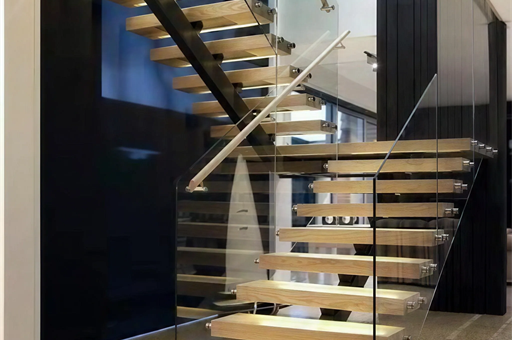
Open risers, the gaps you sometimes see on a floating-look stair, are generally not allowed on accessible commercial stairs. The open gap can catch a foot or a cane tip. That single rule often steers a commercial design toward closed risers from the start. Each of these figures is a common published reference. The current ADA Standards and your adopted local edition govern. Let your design professional confirm the exact values for your area.
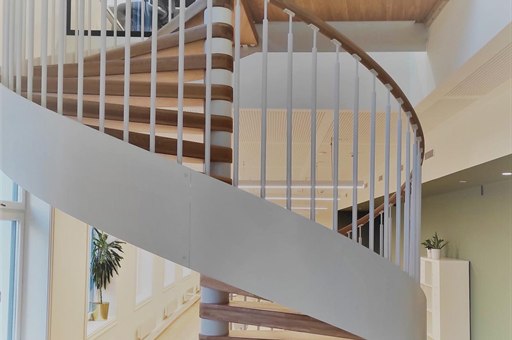
A commercial spiral staircase build and quality check on our factory floor.
Stairway Landing Requirements
Landings are the flat platforms that break a stair, either where it turns or where it meets a floor. The stairway landing requirements treat them as part of the accessible system, not an afterthought. A landing gives a person a level place to pause, to turn, and to find their balance. It is also where the top handrail extension does its work. A well-placed landing turns a long, scary run into a sequence a body can manage.
In practice, the building code beside the ADA commonly asks for a landing at least as deep as the stair is wide. The level area is then big enough to stand and move on. It must also stay clear of door swings and other blocks. The landing surface should be firm, stable, and slip resistant, in the same spirit as the treads. The shift from sloped flight to level platform is never a surprise underfoot. The handrail usually carries on across the landing where extensions are needed.
On a tall commercial stair, landings also break the flight into runs of a workable height. That is both a code matter and a comfort one. As ever, the exact landing sizes come from your adopted code edition working with the ADA Standards. Your design professional confirms them for your project, not a blog. We then build the stair and its landings to that stamped drawing.
A Hedged Reference Table
The table below gathers the common reference values above into one view. You can brief a design talk from a single place. Read every figure as a widely cited reference from the ADA Standards. It is not a fixed dimension for your project. The current adopted edition in your area is what actually governs. Your design professional confirms each value before it reaches a shop drawing.
| Stair element | Common reference (confirm your local edition) |
|---|---|
| Handrails | Both sides, continuous along each flight. |
| Handrail height | Commonly 34 to 38 inches above the nosings, held even. |
| Handrail grip | Round commonly 1¼ to 2 inches across, clear space behind and below. |
| Top extension | Commonly runs flat at least 12 inches past the last step. |
| Bottom extension | Commonly slopes one tread depth past the last nosing, then turns back. |
| Risers and treads | Even throughout; riser commonly 4 to 7 inches, tread commonly 11 inches minimum. |
| Nosing | Radius commonly up to about half an inch; projection commonly limited; closed risers. |
| Landing | Level, firm, slip resistant; commonly at least as deep as the stair is wide. |
Use this as a conversation starter with your architect or access consultant, not as a compliance checklist. The point of the table is to make the relationships clear. You can see how the handrail, the steps, and the landing work as one accessible system. Your local team turns these references into the exact spec your area needs.
How We Build to Your Stamped Drawing
Here is the honest boundary of what a maker does, and it matters for an access-sensitive project. Double Building Materials does not verify or certify ADA or code compliance. That duty sits with your design professional and your local authority. What we do is build to the stamped drawing they produce. You send us the approved geometry, the handrail spec, the riser and tread sizes, and the nosing shape. We turn that into a working shop drawing for your approval before any steel is cut.
From there the sequence is the same one behind every stair we make. We fabricate the stringers, the treads, and the handrail to the approved detail, then trial-assemble the flight on our Guangdong factory floor. The rise, the run, the landings, and the rail extensions all fit before anything ships. Once it passes that check, we crate the staircase for export in the order your installer will need it. Your own contractor fits it on site, and we can help you find one where local install is available.
In short, the access choices are made by your local team. We are the factory that renders those choices in steel with the sizes held true. We bring 25+ years of export making and 800+ projects across 60+ countries to that work. The part we own is precision to the drawing. You can see the commercial stairs we build, and start a drawing-led talk, on our staircase page.
ADA Stairs FAQ
Do ADA compliant stairs need handrails on both sides?
Yes. On accessible commercial stairs, handrails are commonly needed on both sides of the flight. They must also run without a break along its full length. The idea is that a person can hold on without a gap, on whichever side suits them, from the bottom of the stair to the top. Your local adopted edition confirms the exact rule for your project.
Can a staircase be the accessible route in a commercial building?
No. A stair is not treated as an accessible route on its own, because someone using a wheelchair cannot travel it. An accessible building adds a ramp, a lift, or a platform lift to link the levels. The stair serves everyone who walks. The two systems run in parallel and commonly share a landing.
Are open-riser stairs allowed under ADA?
Generally not on accessible commercial stairs. Open risers, the gaps between treads on a see-through stair, can catch a foot or a cane tip. So the common rule is closed risers. This often steers a commercial design toward solid risers from the start. Confirm the current rule with your local team, since adopted editions vary.
How high should an ADA handrail be?
The top of the grip surface commonly sits 34 to 38 inches above the stair nosings, held even along the flight. The rail is also commonly easy to grip, with a round shape around 1¼ to 2 inches across. These are widely cited reference values. Your adopted edition governs the exact figure for your build.
What are the landing requirements on an ADA stair?
A landing is a level, firm, slip-resistant platform where a stair turns or meets a floor. It is commonly at least as deep as the stair is wide. It gives a person room to pause and turn, and it is where the top handrail extension sits. The exact size comes from your adopted code edition, confirmed by your design professional.
Read this beside the cluster pillar, the commercial staircase code and design guide, and the focused piece on commercial stair handrail height and code. When the geometry is settled, browse the commercial flights we build on our staircase range.
Double Building Materials draws, manufactures, trial-assembles, crates, and ships your staircase. We do not verify or certify ADA or building-code compliance, and we do not install on site. Your design professional and local authority own compliance, and your own contractor handles installation. We can help you locate one where available. Every figure above is a common published reference, not project-specific advice. The current ADA Standards and your local adopted edition govern, so confirm each value with your local team.
Talk to us on WhatsApp →