

How Much Does a Floating Staircase Cost? The Price Drivers That Matter
Floating Staircase · Cost Guide
How Much Does a Floating Staircase Cost? The Price Drivers That Matter
A floating staircase cost typically falls between roughly $15,000 and $60,000 or more installed, with many single straight flights cited near $20,000 to $30,000. Those are third-party market figures, not a Double Building Materials quote, because every staircase we manufacture is engineered and priced from your own drawings.
Key takeaways
- Third-party market figures put a floating staircase at roughly $15,000–$60,000+ installed, with single straight flights often cited near $20,000–$30,000.
- Most of the cost sits in the hidden engineered steel, not the treads you see — which is why floating stairs run higher than traditional ones.
- Six drivers set your number: flight size, support type, tread material, railing or glass, finish, and logistics.
- Floating stairs are made to order — we price each one from your drawings, so the figures here are third-party estimates, not a DBM quote.
The number swings widely because the price does not live in the treads you see. It lives in the engineered steel you do not. A floating, or cantilevered, staircase carries each tread from a concealed spine or a wall pocket instead of a visible stringer. That means heavier steel, tighter engineering, and more precise fabrication than a traditional stair. This guide breaks down what your money actually pays for, so you can read any quote — ours or anyone else’s — and understand the number.
Floating Staircase Cost: What the Published Ranges Say
Search the question and you will see a wide spread. Google’s AI Overview and most specialist suppliers quote roughly $15,000 to $60,000 or more installed. A widely shared homeowner thread even cited about $78,000 for a 21-step flight with a landing. Two things explain the gap, and both are worth understanding before you read a single quote.
First, the word “installed” bundles in site labor, delivery, and sometimes structural work. None of that is the staircase itself. Second, floating stairs are almost never off-the-shelf. The span, the height, the tread material, and the railing choice change the parts list completely. So a $20,000 flight and a $78,000 flight can both be a floating staircase, and both be honestly priced. The configuration is doing the work.
It helps to picture where a configuration lands within that published range rather than chasing a single average. The table below maps common specifications to the lower, middle, and upper portions of the third-party figures above.
| Typical configuration | Where it sits in the range |
|---|---|
| Straight flight, engineered-wood treads, open or cable edge | Lower end — roughly $15,000–$25,000 within the third-party range above. |
| Taller flight, solid hardwood or steel treads, frameless glass balustrade | Around the middle — roughly $25,000–$40,000 within that range. |
| Curved or multi-landing flight, stone or structural-glass treads, full glass balustrade | Upper end — roughly $40,000–$60,000+, and the figure that can exceed it. |
These bands are a way to read the third-party figures, not a Double Building Materials price list. We quote each staircase from your drawings, so your number depends on your own specification rather than an average.
Why Floating Stairs Cost More Than Regular Stairs
A traditional staircase shows its support. A stringer down each side does the structural work cheaply and in plain view. A floating staircase has to conceal that support, so the load moves into a steel mono-beam, a cantilever spine, or anchors buried inside the wall. The engineering that was visible and simple becomes hidden and demanding.
We engineer that carrier so every tread behaves like a small diving board. The structure uses more steel, requires genuine structural calculation, and leaves no room for loose fabrication. A few millimetres of drift shows instantly on an open riser, where there is nothing to hide behind. More engineering, heavier steel, and tighter tolerances are the honest reasons a floating staircase sits at the top of the price range. You can read the structure itself in our guide to floating staircase structural design, and the head-to-head money comparison in floating stairs vs regular stairs. If you are choosing between stair types on price, our comparisons of floating vs spiral, floating vs curved, and floating vs straight stairs weigh the cost trade-offs side by side.
The Six Factors That Move the Price
Almost every difference between one quote and another comes back to six variables. Read a quote against these and the spread stops looking random.
| Cost driver | Why it moves the price |
|---|---|
| 1. Flight size | Total rise and number of treads. A taller, longer flight needs more steel in the carrier and more treads — usually the single biggest swing. |
| 2. Support type | A wall-anchored cantilever, a central mono-beam, or a stringer hidden behind cladding. This concealed carrier is the main reason a floating stair costs more than a traditional one. |
| 3. Tread material | Engineered or solid hardwood, stone, marble, or concrete. Thick solid timber, exotic species, and stone push the cost up. Standard engineered treads keep it down. |
| 4. Railing and glass | An open edge is the most economical. A frameless glass balustrade or stainless cable infill adds glass, hardware, and fixings — often a large line item on its own. |
| 5. Finish | Powder-coat colour, paint, or metal cladding on the carrier. Custom or multi-stage finishes add labour over a standard single coat. |
| 6. Logistics and install | Export crating and ocean freight, plus local site access and installation labour. Installation is local, so it varies by market — and it is the part most often hidden inside an “installed” price. |
Flight size and support type together usually account for the largest part of the difference, because both decide how much steel the carrier needs and how much engineering goes into it. The tread material and the railing come next, and they are the two decisions where personal taste moves the number most. The finish and the logistics are smaller, but they still belong in a like-for-like comparison.
Cost by Tread Material
The tread is the part you see, and it is also where the price can quietly double. Materials do not carry a single fixed price, but they do fall into a consistent order from approachable to premium, and that order rarely changes between suppliers.
| Tread material | Relative cost position |
|---|---|
| Engineered wood | The most approachable, and a stable, consistent surface. A common starting point. |
| Steel | Mid-range, and can carry its own load, which sometimes simplifies the carrier. |
| Solid hardwood | Higher, especially in thick sections or exotic species such as walnut. |
| Concrete | Higher again, and heavy, so the supporting structure has to grow with it. |
| Stone, marble or structural glass | The premium tier, on both material and the engineering each one demands. |
If you are weighing one material against another on more than price — on weight, grip, and upkeep — our guide to floating staircase tread materials compares them in detail. The two premium directions have guides of their own: the floating glass staircase and the floating concrete staircase.
How to Read an "Installed" Quote
Most published figures describe an installed price, and that single word hides three separate costs. Pulling them apart is the clearest way to compare suppliers fairly and to see what you are actually buying.
The first cost is the staircase as a manufactured product: the engineered carrier, the treads, the railing, and the finish. The second is freight and crating, which depends on distance and on how carefully the stair is packed for the journey. The third is local installation labour, which depends entirely on your market and your site, and which a manufacturer in another country never charges. When you compare an installed market price with a manufactured price, strip the local labour out of the installed figure first. Only then are you comparing the same thing.
At Double Building Materials we price the staircase as a made-to-order package: drawn, manufactured, trial-assembled, and crated for export. We do not install on site or sign off local code. Your own contractor or installer fits it from our drawings, and we can help you find one where local installation is available. So our number naturally excludes the site labour that an “installed” quote includes.
Ways to Keep the Cost Down
A floating staircase is a considered purchase, but several decisions move the number without changing the floating effect you are paying for. None of these compromise the engineering; they simply trim the parts of the budget that carry the least visual reward.
A straight flight is the most economical shape, because it asks the least of the carrier and the fabrication. Engineered-wood treads hold most of the warmth of solid timber at a calmer price. A cable or slim metal infill guards the edge for less than a full frameless glass balustrade, while keeping the open, see-through line. A single standard powder-coat finish avoids the labour of a custom or multi-stage colour. And a clear, dimensioned drawing at the start prevents the late changes that quietly add cost on any project. Decide the configuration early, and the price becomes predictable.
Does a Floating Staircase Add Home Value?
Buyers often ask whether the cost comes back at resale, and the honest answer is that it depends on the home and the market rather than on the staircase alone. In an open-plan living space where the stair is visible from the entrance, a well-executed floating staircase becomes a genuine focal point. A centrepiece that photographs well tends to help a listing stand out. In a closed stairwell that guests never see, the same staircase delivers far less of that return, because nobody experiences the openness you paid for.
Two things decide whether the investment reads as premium or merely expensive. The first is execution, because a floating staircase that is precisely fabricated and cleanly installed signals quality across the whole house, while a bouncy or poorly finished one does the opposite. The second is coherence with the surrounding interior, since a sculptural stair works hardest when its materials and railing echo the rest of the design rather than competing with it.
We cannot promise a specific resale figure, and any supplier who does is guessing. What we can say is that the staircase is one of the few elements a visitor touches, climbs, and remembers, so the quality of its engineering and finish carries weight beyond its square footage. Treating it as part of the architecture, rather than as a late addition, is what turns the cost into lasting value.
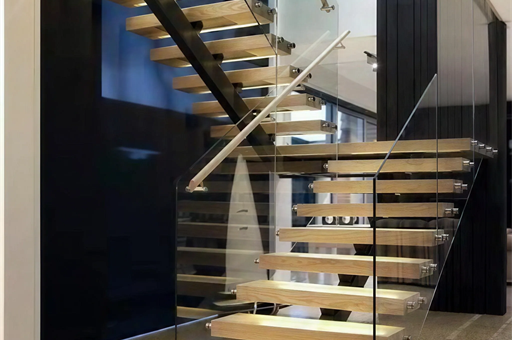
A square-tube floating staircase with glass railing we built for a Virginia home — trial-assembled in our workshop before crating.
Floating Staircase Cost FAQ
How much does it cost to put in a floating staircase?
Third-party market figures run roughly $15,000 to $60,000 or more installed, and a typical single flight is often cited around $20,000 to $30,000. Floating stairs are made to order, so the real figure depends on the six drivers above: flight size, support type, tread material, railing, finish, and logistics. We price each staircase from your drawings, not from a list.
Why are floating stairs so expensive?
Because the support is hidden. Instead of a low-cost visible stringer, the load moves into an engineered steel cantilever or mono-beam. That means more steel, genuine structural work, and very tight tolerances. You are paying for the structure you cannot see, not the treads you can.
How much does a floating staircase cost per step?
Some suppliers do quote per tread, which is why a taller flight costs more than a short one. A rough way to sense it is to divide a flight’s quoted range by its number of treads, but treat that as a guide only. The carrier, railing, and finish are shared across the whole flight, so they do not split evenly step by step.
Is a floating staircase worth it?
That depends on the role the stair plays. In a hallway nobody sees, a regular stair makes more sense. In an open living space where the staircase is the first thing a visitor notices, the floating version earns its cost by opening the room and passing light through. It is a design decision as much as a budget one.
Are floating staircases safe?
Yes, when an engineer designs the structure and details the railing to your local code. A correctly designed cantilever carries normal residential loads with a wide margin, and a guard with baluster or glass infill makes the open edge as secure as any other stair. We go deeper in are floating stairs safe.
New to the topic? Start with our floating staircase guide. See real builds: the Virginia square-tube floating staircase and the Florida white-oak floating staircase. Compare the full staircase range and the glass balustrade options that pair with most floating flights. Comparing stair types? See our guides to spiral staircases, curved staircases, and straight staircases.
Double Building Materials draws, manufactures, trial-assembles, crates, and ships your staircase. Your own contractor or installer handles on-site installation and local code sign-off — we can help you find one where available. Figures above are third-party market estimates, not a DBM price.
Get a drawing-based quote on WhatsApp →