




Are Floating Stairs Safe? What Makes Them Safe, and What to Watch
Floating Staircase · Safety
Are Floating Stairs Safe? What Makes Them Safe, and What to Watch
Are floating stairs safe? Yes, when an engineer designs the structure and a builder details the railing to local code. The hidden steel carries the load with a wide margin, a guard and infill protect the open edge, and a textured tread gives grip. The open risers are a detailing question, not a weakness.
The open risers and the missing stringer make a floating staircase look daring, so it is natural to ask whether floating stairs are safe to live with. The honest answer is that safety comes from the engineering and the detailing, not from the appearance. A floating stair built properly is as safe as any other stair in the house, and a poorly built one is not, exactly as with a conventional flight. This guide explains what makes a floating staircase safe, the questions worth asking if you have young children, and the few things to watch over time.
Are Floating Stairs Safe? The Short Answer
Yes. Floating stairs are safe when they are engineered and detailed correctly, and that is the whole story. The look is dramatic, but the safety is ordinary engineering. The treads carry the same loads as any stair, the guard meets the same rules, and the grip is handled the same way. Nothing about the floating appearance reduces the safety, provided the design does its job.
The fear usually comes from two places: the open risers and the missing side support. Both look risky and are not. Code addresses the open risers directly, and the support has simply moved into a hidden steel structure rather than vanished. The rest of this guide takes the worries one by one and shows the answer behind each, using common US residential reference values where code figures apply.
The Structure Underneath
The first reassurance is the part you cannot see. A floating staircase carries its load through engineered steel, whether that is arms set into a wall, a central mono-beam, or a concealed stringer. We design each tread to behave like a small cantilever, sizing it for the load with a safety margin on top, so it carries far more than a household will ever apply.
The common worry that a floating stair will feel bouncy is really a question about stiffness, not strength, and a good design answers it. We size the steel for movement as well as load, so the natural frequency of the flight stays high and the stair feels firm from the first step. A staircase that flexes underfoot has been underbuilt, not floated, and that is exactly what proper engineering prevents. The full picture sits in our guide to floating staircase structural design.
The Guard and Infill
The guard along the open edge is the part of a floating staircase that does the most safety work, and it follows the same rules as any stair. Common US residential values set the guard at least 36 inches tall, with the openings in it small enough to reject a 4-inch sphere. That sphere rule is the one that matters most around children, and it shapes the infill you choose.
A frameless glass balustrade answers the rule cleanly, because a solid panel has no gaps at all. Stainless cable or slim baluster infill meets it by spacing the elements to the limit. A continuous handrail, commonly set between 34 and 38 inches, gives the hand something to hold the whole way up. None of these compromise the open look, and together they make the edge of a floating stair as secure as the edge of any other. Confirm the exact figures with your local edition, since they vary by jurisdiction.
Grip and Slip
Grip is the safety question that depends on the tread material, and every material has a sure-footed answer. Timber with a satin finish is naturally grippy underfoot. Polished stone and bare steel can be slippery, so they take a textured finish, an insert, or a non-slip nosing. Glass treads carry a fritted or sandblasted zone exactly where the foot lands.
The nosing helps too, because a defined front edge gives the foot a consistent landing on every step. On a floating stair with thick treads, the nosing is part of the look as well as the grip. The point is that slip is a finish decision, made deliberately at the design stage rather than left to chance. A floating staircase is no more slippery than any other stair, as long as the tread surface is chosen with grip in mind. Our guide to floating staircase tread materials covers grip by material.
The Open-Riser Question for Kids
This is the worry parents raise most, and it deserves a straight answer. The open gap between treads is exactly what the 4-inch sphere rule governs. Where that gap sits more than 30 inches above the floor, common US residential rules require it to reject a 4-inch sphere, the figure that stands in for a small child’s head. Designed to that rule, the gaps are already sized for safety.
Some families want more reassurance than the rule alone, and there are easy ways to add it. A slim sub-rail or a glass infill between the treads closes the gaps entirely, while a removable safety gate at the top or bottom handles the toddler years and comes off later. None of these are signs that a floating stair is unsafe; they are ordinary choices a parent can make, the same way they would on any open stair. The openness that looks alarming on paper is a detailing question with several good answers.
Weight Capacity
A floating staircase is engineered to carry the same loads as any residential stair, despite its light appearance. Common US residential rules set a uniform live load near 40 psf, together with a concentrated load of around 300 pounds applied to a single tread. We design the structure for the worst of those cases and add a margin on top, so the everyday loads of a household sit comfortably inside what the stair can hold.
This is why the hidden steel is heavier than it looks, and why a floating stair is not the lightweight it appears to be. The treads carry a person landing hard, a crowd on the flight, and the occasional heavy or awkward load, all with room to spare. Confirm the design load against your current local edition, since the figures vary. The principle holds everywhere, though: we build a floating stair to the same strength rules as a solid one, with no allowance for its appearance.
What Makes a Floating Stair Unsafe
It is fair to ask the opposite question too: what would make a floating stair unsafe? Knowing the failure points is the clearest way to judge a design or a supplier, because every one of them is avoidable.
The first is an underbuilt structure. A carrier sized for looks rather than load gives the bouncy, nervous feel that makes people distrust a stair, so the engineering has to come first. The second is the wrong infill spacing, where gaps in the guard or between the treads exceed what the sphere rule allows, which is a genuine risk around children. The third is an untreated slippery tread, where polished stone or bare glass ships without a grip finish. The fourth is a poor fixing into a weak wall, where a cantilever is anchored into a partition that cannot hold it.
Every one of these is a design or workmanship failure, not a flaw in the floating idea itself. They are exactly what proper engineering, detailing to code, and a workshop trial assembly are meant to catch. So when you judge a floating staircase, judge the structure, the infill, the grip, and the fixing, because that is where safety is won or lost.
What to Watch Over Time
A well-built floating staircase needs very little attention, but a few simple checks keep it sound over the years. The fixings that anchor the carrier to the wall or the landings do the hardest work, so it is worth confirming they remain tight, especially in the first months after installation while the building settles.
The rest is ordinary upkeep. A timber tread benefits from an occasional re-oil, a stone or concrete tread from a refreshed sealer, and any glass from a regular clean. If a tread ever begins to feel different underfoot, or the railing loosens, it is worth a look sooner rather than later. None of this is unique to floating stairs; it is the same care any quality staircase rewards. Caught early, the small things stay small, and a floating stair stays as safe as the day it went in.
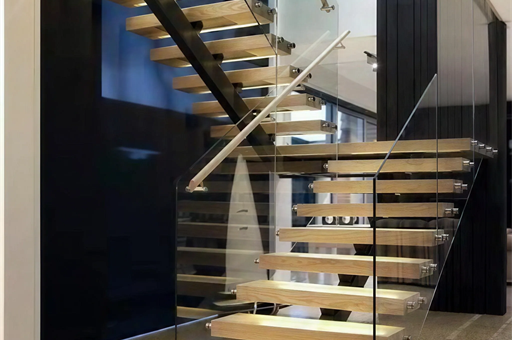
A floating staircase with a frameless glass railing we built for a Virginia home — the glass panel guards the open edge with no gaps.
Are Floating Stairs Safe FAQ
Are floating stairs safe for toddlers?
They can be, with the right detailing. The open gaps already follow the 4-inch sphere rule that protects a small child, and a slim sub-rail or glass infill closes them entirely where parents want more. A removable safety gate handles the toddler years and comes off later. These are the same choices a parent would make on any open stair.
Do floating stairs feel sturdy or wobbly?
A well-engineered one feels sturdy. Bounce comes from low stiffness, so we size the steel for movement as well as strength, which keeps the flight firm underfoot. A floating stair that feels wobbly has been underbuilt rather than floated, and proper engineering is what prevents it.
How much weight can a floating staircase hold?
It is engineered to the residential load your code requires, commonly a 40 psf live load plus a concentrated tread load, with a safety margin on top. That carries everyday household use with room to spare. Confirm the exact design load against your current local edition.
Are open-riser stairs dangerous?
No, not when they are detailed to code. The open risers are governed by the 4-inch sphere rule, and the grip is handled by the tread finish. Open risers look daring, but they are a long-established, code-recognised design, not a hazard in themselves.
Is a floating staircase safe as a main staircase?
Yes, when it is engineered and detailed for daily use. A main flight carries more traffic than a feature stair, so we size the structure and choose the tread grip with that in mind. A generous width and a continuous handrail make it comfortable as well as safe for everyday climbing.
What is the safest infill for a floating staircase with children?
A frameless glass panel is the most reassuring, because a solid sheet has no gaps at all. A slim sub-rail between the treads is the next best, closing the open risers while keeping much of the light. Both satisfy the sphere rule, and both are easy to specify from the start.
Do floating stairs need a handrail to be safe?
In almost all cases yes, and the code usually requires one once a flight has four or more risers. A continuous handrail gives the hand something to follow the whole way, which matters most on the open edge of a floating stair. We run it at the height your local code sets, and we return its ends as the rule asks.
Background: the floating staircase guide. Related: do floating stairs meet code and structural design. Browse the staircase range and the glass balustrade options.
Double Building Materials draws, manufactures, trial-assembles, crates, and ships your staircase. Your own contractor or installer handles on-site installation and local code sign-off — we can help you find one where available. Load and code values above are common US residential references; your current local edition governs.
Ask a safety question on WhatsApp →