

Custom vs Manufactured Stairs: Which Is Right for Your Project?-Staircase Guides
Custom Staircase Manufacturer · Custom vs Stock
Custom vs Manufactured Stairs: Which Is Right for Your Project?
Manufactured stairs follow fixed catalogue sizes and ship fast at a lower entry cost, which suits a standard opening or a simple swap. A custom staircase fits your exact sizes and finishes, so it works in a non-standard space or a feature stair where a stock unit cannot. The right choice rides on your opening, your design goal, and your timeline.
Almost every staircase decision lands somewhere on this line between the catalogue and the bespoke. This guide explains what manufactured stairs and custom stairs really are. It then shows how they differ in fit, materials, design freedom, lead time, and price, so you can read your own project and pick the right one. We close with a clear comparison table and the honest scope of what a factory like ours does and does not do.
What Manufactured Stairs Are
Manufactured stairs follow a fixed catalogue of sizes and finishes. The factory sells them from that standard range rather than drawing them for one address. You pick a model, choose from a short list of widths and heights, and the factory ships a unit it has made many times before. People also call these stock stairs or prefabricated staircases, because the parts repeat to set sizes and the design holds firm in advance. The whole point is speed and a steady, lower entry price.
That repeat pattern is the real strength of manufactured stairs. Standard tooling and standard parts let the factory hold a quick turnaround and a tighter cost. For a plain staircase in a regular opening, that value is genuinely hard to beat. The trade is flexibility. A catalogue unit fits only the sizes it grew up around, and it offers only the finishes the catalogue lists, so your space has to suit the product rather than the other way round.
It pays to be honest about where stock suits a home. A stock staircase shines when the opening is regular, the layout is simple, and the look you want already sits within the standard range. Where the shape is unusual, or the stair has to be the star of a room, the limits of a fixed catalogue start to show, and a made-to-measure stair earns its place.
What a Custom Staircase Is
A custom staircase is the opposite starting point. Instead of choosing from a catalogue, you begin with your own floor-to-floor height, the exact size of your floor opening, and the look you want, and the maker draws the staircase around those numbers. The terms made to measure stairs and bespoke stairs describe the same idea, where you decide the sizes, the materials, and the railing for your project alone. The factory cuts nothing until the drawing matches your space.
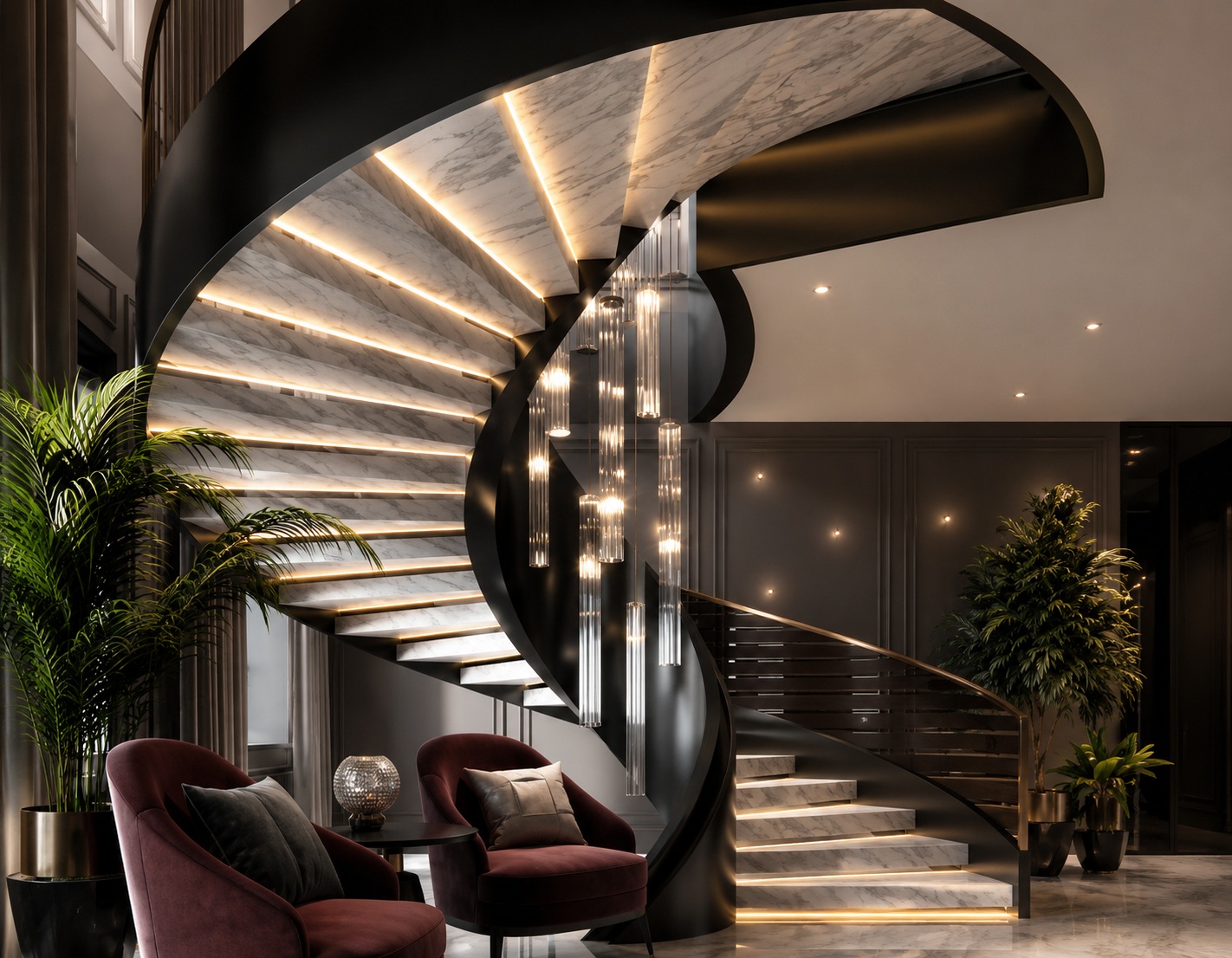
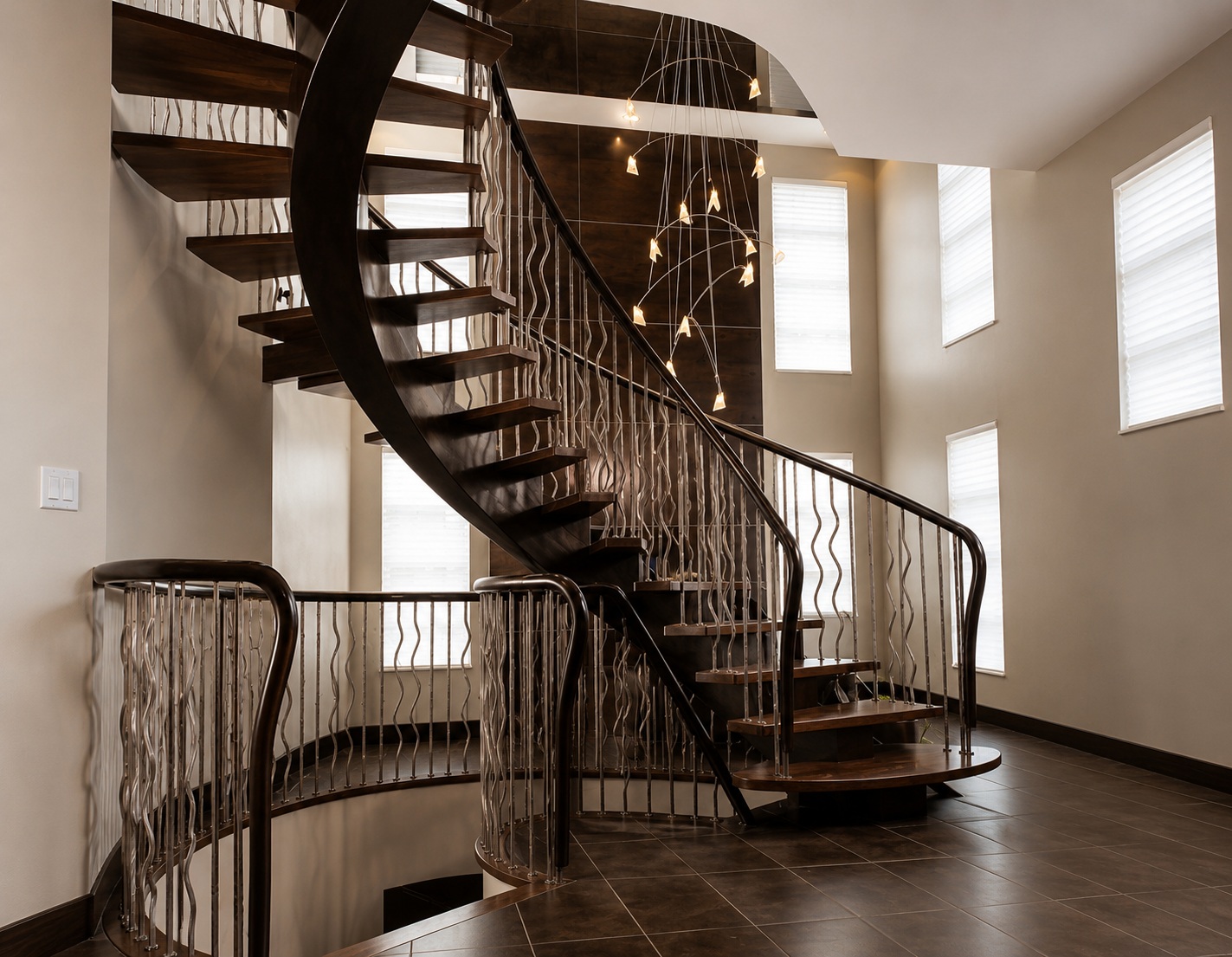
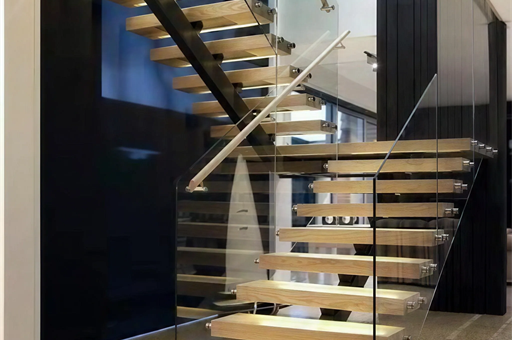
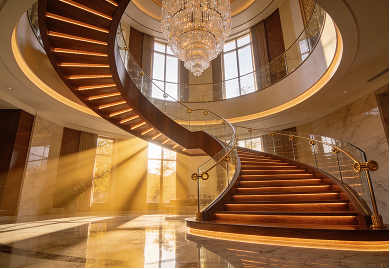
That freedom is why owners choose custom for a feature stair. You can set the tread depth and the rise to suit your ceiling height exactly. You also pick the structure that gives the look you want, and match the treads and railing to the rest of the home. A floating flight, a curved sweep, a mono-stringer, or a glass railing all become possible, because the maker shapes the stair to your geometry rather than pulls it from a shelf. The result reads as part of the home, not a part dropped into it.
The cost of that freedom is time and money. A bespoke stair takes longer than pulling a catalogue unit, because the maker has to draw, plan, and build it from scratch, and it usually costs more for the same reason. For a villa, a new build, or any feature stair, most owners find the fit and finish worth it. For a simple second flight, the sums can tilt the other way.
Fit: the Deciding Factor
Fit is the single point that settles most of these calls. A staircase has to land exactly between two finished floors, and the opening above it is rarely a tidy round number. Manufactured stairs come in set steps of size, so they fit best when your opening happens to match one of those standard sizes, give or take an adjustable bottom step. When the opening sits between those steps, a stock unit either misses the gap or fights it, and a forced stair is an awkward stair.
A custom staircase removes that problem, because the maker works out the rise and the going from your real height and your real opening. This matters most for a non-standard space, such as a high ceiling, a tight landing, an awkward turn, or a stair that has to clear a beam or a door swing. It also matters whenever the staircase is a feature, where every tread is on show and a slightly off shape jumps out to the eye. If your opening is irregular, custom is usually less a luxury than a need.
Materials and Design Freedom
Material choice is where the two paths split most plainly. Stock stairs offer the finishes the catalogue carries, which is usually a sound core range of common woods and a few metal or painted options. That covers a great many homes perfectly well. What it cannot easily do is match an unusual wood, a specific stone tread, a one-off paint colour, or a structure the catalogue simply does not list.
| Element | Custom vs catalogue |
|---|---|
| Structure | Stock leans to straight or standard switchback flights. Custom adds floating, curved, mono-stringer, and helical forms drawn for your space. |
| Tread material | Catalogue carries common woods and a few metals. Custom opens up specific timber species, stone, and laminated glass treads. |
| Balustrade | Stock offers set railing styles. Custom matches frameless glass, slim metal, or cable to the rest of the home. |
| Finish colour | Catalogue lists stock colours. Custom matches a specified powder-coat or stain to your joinery and floor. |
| Proportions | Stock uses fixed rise and going increments. Custom tunes tread depth and rise to your ceiling height for an even, comfortable climb. |
Design freedom is the headline reason owners go custom, and it runs deeper than looks. A drawn staircase lets you balance the shape across the whole flight, so the rise feels even underfoot and the treads sit well for your ceiling height. It also lets the stair echo materials elsewhere in the home, which is how a stair stops looking like a spare part and starts looking planned. A catalogue unit can look perfectly good; a bespoke stair can look like it always belonged.
Lead Time and Cost
Lead time is usually the most practical gap on a live project. Manufactured stairs move quickly, because the design already holds and the parts repeat, so a stock unit can ship on a short, steady schedule. A custom staircase takes longer, because the maker has to draw it, win your sign-off, plan it, and build it before the crate goes on a truck. If your programme is tight and the opening is standard, that speed is a real point in favour of a catalogue product.
Cost follows the same logic, and the only honest way to talk about it is in drivers, not numbers. A stock staircase sits at the lower entry point, because one shared tooling run spreads across many identical units. A custom staircase carries the drawing, the planning, and the one-off build, so it usually sits higher. Within custom, the drivers are the structure, the span, the tread material, and the railing. Because every made-to-order staircase grows from its own drawing, we do not publish a price; we quote each project on its own. For how the buying steps actually run, our guide to how to buy a staircase walks through the sequence.
A 2026 custom staircase factory tour — how we build and quality-check.
Side-by-Side Comparison
The table below sets the two paths next to each other on the factors that decide most projects. Read it as a guide to where each one is strong, rather than a verdict, because the right answer always rides on your own opening, budget, and design goal. Neither path wins across the board; they simply solve different problems.
| Factor | Manufactured stairs | Custom staircase |
|---|---|---|
| Fit | Standard increments; best when the opening matches a catalogue size. | Drawn to your exact height and opening, including non-standard spaces. |
| Design freedom | Choices limited to the catalogue range. | Structure, material, and finish all specified for your home. |
| Materials | Common woods and a few metal or painted options. | Specific species, stone, glass, and matched powder-coat finishes. |
| Lead time | Short and predictable; design already settled. | Longer; allows for drawing, approval, and one-off fabrication. |
| Cost driver | Lower entry point from standardisation. | Priced per drawing; structure, span, and material drive it. |
| Suits | Standard openings and simple replacements on a tight timeline. | Villas, new builds, feature stairs, and irregular openings. |
Which to Choose by Project Type
The cleanest way to decide is to read your project rather than the product. For a simple replacement, where you are swapping an old flight in a regular opening and the look you want is conventional, manufactured stairs often make the most sense. The fit is straightforward, the lead time is short, and the entry price is friendly. There is little to gain from a bespoke drawing when a catalogue unit lands cleanly in the space.
For a villa, a new build, or any project where the staircase has to catch the eye, the balance shifts to custom. These projects usually carry non-standard openings, higher ceilings, and a clear design goal, all of which favour a staircase drawn to fit. A batch renovation of apartments can go either way: matching, regular units may suit a stock approach, while a mix of layouts often needs made-to-measure work. When you are unsure, the deciding questions are simple. Is the opening standard? Is the stair on show? Is the timeline tight? If the first and third are yes and the second is no, stock makes sense; otherwise, custom usually wins. Our pillar guide on how to choose a custom staircase manufacturer takes that call further.
How a Custom Stair Is Made
At Double Building Materials, a custom staircase begins as a drawing, not a catalogue pick. We take your floor-to-floor height, the size of your floor opening, and your chosen look, then turn them into a working shop drawing that fixes every tread, the structure, and the railing. We cut nothing until you approve that drawing, because a made-to-order staircase leaves little room to fix a mistake later. With 25+ years of factory work and 800+ projects across 60+ countries, that drawing-first habit is how we keep a one-off stair on track.
From the approved drawing we build the structure and the treads, then trial-assemble the whole staircase on our 4,500 m² floor in Guangdong. That trial build is where we check the rise, the turn, and the fit of every step before anything ships, which is exactly the check the catalogue process settles in advance. Once it passes, we crate the staircase for export in the order your installer will want it. Your own contractor fits it on site from our drawings, and we can help you find one where local installation is available. We do not install on site or sign off local code; that stays with your local team. You can see the range we build on our custom staircase page.
Custom vs Manufactured Stairs FAQ
What is the difference between custom and manufactured stairs?
Manufactured stairs follow a fixed catalogue of sizes and finishes and ship from that standard range, so they fit a regular opening quickly and at a lower entry price. A custom staircase grows from a drawing made to your exact sizes and chosen materials, which lets it fit a non-standard space and become a feature stair. The split pits stock speed against tailored fit.
Are custom stairs worth the extra cost?
For a feature stair, a villa, or an irregular opening, most owners find a made-to-measure staircase worth it, because the fit, the shape, and the finish all improve where they show most. For a simple swap in a standard opening, a stock staircase often gives better value. The honest test is whether your space and your design goal truly need the freedom a custom build brings.
Can I get a custom staircase for a non-standard opening?
Yes, and that is exactly where custom earns its place. The maker works a bespoke staircase out from your real floor-to-floor height and the actual size of your opening. So it handles high ceilings, tight landings, awkward turns, and clearances that a fixed catalogue size cannot match. A stock unit forced into an irregular opening tends to read poorly and walk worse, so a drawn stair is the sound route.
Are prefabricated staircases lower quality than custom ones?
Not by default. Prefabricated staircases follow repeating sizes on settled tooling, which can make them very even within their range. The real gap is fit and freedom rather than build quality. A stock stair sticks to its catalogue sizes and finishes, while the maker shapes a custom staircase to your geometry and your materials, which is what an unusual space or a feature stair truly needs.
How long does a custom staircase take versus a stock one?
A stock staircase moves faster, because its design already holds and its parts repeat, so it ships on a short, steady schedule. A custom staircase takes longer, since the maker has to draw it, win sign-off, plan it, and build it before crating. If your programme is tight and the opening is standard, that speed favours a catalogue unit; if the stair is bespoke, the extra time buys the exact fit.
Keep reading in this cluster: our pillar on how to choose a custom staircase manufacturer and the step-by-step on how to buy a staircase. When you are ready to compare your options, browse the full custom staircase range.
Double Building Materials draws, manufactures, trial-assembles, crates, and ships your custom staircase. Your own contractor or installer handles on-site installation and local code sign-off — we can help you find one where available. Any dimensions mentioned are common references and any code points are typical US residential figures; your local adopted edition governs, so confirm the current version with your local team.
Talk to us on WhatsApp →