




Commercial Stair Width & Egress Requirements (IBC 1011 Explained)-Staircase Guides
Commercial Staircase · Width & Egress
Commercial Stair Width & Egress Requirements (IBC 1011 Explained)
Under common IBC references, the minimum commercial stair width is 44 inches, dropping to 36 inches where the stair serves fewer than 50 occupants. On larger floors the egress stair width grows with occupant load: you multiply the occupants served by a capacity factor, so a busy stair simply gets wider. Your local adopted edition governs the final figure.
A commercial staircase is part of the building’s escape route. Its width is set by how many people must use it, not by taste alone. This guide explains the commercial stair width rules in the International Building Code in plain words. We define each term first, then give the common figure. And we are honest about one point throughout: every number here is a widely cited reference, not the final ruling for your job.
Means of Egress, in Plain Terms
Before any number makes sense, two terms need defining. The whole chapter turns on them. The means of egress is the clear, unblocked path that lets people leave a building safely. It runs from any occupied point all the way to a public way outside. A commercial stair is one link in that chain. So the code treats it as life-safety equipment, not just a way to get around. The occupant load is the number of people a space is built to hold. The code sets it from the floor area and the use of the room.
These two ideas drive everything that follows. A stair forms part of the escape route. So its size is tied to the occupant load it must carry in an emergency. It is not set by how it looks, or by how often it is used on a calm afternoon. The International Building Code, or IBC, gathers these rules in Chapter 10. Section 1011 is the part that governs stairways. Throughout this guide, treat each IBC stairs figure as a common reference. The edition your area has adopted is the version that truly applies.
The Minimum Commercial Stair Width
The headline figure is the one most people search for first. Under common IBC references, the minimum commercial stair width is 44 inches. That is the baseline for a stairway that serves an occupant load of 50 or more, and it is wide enough for two lines of people to move at once. The width is measured clear, between the surfaces that actually narrow the path, so handrails and any projection count against it.
There is one widely used relaxation worth knowing. Where a stairway serves an occupant load of fewer than 50, the common IBC stair width reference drops to 36 inches. A small mezzanine office or a service stair to a plant room often falls under that lighter rule. So the minimum commercial stair width is really two numbers in one: 44 inches as the general case, and 36 inches for the lightly used exception. Which one applies to your project depends on the occupant load the stair must serve, and that load is the subject of the next section.
How Occupant Load Drives the Width
The 44-inch baseline is a floor, not a ceiling, because a single stair on a heavily occupied building may need to be wider still. The IBC sets the required egress stair width as the larger of two results: the fixed minimum just described, and a calculated capacity that scales with the occupant load. On a small building the minimum wins, so 44 inches is enough. On a large floor the calculation wins, and the stair grows accordingly.
This is the logic that protects a crowd. A theatre level holds several hundred people. It cannot empty through a 44-inch flight at a safe pace. So the code widens the egress stair width until it can. The occupant load also decides how many separate stairs a floor needs. That is a related topic we cover in the pillar. For the width of any one stair, the rule is simple. Take the larger of the minimum and the calculated capacity, and build to that. The math itself is the next section, and it is easier than it sounds.
The Egress Capacity Factor
The capacity calculation rests on one multiplier, the egress capacity factor. You take the occupant load the stair must serve and multiply it by a figure given in inches per occupant. The result is the egress stair width that crowd needs. Common IBC references give a capacity factor of 0.3 inch per occupant for stairways in most buildings, which expresses how much rail-to-rail room each person requires to descend safely.
A real reduction applies to fully protected buildings. Some buildings have a full sprinkler system and an emergency voice or alarm system throughout. There, the common reference factor falls to 0.2 inch per occupant for stairs. Those systems buy time and slow the spread of a fire. So a slightly narrower egress stair width stays safe. A worked example makes the idea clear. At 0.3 inch per occupant, a stair serving 300 people works out to 90 inches. In a fully sprinklered building at 0.2 inch, the same crowd works out to 60 inches. The designer then checks that figure against the 44-inch minimum and builds to whichever is larger. We treat these factors as references. Your engineer applies the exact value your area has adopted.
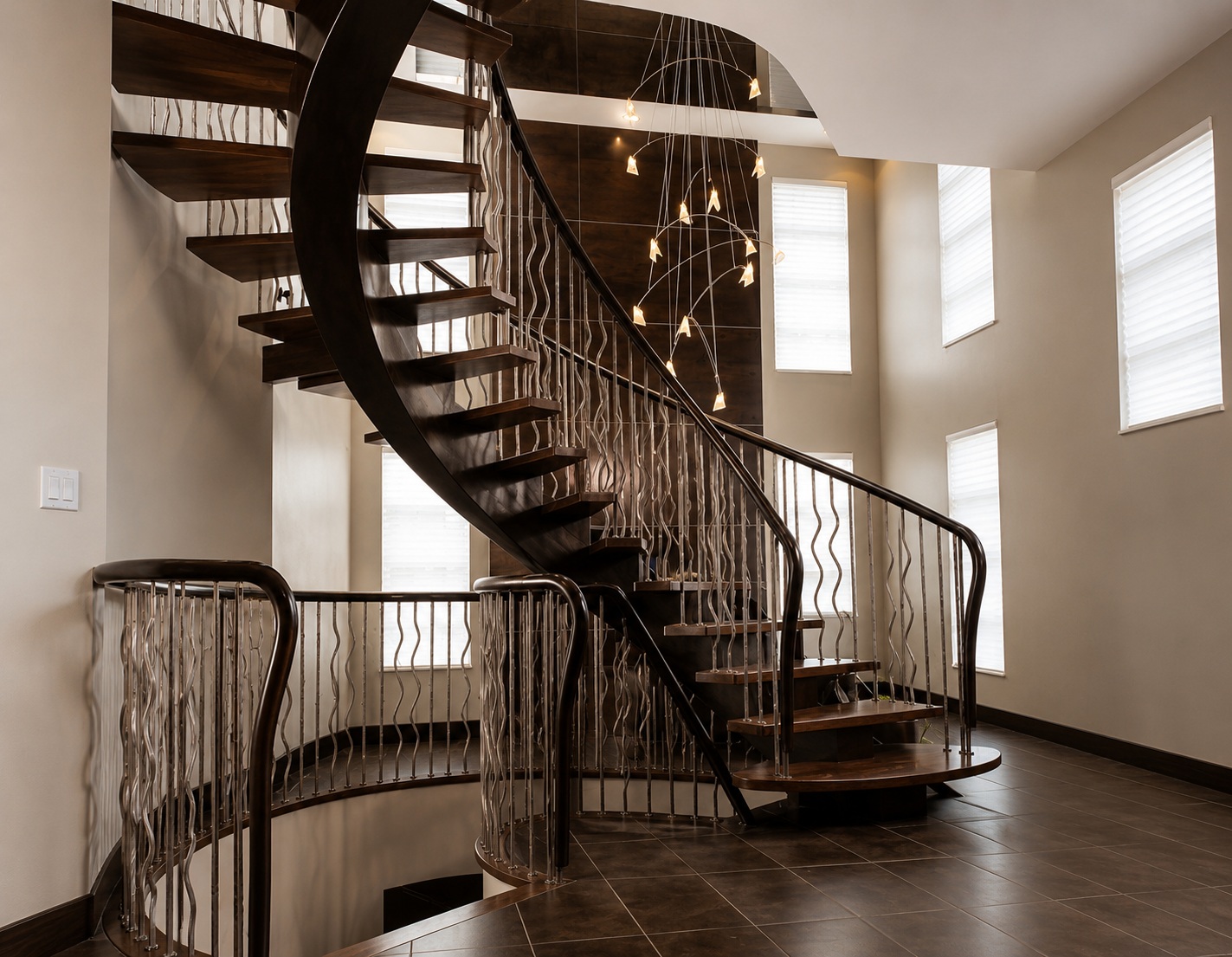
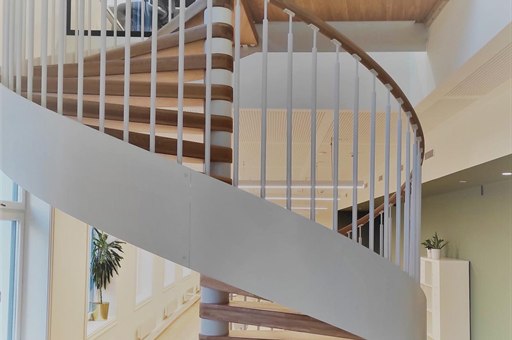
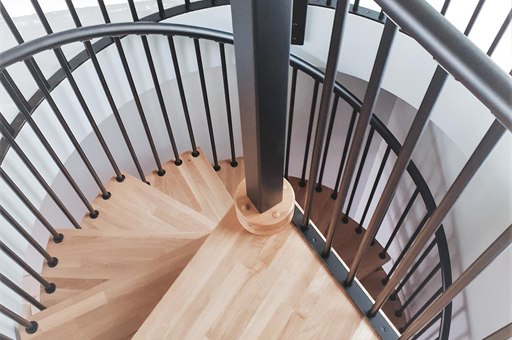
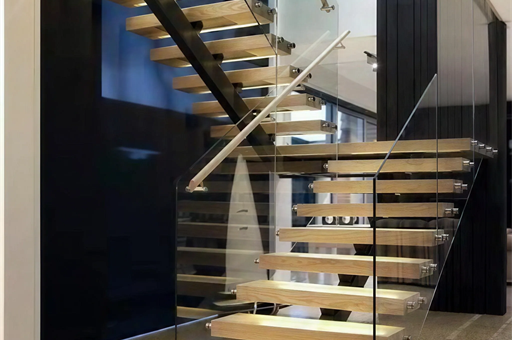
Architectural staircase designs, from villa to commercial, by Double Building Materials.
Riser, Tread, and Uniformity
Width is the headline, yet the step geometry sits right beside it in the same section, and it shapes how a commercial stair feels underfoot. The riser is the vertical face between one step and the next; the tread depth is the horizontal run your foot lands on. Common IBC references cap the riser at 7 inches maximum and 4 inches minimum, and they ask for a tread depth of at least 11 inches. Those proportions give a gentler, more generous climb than a tight residential stair.
A matching rule prevents falls. Within a single flight, the common reference lets the risers vary by no more than three-eighths of an inch. The treads may vary by the same small amount. The point is that your foot meets the same shape on every step, so the rhythm of the climb never surprises you in a hurry. When we draw a commercial stair, we lock the riser, the tread, and that tight tolerance into the shop drawing first. They anchor every dimension that follows. The matching rail rules sit in our guide to commercial stair handrail height.
Landings and Clear Width
A long commercial flight is broken by landings, the level platforms that interrupt the climb and give a place to pause or change direction. The IBC asks for a floor or landing at the top and the bottom of every stairway, and it limits how far a flight may rise before a landing is required. A landing also has to be at least as wide as the stair it serves, so the egress stair dimensions stay consistent and the path never pinches at the turn.
Headroom belongs in the same conversation, because it is part of the clear path. Common IBC references set the minimum headroom on a commercial stair at 6 feet 8 inches, measured straight up from a line along the tread nosings. Read together, the width, the landings, and the headroom describe a corridor in three dimensions that a crowd can move through without obstruction. We check all of these egress stair dimensions on the drawing before any steel is cut. A stair that is short on clear width or headroom is hard and costly to fix once it is built.
Reference Table and How We Use It
Here are the common IBC commercial stair references in one place. Read every figure as a widely cited value drawn from the IBC Chapter 10 means-of-egress provisions, not as the ruling for your project. The edition adopted in your jurisdiction is what actually governs, occupancy type can change the figure, and local amendments do occur.
| Commercial stair requirement | Common IBC reference value |
|---|---|
| Minimum width (occupant load 50+) | 44 inches clear. |
| Minimum width (occupant load under 50) | 36 inches clear. |
| Egress capacity factor | 0.3 inch per occupant; 0.2 inch in a fully sprinklered building with voice alarm. |
| Riser height | 7 inches maximum, 4 inches minimum. |
| Tread depth | At least 11 inches. |
| Riser and tread uniformity | Vary no more than three-eighths inch within a flight. |
| Minimum headroom | 6 feet 8 inches from the nosings. |
Here is how we work with that table, and where the line sits. At Double Building Materials, we fabricate each commercial stair to the engineer’s stamped drawing and to the local code your project is built under. We draw the geometry to these reference values, trial-assemble the whole stair on our Guangdong floor, then crate it for export. We do not verify or certify code compliance ourselves; that sign-off belongs to your engineer and your local building official. The wider picture, including how many stairs a floor needs, sits in our pillar guide to commercial staircase code and design, and you can see the stairs we build on our staircase range.
Commercial Stair Width FAQ
What is the minimum commercial stair width under the IBC?
Common IBC references set the minimum commercial stair width at 44 inches, measured clear, for a stairway serving 50 or more occupants. Where the stair serves fewer than 50 occupants, the reference drops to 36 inches. On heavily occupied floors the required width can be larger again, because it must also satisfy the calculated capacity. Your local adopted edition governs the final figure.
How is egress stair width calculated from occupant load?
You multiply the occupant load the stair serves by the egress capacity factor, commonly 0.3 inch per occupant, or 0.2 inch in a fully sprinklered building with a voice alarm. That gives the required egress stair width for the crowd. The designer then compares it with the fixed minimum and builds to whichever is larger. The exact factor depends on the edition adopted locally.
What riser and tread does the IBC require for commercial stairs?
Common IBC references cap the riser at 7 inches maximum and 4 inches minimum, with a tread depth of at least 11 inches. Within a single flight, the risers and the treads may each vary by no more than three-eighths of an inch, so the climb stays even. These IBC stairs figures are references; confirm the current values with your local building official.
Are commercial stair width rules the same as residential?
No. Commercial stairs follow the IBC and are sized for egress, so the minimum commercial stair width and the gentler riser and tread reflect the need to move a crowd. Residential stairs follow the IRC, which permits a narrower stair and a steeper step. The two codes serve different buildings, so always work to the one your jurisdiction has adopted for your project.
Does DBM certify that a commercial stair meets my local code?
No. We fabricate your commercial stair to the engineer’s stamped drawing and to the local code your project is built under, then trial-assemble and crate it for export. Verifying and signing off code compliance belongs to your engineer and your local building official. We can help you find a local installer where available, but the code sign-off stays with your local team.
Read more in the commercial cluster: start with the pillar on commercial staircase code and design, then set the rail with our guide to commercial stair handrail height. Or browse the stairs we manufacture on our staircase range.
Double Building Materials draws, manufactures, trial-assembles, crates, and ships your commercial stair to the engineer’s stamped drawing and your local code. Your own engineer and local building official verify and sign off code compliance — we do not, and we can help you find a local installer where available. Every code value above is a common IBC reference; occupancy and your local adopted edition govern, so confirm the current version with your local team.
Talk to us on WhatsApp →