

How Much Does a Curved Staircase Cost? Price Drivers Explained-Staircase Guides
Curved Staircase · Cost
How Much Does a Curved Staircase Cost? Price Drivers Explained
Curved staircase cost depends on the curved stringer, the radius and size, the tread material, the railing, and the storey height, not on one fixed price. A curved stair sits at the top of the staircase price range, because its curving stringer is the hardest part of the whole structure to fabricate. Every curved staircase is made to order, so your real figure comes from the drawing.
If you are budgeting a curved staircase, the honest answer arrives in pieces. The price comes from several separate drivers, not from a single published number. This guide walks through every factor that moves the figure up or down. That way, you can picture where your own design is likely to land before anyone draws it. We do not publish a quote, because a made-to-order stair has none until we draw it. Where we name a dollar range, it comes from third-party market sources, not from us.
Why a Curved Staircase Cost Has No Single Number
The first thing to understand about a curved staircase cost is that no honest maker can quote a figure before you configure the stair. A curved staircase is not a catalogue product with a sticker price. We build it around the exact height of your floors, the sweep of the curve you want, the width of the flight, and the materials you choose. Change any one of those, and the figure moves with it, sometimes by a considerable margin.
This is why two curved staircases that look similar in a photograph can sit at very different prices. A gentle single sweep in painted timber and a grand double-curve centrepiece in stone and glass belong at opposite ends of one category. So the honest way to picture cost is not as a number. Picture it as a set of factors you can adjust. Once you understand which factors carry the most weight, you can read your own design and form a fair expectation before you request a quotation.
Throughout this guide, we show the way each factor pushes the budget, rather than inventing prices. Where we cite a dollar range, we draw it from third-party market sources and label it that way. As a made-to-order manufacturer, Double Building Materials prices each curved staircase from its finished drawing. That drawing is the only figure that genuinely fits your particular project.
Are Curved Staircases More Expensive?
In general, yes. Independent cost guides agree, and they place the curved staircase at the top of the staircase price range, above straight, floating, and spiral stairs. The reason is structural rather than visual. A straight flight runs along two straight stringers, which are fairly simple to cut and fit. A curved staircase asks its stringers to bend smoothly through the rise, and that is a much harder piece of work.
That single difference flows through the whole project. The curving frame needs more design, more skilled labour, and more exact fitting than any straight stair. The handrail must follow the same flowing curve, so it is shaped to order rather than cut from stock. Even the treads vary slightly along the sweep. None of this makes a curved staircase a poor buy; it simply shows why the shape sits in the upper band, and why its price comes from craft more than from raw material weight.
The Price Drivers at a Glance
A handful of factors do most of the work in setting a curved staircase price. The table below names each one and shows what tends to raise it and what tends to lower it. None of these entries are prices; they are the levers that determine where your own configuration sits within the band. The sections that follow expand on the most influential drivers in turn.
| Cost driver | What raises it | What lowers it |
|---|---|---|
| Curved stringer | A tight or compound curve needs intensive shaping and skilled fabrication. | A gentle, generous radius is comparatively simpler to build. |
| Radius and size | A larger sweep and a wider flight consume more material throughout. | A modest width and footprint keep the quantities contained. |
| Tread material | Natural stone, laminated glass, or premium hardwood treads cost more. | Painted timber or standard hardwood treads keep the surface modest. |
| Railing | Curved glass panels or forged ironwork add material and labour. | A slim metal balustrade is the lightest railing option. |
| Single vs double curve | A double curve doubles the demanding geometry and the fitting work. | A single continuous sweep is the more economical form. |
| Storey height | A taller floor-to-floor height adds treads and lengthens the stringer. | A standard storey keeps the tread count predictable. |
| Finish detail | Hand-applied finishes and ornamental detailing are labour-intensive. | A clean, contemporary profile carries no ornament premium. |
Read the table as a budget map rather than a price list. If your configuration sits in the left-hand column on several drivers at once, the total climbs accordingly. If it sits on the right, the total stays more contained. Most real projects fall somewhere in between, which is precisely why the final figure has to come from a drawing rather than from a guess.
The Curved Stringer, the Costliest Part
The stringer is the structural spine that carries every tread, and on a curved staircase it is the single most costly part to make. A stringer is the sloping beam that runs up the side of a stair and holds the steps. On a straight flight it is a simple sloping beam. On a curved stair it must bend smoothly through the rise while staying true to the radius, which is one of the hardest jobs in the whole trade.
Shaping that curve takes special skill and time. The material is bent, glued, or built up in stages, then checked against the curve so the sweep stays true from bottom to top. Any error shows at once on a curve, far more than it would on a straight run, so the tolerance is tight and the work is slow. This depth of skilled labour is the core reason a curved staircase sits above other shapes. When you grasp the stringer, you grasp most of the price. We explain the wider layout in the pillar guide to what a curved staircase is.
Radius, Size, and Storey Height
After the stringer itself, the shape of the curve drives cost more than almost anything else. The radius describes how tightly the staircase turns. A wide, sweeping radius is more forgiving to build, while a tight radius forces the frame and the handrail through a sharper bend that takes more careful work. The overall size matters too, because a wider flight and a longer sweep use more material in every tread, every stringer section, and every railing run.
The storey height adds the upright side to all of this. A taller floor-to-floor height simply needs more treads to climb it, and a longer stringer to carry them around the curve. A standard storey gives a tread count you can predict, while a double-height entrance hall raises both the steps and the load on the frame. When you balance the radius and the width against the space you can give the stair, you are also balancing presence against budget. Our companion guide to curved staircase design works through radius, shape, and layout in detail.
Tread Material
The treads are the surface you see and touch on every step, and the material you select for them is a major lever on the budget. Painted timber treads sit at the more economical end, and standard hardwood treads on a curved timber structure are a popular, warm combination that suits most homes. The species, the grade, and the finish each shift the figure within the timber range, so even a wooden tread offers room to manage cost.
Laminated glass treads and natural stone treads carry the look further, and the price with it. Glass needs precise detailing and a slip-resistant surface, and on a curve each panel relates to the sweep, which adds work. Stone is heavy, and harder to cut and fix accurately to a curving frame. Both produce a striking staircase, and both sit at the top of the tread range. The sensible move is to match the tread to the room. A warm timber tread suits most settings, while the costlier surfaces earn their place where the stair is a genuine feature.
Railing: Glass or Forged Iron
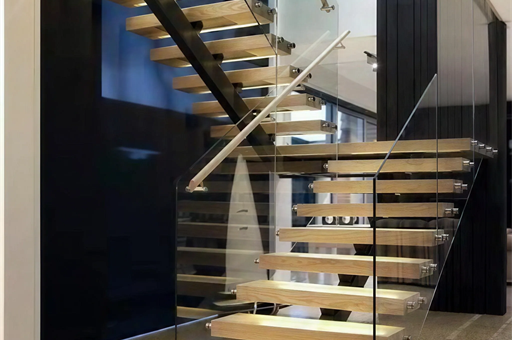
The railing follows the full length of a curved staircase, so its style influences cost more than its modest size suggests, and on a curve the geometry raises the work further. A slim metal balustrade is the lightest and most economical option, and it suits a clean, contemporary stair. Curved glass panels cost considerably more, because each panel has to be shaped to the precise radius of the staircase and detailed carefully. A curving run is inherently more demanding to make than a straight one.
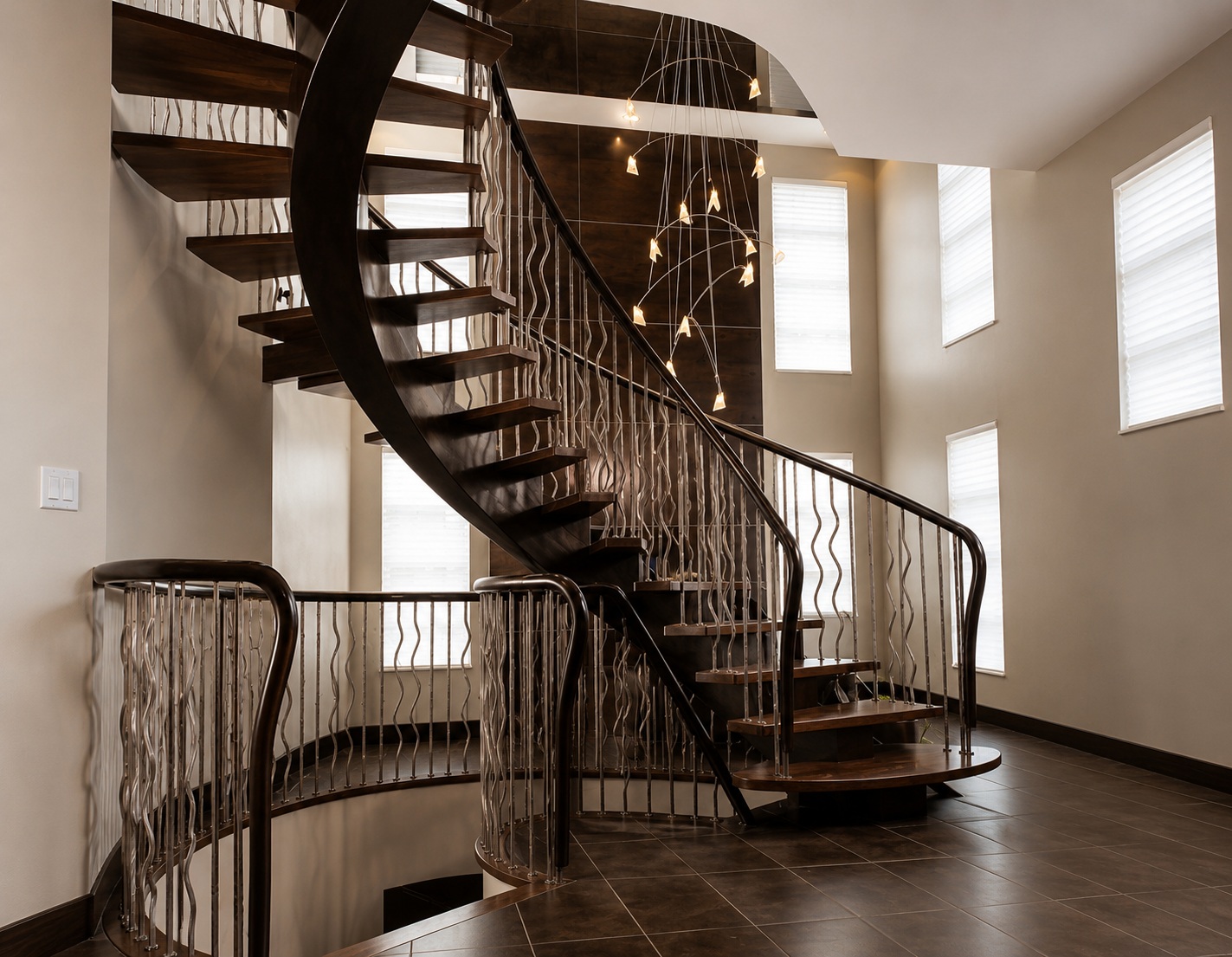
Hand-forged iron is where ornamental work makes the largest difference. Scrollwork, twisted balusters, and decorative detailing are labour-intensive by nature, and following them around a continuous curve compounds that labour. The craftsmanship is reflected directly in the figure. A forged-iron curved staircase is a beautiful, characterful object, and it is also one of the more expensive routes available. A clean, modern profile carries no ornament premium at all, so the railing is one of the clearest places to dial the budget up or down to taste.
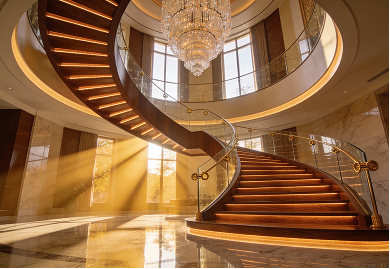
A curved glass staircase with wood steps — installed and ready.
Single Curve Versus Double Curve
The number of curves is a clear divide in curved staircase cost. A single-curve staircase sweeps in one continuous arc from one floor to the next, and it is the more economical of the two forms. The structure turns once, the handrail follows one curve, and the fabrication, while still demanding, is contained to a single radius. For many homes, an elegant single sweep delivers the whole impression of a curved stair at the lower end of the range.
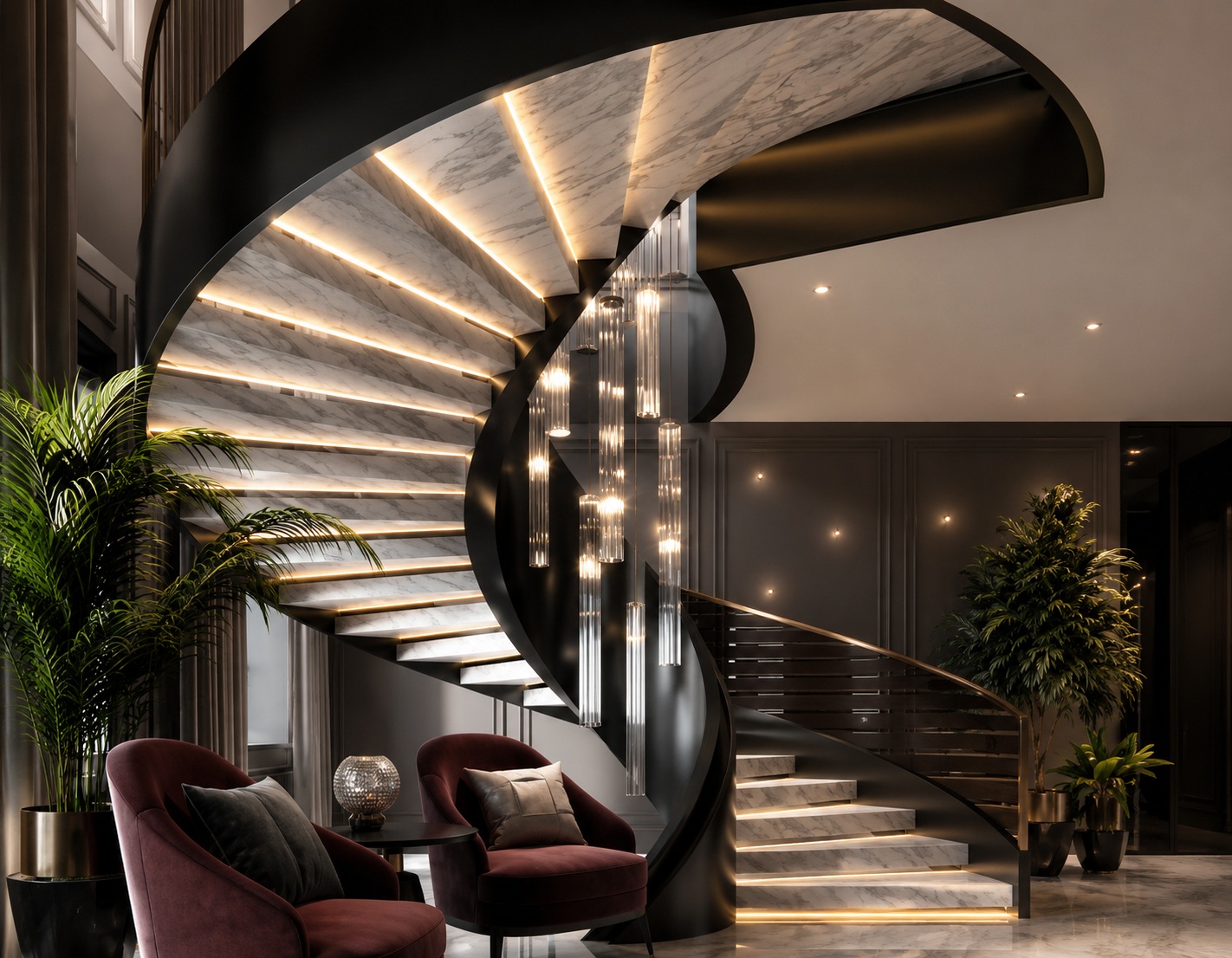
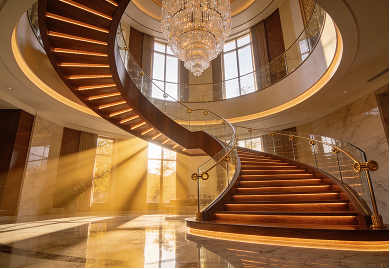
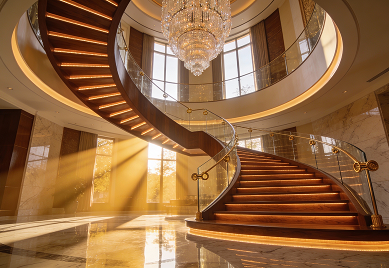
A double-curve staircase, sometimes arranged as a sweeping double-flight or a returning curve, effectively repeats the hardest work. Two curving stringers, two shaped handrail runs, and twice the precise fitting all add to the figure. The grand, symmetrical double staircase that anchors a large entrance hall is the most involved curved form, and it sits firmly at the top of the price band. If a bold statement is the goal, the double curve delivers it, at a premium that reflects the additional geometry rather than any single luxury material.
Third-Party Market Ranges, in Context
Many buyers want at least a rough order of size before they begin, so here is the careful version. Independent home-improvement cost guides commonly place a custom curved staircase well into five figures, with simpler examples starting in the high single-digit thousands and large, ornamental, stone-and-glass installations rising past one hundred thousand dollars. Those guides also rank the curved shape as the most expensive staircase type. Those figures are a third-party market estimate, not our quote. General renovation sources publish them, not us.
Treat any such range as a wide indicator and nothing more. It blends together different countries, vastly different specifications, and everything from a modest single curve to a grand double staircase, so it cannot describe your particular project. The drivers above are what actually move your figure within that broad band, which is why a drawing always beats a published average. We never publish our own price list, because every curved staircase we build is made to order and costed individually from the finished design.
How to Manage the Budget
If you want a striking curved staircase without an unlimited budget, a few choices carry most of the savings. Selecting a single continuous curve rather than a double staircase is the largest single economy available, because it halves the most demanding fabrication. Choosing a generous radius over a very tight one keeps the stringer and handrail work more straightforward. Timber treads instead of stone or glass, and a slim metal balustrade rather than forged ironwork, then keep the surfaces affordable. None of these choices compromises the staircase; they simply concentrate the budget where it shows the most.
At Double Building Materials, a curved staircase begins as a shop drawing, not a kit. We take your floor-to-floor height, your floor opening, and your chosen radius and width, then draw the curving stringer, every tread, and the handrail before any material is cut. That drawing is also where the price becomes real, because it fixes every quantity in the design. We then fabricate, trial-assemble the whole staircase on our Guangdong factory floor, and crate it for export in the order your installer needs. Your own contractor fits it on site, and we can help you find one where local installation is available. The full sequence appears in our guide to what a curved staircase is, and you can browse the range on our curved staircase page.
Curved Staircase Cost FAQ
How much does a curved staircase cost?
There is no single price, because a curved staircase is made to order around your radius, size, height, and materials. Third-party renovation guides commonly span from the high single-digit thousands for a simpler custom curve into six figures for a large, ornamental installation, but that is a third-party market estimate, not our quote. The genuine figure for your project comes from its finished drawing.
Are curved staircases more expensive than other staircases?
Generally yes. Independent cost guides rank the curved staircase as the most expensive staircase shape, above straight, floating, and spiral stairs. The reason is the curving stringer, which is the hardest part of any stair to fabricate accurately. That concentration of engineering and skilled labour, rather than raw material weight, is what places curved stairs at the top of the range.
What is the biggest factor in curved staircase cost?
The curved stringer is usually the largest single factor, because shaping a beam to follow the sweep accurately demands specialised skill and time. After the stringer, the radius and overall size set the quantity of material, while the tread material and the railing style decide the finish. A double curve, which repeats the hardest work, then moves the figure higher again.
Is a double-curve staircase much more expensive than a single curve?
Typically yes, because a double curve essentially repeats the most demanding fabrication. Two curving stringers, two shaped handrail runs, and twice the precise fitting all add to the figure. A single continuous sweep delivers much of the same impression at the lower end of the range, which is why a single curve is the more economical choice for most homes.
Why will a manufacturer not give a price upfront?
Because a made-to-order curved staircase has no price until it is configured. The figure depends on the exact radius, the size, the height, the stringer, the treads, and the railing, so a number quoted before the drawing would be a guess. A reputable manufacturer prices from the finished shop drawing, which is the only document that reflects every quantity in your particular staircase.
Read more in the cluster: start with the pillar on what a curved staircase is, then shape your project with the curved staircase design guide. When you are ready, browse the full curved staircase range.
Double Building Materials draws, manufactures, trial-assembles, crates, and ships your curved staircase. Your own contractor or installer handles on-site installation and local code sign-off — we can help you find one where available. Dollar figures above are third-party market estimates, not our quote; we price each made-to-order curved staircase from its finished drawing. Any code or dimension values are common US residential references, and your local adopted edition governs, so confirm the current version with your local team.
Talk to us on WhatsApp →