

Modern Balcony Railing Design: Materials, Styles & How to Get the Look Right-Railing Guides
Balcony Railing Guides · Modern Design
Modern Balcony Railing Design: Materials, Styles & How to Get the Look Right
Modern balcony railing design favours clean horizontal lines, slim profiles, and open views. The usual ways to get the look are frameless glass panels, tensioned cable, or slim metal posts. The style favours clear sight and good proportion over decorative detail, so the railing protects the edge while it nearly disappears. That keeps the building and the view as the main thing you see from the balcony.
A balcony railing is the most visible safety part on a wall, so its design carries real weight. This guide walks through the materials, infill styles, and proportions that define a modern look. It covers indoor and outdoor locations, the trade-offs of each style, and the regulatory and cost factors behind every project. Where a topic runs deep, we link out to a focused guide.
What Makes a Modern Balcony Railing Design
A modern balcony railing is set less by one material than by how you treat the edge. The main idea is restraint, which means fewer upright bars, slimmer shapes, and a side-to-side emphasis. This stretches the wall out rather than chopping it into bits. An old railing shows off with turned posts and scrollwork, but a modern one tries to step back. It lets the view, the building, and the daylight do the talking.
That restraint shows up in three steady ways. Clear sight comes first, through glass you see straight through, or thin cable lines the eye reads past. Slim shape comes second, with handrails and posts kept thin so the whole thing feels light. Clean form comes third, with plain rectangles and long lines over detail. Get those three right and almost any material can look modern.
It also helps to be honest about what restraint costs. A clean railing hides nothing, so every weld, every fixing, and every joint is on show and has to be neat. The simpler the design looks, the more exact the work behind it must be. That is the quiet trade of a modern look: you get calm on the balcony, but tight margins back in the workshop.
The Materials Behind the Modern Look
Material choice sets both the character and the maintenance of a modern balcony railing. Most designs settle on one of four families, each with its own personality. Glass gives the cleanest, clearest edge, while stainless steel and aluminium give crisp metal lines that hold a clean shape. Tensioned cable makes an almost invisible side screen. The table below sums up how each one behaves and where it suits a balcony.
| Material | Modern character and where it suits |
|---|---|
| Tempered / laminated glass | The most transparent option, frameless or slim-framed. Ideal where the outlook is the feature; needs periodic cleaning to stay pristine. |
| Stainless steel | Crisp, corrosion-resistant metal lines for posts, handrails, and frames. Grade 316 is the common choice near coastal or humid environments. |
| Aluminium | Lightweight, powder-coated, and low maintenance. A practical frame for glass infill or a minimalist picket pattern, available in many colours. |
| Stainless cable | Tensioned horizontal lines that nearly vanish at a distance. Highly modern; spacing and tension are governed by code and must be detailed carefully. |
Many of the most striking balconies mix these rather than pick just one. A common pair is a stainless or aluminium frame that holds frameless glass. This keeps the strength and slimness of metal while it saves an open view. We cover the full range of options in the balcony railing materials and types guide.
Modern Infill Styles Compared
Infill is the part that fills the gap between the top rail and the floor, and it is what people see first from across a room or a yard. Three infill styles lead modern balcony design, and each one gives a clearly different feel. Frameless glass gives a smooth, almost liquid clarity, while side cable makes a fine ruled screen. Upright bars with slim square pickets read as ordered and clean rather than fancy.
Glass suits a balcony where the view is the prize, such as water, a garden, or a city skyline, since it takes away every break in the sight line. Cable suits a wider run where you want to feel the breeze and read straight through the railing, and it is a favourite on modern timber and steel walls. Slim upright bars suit owners who want a calm, ordered rhythm without classic posts, and they often cost less than glass.
There is no single right answer. The right infill follows the building and the way the balcony is used. A frameless glass balcony reads as rich and open, which is why it leads high-end home design. If glass appeals, our glass balcony railing guide covers the systems, the safety glass, and the detailing in depth.
Proportion, Sightlines, and Detailing
Modern design lives or dies on proportion. The handrail shape, the post width, and the gaps between parts shape the final look more than the material does. A handrail that is a touch too thick, or posts set too close, drags a railing back toward a heavy, dated look. The modern habit is to make every part as slim as the structure safely allows, then stop.
Sight lines need the same care. You usually see a balcony railing at eye level from inside the room, so the designer thinks about what the eye crosses to reach the view beyond. Frameless glass gives the clearest sight line, cable the next clearest, and posts the most. Detailing finishes the job, since hidden fixings, flush base channels, and long handrail runs all make the railing feel like one calm move, not a pile of parts.
This is just where drawing-first coordination earns its keep. Slim parts and hidden fixings only work when the loads, the glass thickness, and the joint details are sorted on paper before anything is cut. A clean railing is a hard problem dressed as a simple one. Treating it that way from the first drawing is what keeps the result both safe and neat.
Indoor Juliet vs Outdoor Balcony
A modern balcony railing has two common homes, and each asks for slightly different thinking. A Juliet balcony is the shallow guard set across full-height doors or an inner void, so it is almost purely a design feature. Here clear sight matters most, and frameless glass or a single sweep of cable lets the opening read as a clean box of light. The railing guards the threshold without adding bulk to the wall.
An outdoor balcony you actually stand on shifts the focus toward weather and long life. Salt air, rain, and sun all attack finishes over time, so the material choice is about how long it lasts as much as how it looks. Grade 316 stainless steel, marine-grade aluminium, and good powder coatings are the common answers where the climate is harsh, and laminated glass is usually the pick for open outdoor guards.
The visual style stays the same in both spots, even as the build details change. A clean, clear, side-stressed railing reads as modern whether it spans a Juliet opening on the second floor or wraps a rooftop deck. The art is to hold that visual look while you pick the right grade and finish for where the railing really lives. That call is best made on the drawing.
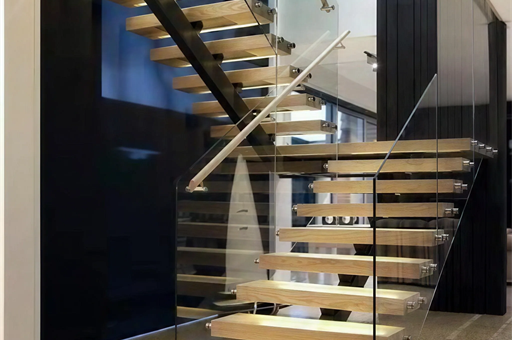
A modern mono-stringer stair with frameless glass railing we built — the same clean glass detailing carries straight onto a balcony. Tap to play.
Code, Height, and Safety
A modern look never beats the safety rules, and those rules shape what a slim railing can do. Under common US home references, a balcony guard is usually at least 42 inches tall, while many indoor home guards sit at 36 inches; the figure that governs depends on the use and the local area. The infill is also limited so a small child cannot slip through, and the well-known rule is that a 4-inch ball must not fit through any gap.
| Common reference requirement | Typical value (confirm local edition) |
|---|---|
| Guard height, residential exterior balcony | Commonly 42 in (IRC / IBC references); 36 in often applies to certain interior residential guards. |
| Opening / infill limit | No 4-inch sphere may pass through; tighter limits apply near the base on some guards. |
| Glass type for guards | Safety glazing (tempered or laminated) per IBC / AS 1288 where adopted; laminated often required for frameless guards. |
| Load resistance | Guards must resist a specified concentrated and distributed load; the adopted edition and the NCC (Australia) set the figures. |
These are widely used reference values, not a stand-in for your approved drawings. The figures that govern come from your local adopted code edition, so confirm the current version with your local team or building official. Cable railings have their own spacing and sag rules, and frameless glass guards have their own glass rules, but a good shop drawing sorts both before any work starts. The balcony numbers live in our balcony railing height and code guide.
How a Modern Railing Is Built
At Double Building Materials, a modern balcony railing starts as a drawing, not an off-the-shelf kit. We take your balcony sizes, the mount type, and your chosen material and infill, then turn them into a working shop drawing. That drawing fixes the post spacing, the glass or cable spec, the handrail shape, and every fixing before any metal is cut. We cut nothing until you sign off, because a slim design leaves little room for a fix on site.
From there we make the parts and trial-build the railing on our 4,500 m² Guangdong floor. That trial build before packing is where we check the fit, the line-up, and the finish before anything ships. It matters most on slim minimalist designs, where one post out of line is easy to spot. Once it passes, we use export-ready crating so the parts arrive safe and in the order your installer needs. With 25+ years of factory work and 800+ projects across 60+ countries behind us, that drawing-first order is just how we work.
Your own contractor or installer fits the railing on site from our drawings, and we can help you find one where local install is on offer. We do not install on site or sign off local code, so that duty stays with your local team. You can see the modern balcony, stair, and deck railings we make on our balustrade and railing systems page.
What Modern Designs Cost
A modern balcony railing covers a wide price range, and your design choices drive it. Because every railing is made to order, there is no single price tag; there are drivers. The biggest is the infill, since frameless glass usually sits at the high end, due to the thick safety glass and exact fittings, while a slim metal picket pattern is usually cheaper. Cable falls in between, with the hardware and tensioners adding to the metalwork.
A few other things move the figure. The material grade matters, since marine-grade 316 stainless costs more than plain aluminium, and the length of the run, the number of corners, and a tricky mount all add labour and material. A taller 42-inch guard uses more material than a 36-inch one, and custom finishes, special powder-coat colours, and curved sections elevate the figure considerably.
Treat any dollar figures you find online as third-party market guesses, not our quote. They cannot know your design, your length, or your shipping. As a made-to-order manufacturer, we price each project from its approved drawing and crating plan. The honest way to budget a modern balcony railing is to settle the infill and material first, then ask for a project quote.
Modern Balcony Railing FAQ
What is the most modern balcony railing material?
Frameless tempered or laminated glass is widely seen as the most modern balcony railing material. It guards the edge while it stays almost invisible. Tensioned stainless cable and slim powder-coated metal posts are close behind. The modern feel comes less from any one material than from clear sight, slim shapes, and clean side lines. So several materials can read as modern when they are detailed well.
How tall does a modern balcony railing need to be?
Under common US references, an outdoor balcony guard is usually at least 42 inches tall. Some indoor home guards are allowed at 36 inches. The height that governs depends on the use and the local area. So a modern design must hit the required figure no matter how slim it looks. Your local adopted code edition governs, so confirm the current value with your local team.
Is glass or cable better for a modern balcony?
Both are firmly modern, and the choice follows the setting. Glass gives the most complete clear sight and a rich, sheltered feel. That suits a prized view or a high, open balcony. Cable gives a finer, airier screen that lets the breeze through. It reads well on side-lined timber and steel walls. Glass usually costs more and needs cleaning. Cable needs a tension check now and then.
Can a modern railing work on an older home?
Yes, and the contrast is often striking. A slim glass or cable balcony railing can update an old wall without taking it over, above all when the metal finish picks up a colour already on the building. The key is proportion. Keep the handrail and posts slim so the modern railing works with the older style rather than fights it.
Does a modern balcony railing cost more than a traditional one?
It depends on the infill rather than the era of the look. A frameless glass design usually costs more than fancy ironwork, due to the safety glass and exact fittings. A slim metal picket pattern can cost less than detailed old posts. Price tracks the material, the infill, the run length, and the finish, so settle those before you budget.
Continue exploring the cluster: start with the pillar on balcony railing ideas, then read the glass balcony railing guide and our overview of balcony railing materials and types. When you are ready to specify, browse the balustrade and railing systems we manufacture.
Double Building Materials draws, manufactures, trial-assembles, crates, and ships your balcony railing. Your own contractor or installer handles on-site installation and local code sign-off — we can help you find one where available. Dimensions and code values above are common US references (IRC / IBC / ADA / OSHA; AS 1288 / NCC where relevant); your local adopted edition governs, so confirm the current version with your local team.
Talk to us on WhatsApp →