

Curved Staircase Design: Shapes, Layouts & Plans Explained-Staircase Guides
Curved Staircase · Design
Curved Staircase Design: Shapes, Layouts & Plans Explained
Curved staircase design shapes a flight along a sweeping arc instead of straight runs and sharp landings. The radius sets how gentle or tight the curve feels, the layout fits the arc to your entry or foyer, and the treads widen along a walking line. A continuous railing then follows the sweep as one flowing line.
A curved stair is the most sculptural staircase you can put in a home, and it earns that drama through careful geometry rather than a flattering render. This guide walks through how the design works: the radius and the sweep, gentle curves against tight ones, single and double-curve grand stairs, and how the arc settles into an entry. It then covers the floor opening, the headroom along the curve, the tread proportions, and the railing that ties it all together.
What Curved Staircase Design Means
Curved staircase design is the art of carrying a flight up along a smooth arc rather than a straight line broken by landings. The treads turn continuously as you climb, so the stair sweeps through the room like a ribbon and reads as one flowing gesture. It is the configuration architects reach for when a staircase is meant to be the centrepiece of an entrance, not merely a route between two floors.
It helps to separate a curved stair from its cousins early, because the names overlap in everyday use. A curved staircase follows a broad, open arc with a generous radius. It usually feels gracious and easy underfoot. A spiral staircase winds tightly around a central column in the smallest possible footprint. A helical stair curves around an open well with no column at all. That makes it the most demanding shape of the three to engineer, and the closest relative of a grand curved flight.
The appeal of curved staircase design is mostly emotional before it is technical. The eye follows the sweep, the climb feels unhurried, and the open underside leaves the floor below visually generous. That sculptural effect is the reason owners choose a curved stair, and the rest of this guide explains the geometry that turns the effect into a stair you can actually build and walk every day.
Radius and Sweep: the Core of the Design
The radius is the single most important number in any curved staircase design, because it governs how the whole flight feels. The radius is the distance from the centre point of the curve out to the stair, and a larger radius produces a gentle, sweeping arc while a smaller radius produces a tighter, more compact turn. Get the radius right and everything else, from the tread shape to the railing, falls into place around it.
Sweep is the companion idea. It describes how much of a circle the flight travels through as it climbs. A grand entrance stair might sweep through only a quarter or a third of a circle in a long, lazy arc. A compact curved stair in a corner might sweep through a half circle or more to gain its height in less floor space. Radius staircase design, as some specifiers call it, is the craft of balancing these two quantities against your room and your climb.
The two numbers pull against each other in a way worth understanding. A generous radius gives the most comfortable, gracious stair. It also asks for the most floor area to develop the curve. Tighten the radius to save space and the arc grows busier. The treads taper more sharply toward the inside, and the climb starts to feel more like a spiral. A good curved staircase design holds these forces in balance, so the stair looks effortless and still fits the room.
Gentle, Tight, Single and Double Curves
Within curved staircase design there is a whole family of shapes, and choosing among them is the first creative decision. The split runs along two lines: how gentle or tight the arc is, and whether the stair turns through a single curve or a dramatic double curve. The table below sets out the common types, what each one feels like, and the kind of space it suits.
| Curve type | How it feels and where it suits |
|---|---|
| Gentle single curve | A long, generous arc with a large radius. The most gracious and easy to walk, and the natural choice for a wide foyer or an open hallway. |
| Tight single curve | A smaller radius that turns more sharply to save floor area. More compact, with treads that taper more toward the inside, suiting a corner or a narrower entry. |
| Double curve (S-shape) | Two arcs that reverse direction, sweeping one way then the other. A sculptural flight for a tall, open volume that can carry the gesture. |
| Double-curve grand stair | Two matching flights that curve up from either side to meet at a shared landing. The classic hotel-lobby gesture, and it asks for considerable space and height. |
A gentle single curve is where most homes start, because it delivers the sweeping look with the least difficulty and the easiest climb. A double curve, sometimes called a double-helix when two flights wind together, is the grandest of these ideas, and it belongs in a soaring entrance hall that can give the two arcs room to breathe. We build both ends of this range, and the right shape depends on your ceiling height, your floor area, and how much of a statement the stair needs to make.
Layout: Fitting the Curve to Your Space
A curved staircase layout begins with the room rather than the stair, because the arc has to settle naturally into the space it serves. In an entry or a foyer the most common move is to spring the curve off one side of the hall and sweep it up toward the landing. The stair then greets a visitor as they step through the door. The curve draws the eye upward and gives the entrance a sense of arrival that a straight flight rarely manages.
The position of the lower and upper points fixes much of the design. Where the stair starts on the ground floor, where it lands above, and how the arc connects the two are the first lines on any curved staircase plan. A flowing layout keeps the bottom of the flight clear of doorways and traffic. It lets the curve open into the room rather than crowd a wall. And it places the landing where it reads as a natural pause at the top.
Proportion matters as much as position. A curved stair wants a little breathing room around it, so the sweep is read as a deliberate gesture rather than a stair squeezed into a tight pocket. When the layout allows the arc to develop fully, even a modest flight feels gracious. When the room forces a very tight radius, the design tips toward a spiral, which is a fine outcome if space is the priority but a different look from a true sweeping curve.
Floor Opening and Headroom Along the Arc
The opening in the floor above is where curved staircase design turns from a drawing into a buildable plan, because the arc has to pass cleanly through it. On a curved stair the opening is not a simple rectangle; it follows the sweep of the flight, so its shape and size are dictated by the radius and the direction of the turn. Settling the opening early keeps the upstairs floor framing and the stair geometry in agreement from the start.
Headroom is the number that protects the climb, and it deserves attention all the way along the curve rather than at a single point. You need enough clear height where the flight passes beneath the edge of the floor opening, so that a tall person on the upper treads never has to duck. Because the stair turns as it rises, the tightest headroom often sits on the inside of the curve, which is exactly where the design has to be checked most carefully.
As a common reference, US residential codes ask for roughly six feet eight inches of headroom measured vertically above the line of the stair, though your local adopted edition is what actually governs. Australian practice under the NCC works to a comparable clearance. These figures are widely used starting points rather than the last word, so confirm the current version with your local team before the floor opening is framed.
Tread Proportions on a Radius
The treads on a curved stair are not rectangles; they are gentle wedges that fan out along the arc, wider at the outer edge and narrower toward the inside of the curve. This is the defining detail of the geometry, and getting the proportions right is what makes a curved staircase comfortable rather than awkward. The art lies in keeping the part of each tread that people actually walk on a consistent, generous depth all the way up.
That walked path is called the walking line, an imaginary line tracing where a person naturally steps as they follow the curve. On a curved flight the walking line sits out toward the wider, outer portion of the treads, well away from the tight inside edge. A careful curved staircase design measures the tread depth along that walking line and holds it even, so the rhythm of the climb stays smooth and predictable from bottom to top.
Codes lend a useful discipline here. Common US residential references look for a minimum tread depth measured at the walking line and a consistent rise from step to step, while Australian and European practice set comparable expectations. Among the curved staircase dimensions that matter, the tread depth at the walking line and the matching riser height are the two that decide whether the stair feels effortless underfoot. The exact figures depend on your local adopted edition, so treat any number as a starting point to confirm locally.
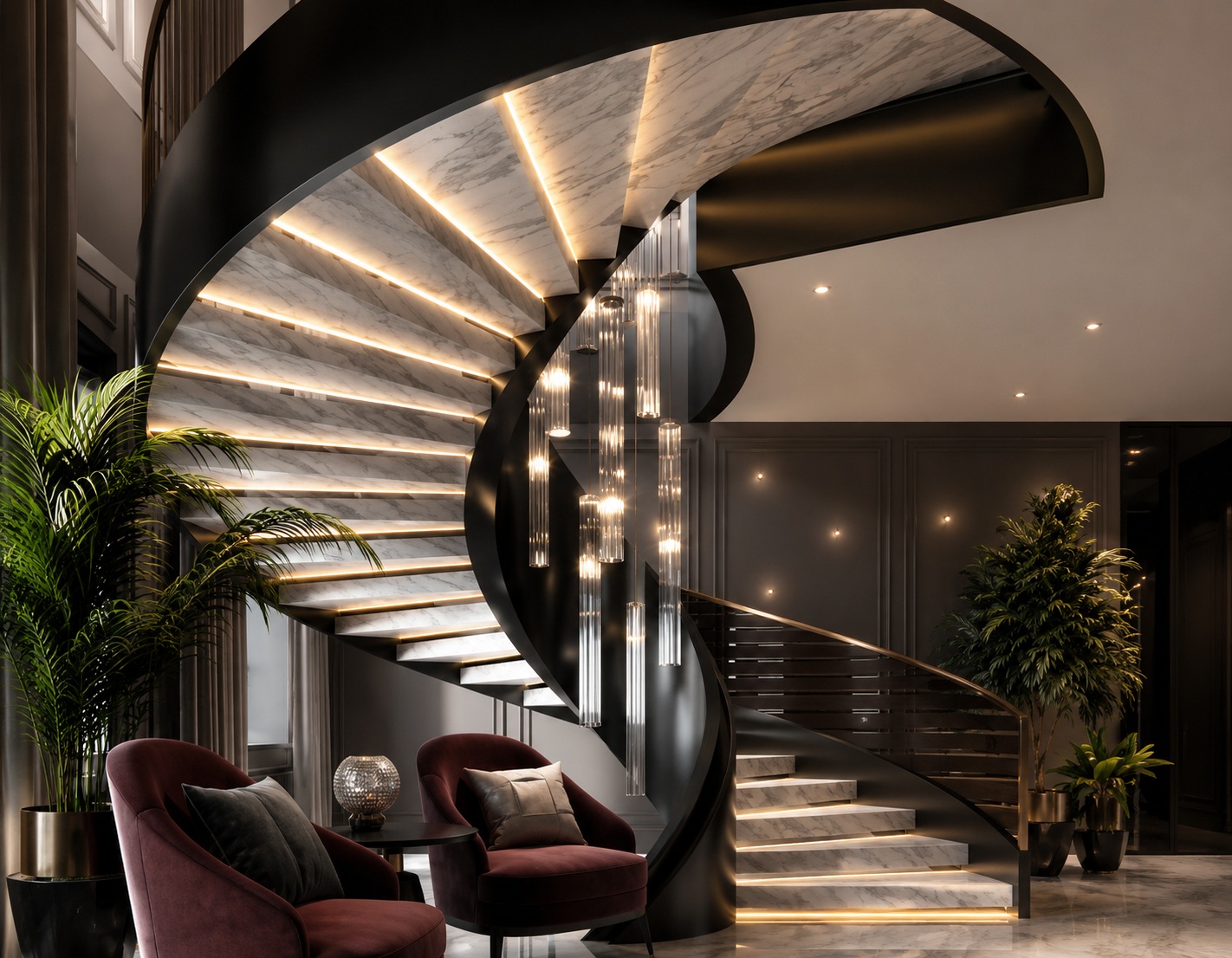
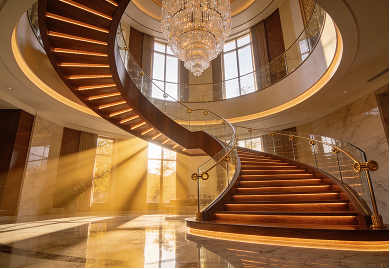
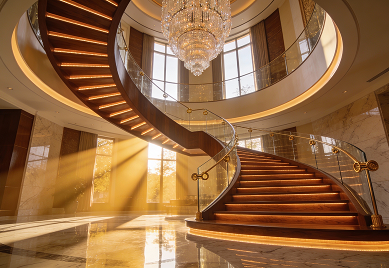
A double marble and wrought-iron curved staircase — a luxury custom build from our factory.
Railings That Follow the Curve
The railing is half the drama of a curved staircase, because on a sweeping flight it has to bend with the arc as one continuous, flowing line. A handrail that follows the curve cleanly is a hallmark of a well-resolved design, while a railing that fights the sweep undoes the whole effect. This is also the most demanding part to fabricate, since every component has to be shaped to the radius rather than cut from straight stock.
The choice of infill sets the character of the finished stair, and a few options suit the curve especially well. The table below lays out the common railing styles for a curved flight and the look each one brings.
| Railing style | Character on a curved flight |
|---|---|
| Frameless glass | Curved glass panels guard the edge without a single post, keeping the sweep open and modern. The most transparent option, and a demanding one to shape to the radius. |
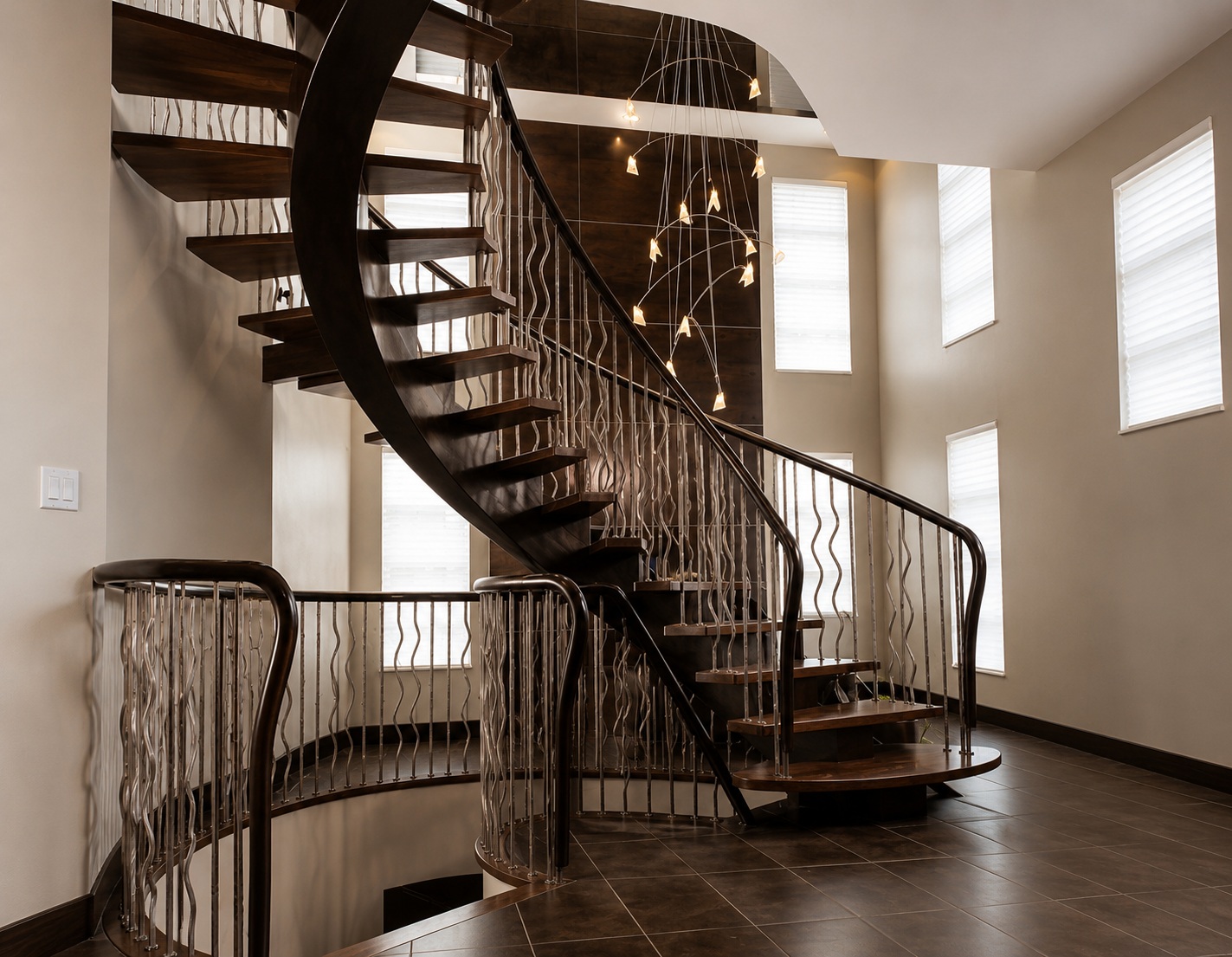
| Forged wrought iron | Hand-shaped balusters and scrollwork that flow with the curve for a classic, ornamental grand stair. Full of craft and character, and weighty. |
| Slim metal balusters | A crisp run of thin vertical bars under a curved handrail. Quiet and contemporary, and a versatile partner for most rooms. |
| Stainless cable | Fine horizontal cables that the eye reads straight through, tracing the arc with thin lines. Light and modern, and best where the cable runs allow the curve. |
Frameless glass and a forged-iron balustrade sit at the two poles of curved staircase design, one all transparency and the other all craft. A slim metal railing offers a quiet middle path that flatters most interiors. Whichever you choose, the railing has to be drawn to the same radius as the stair. The handrail then flows as one unbroken sweep. That is exactly the kind of detail we resolve on the working drawing before any metal is shaped.
From Idea to a Working Plan
A curved staircase ideas board is a wonderful starting point, but a sweeping flight has to become a precise plan before anything can be made. At Double Building Materials a curved stair begins as a drawing, not a kit. We take your floor-to-floor height, the shape of your floor opening, your chosen radius, and the railing you want. We then turn them into a working shop drawing that fixes every tapered tread and the line of the handrail.
That drawing is where the whole curved staircase design is proven before any material is cut. We confirm the radius, the sweep, the walking line, and the headroom on paper. We then trial-assemble the finished flight on our Guangdong factory floor to check the curve and the fit step by step. Once it passes, we crate the staircase for export in the order your installer will need it. Your own contractor fits it on site from our drawings, and we can help you find one where local installation is available. We do not install on site or sign off local code, which stays with your local team. For the build sequence in detail, see how a curved staircase is built, and for budgeting the project, the curved staircase cost guide breaks the drivers down.
Curved Staircase Design FAQ
What is the difference between a curved and a spiral staircase?
A curved staircase follows a broad, open arc with a generous radius, so it sweeps gently through a room and feels easy to climb. A spiral staircase winds tightly around a central column in the smallest footprint of any stair. Put simply, a curve is gracious and space-hungry, while a spiral is compact and a tighter walk.
How much space does a curved staircase need?
More than a straight flight, because the arc needs room to develop its sweep. The larger the radius, the more gracious the stair and the more floor area it asks for. A foyer or an open hallway gives a curved staircase design the breathing room it wants, whereas a very tight space pushes the design toward a spiral instead.
What is the walking line on a curved staircase?
The walking line is an imaginary line tracing where a person naturally steps as they follow the curve, sitting out toward the wider, outer portion of the treads. A good design measures the tread depth along that line and keeps it even all the way up, which is what makes the rhythm of the climb feel smooth and predictable.
What is a double-curve or double-helix staircase?
It is the grandest form of curved staircase design: two flights that curve up from either side, often to meet at a shared landing, or two arcs that wind together through a tall void. It is the classic hotel-lobby gesture, and it asks for considerable ceiling height and floor area to let both arcs breathe.
Can a curved staircase be made of any material?
Largely, yes. The structure is usually steel, while the treads can be timber, stone such as marble, or glass, and the railing ranges from frameless glass to forged iron. Each combination changes the look and the budget. We confirm the materials on the working drawing so the weight and the fixings suit the curve. Browse the range on our curved staircase page.
Start with the basics in what is a curved staircase, then see how a curved staircase is built and weigh the curved staircase cost. Or browse the full curved staircase range.
Double Building Materials draws, manufactures, trial-assembles, crates, and ships your curved staircase. Your own contractor or installer handles on-site installation and local code sign-off — we can help you find one where available. Dimensions above are common references and code values are typical US residential figures (with AS/NCC noted where relevant); your local adopted edition governs, so confirm the current version with your local team.
Talk to us on WhatsApp →