

What Is a Curved Staircase? The Complete Guide to Curved & Radius Stairs-Staircase Guides
Curved Staircase · Complete Guide
What Is a Curved Staircase? The Complete Guide to Curved & Radius Stairs
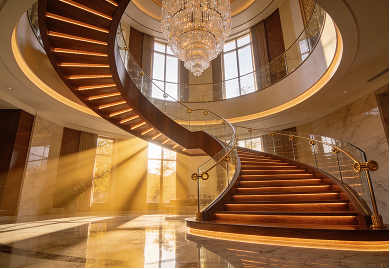
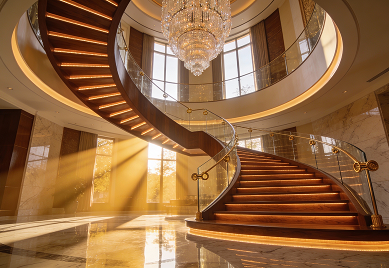
A curved staircase is a stair whose treads sweep along one continuous arc, or radius, as they rise between floors. Unlike a spiral, it has no tight central column; the curve is gentle and open. The shape gives a generous, sculptural climb and makes a curved staircase the most demanding stair to fabricate.
That sweeping arc is the whole character of a curved staircase. This guide explains how the curve works, how it differs from a spiral and a straight flight, and why the stringer is the heart of the build. It walks through materials, shapes, the manufacturing sequence, the honest picture on cost and code, then links to focused guides where a topic runs deep.
What a Curved Staircase Is
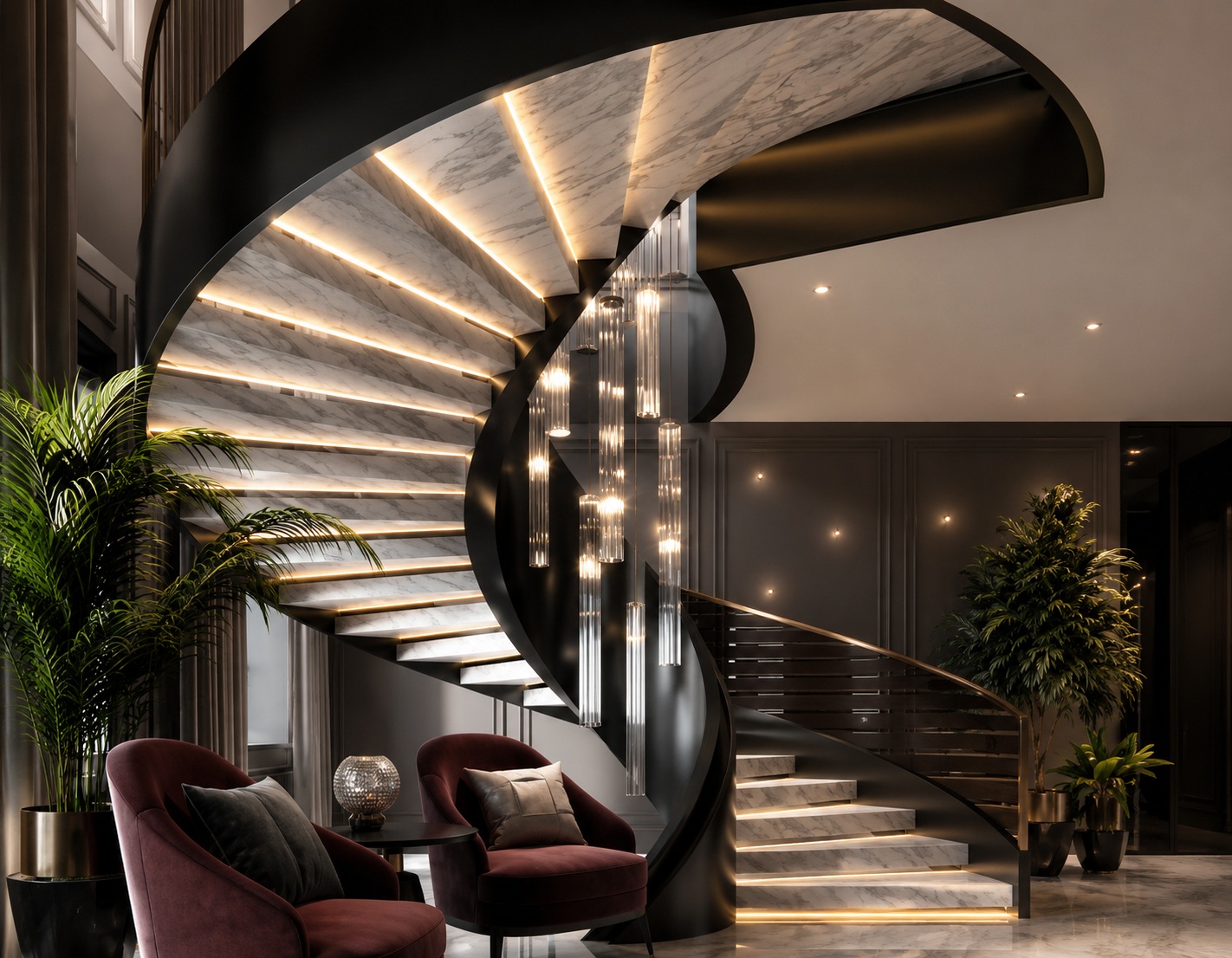
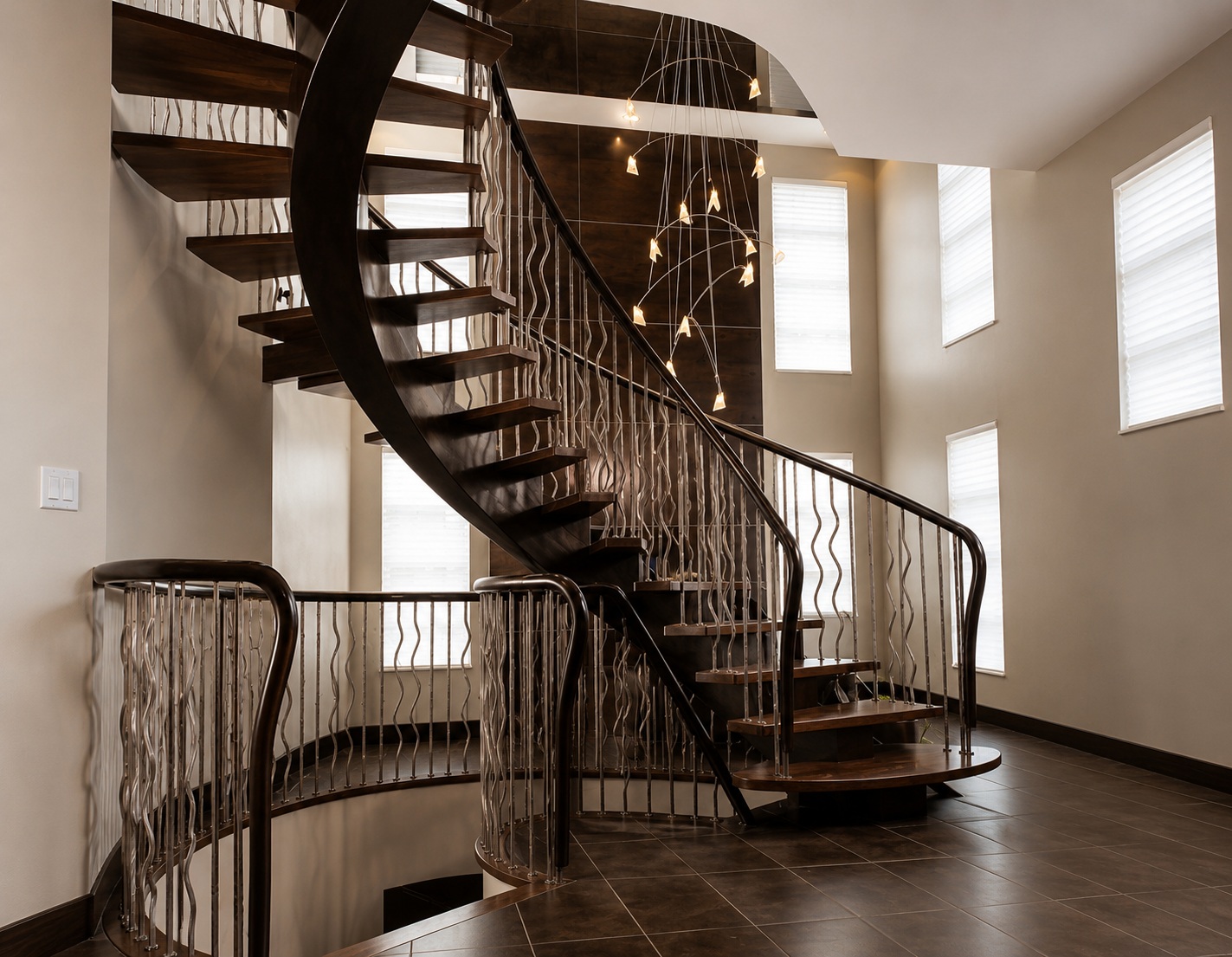
A curved staircase carries its treads along one continuous arc as it climbs from floor to floor, so the whole flight reads as a single sweeping line rather than a series of straight runs. The curve follows a large, gentle radius, which keeps every tread close to rectangular and every step comfortable underfoot. You walk a smooth bend, never a sharp turn, and that flowing geometry is the defining characteristic of the configuration.
The appeal is unapologetically about presence. A curved staircase is the grandest of the residential stairs, the sculptural centrepiece that an entrance hall is often designed around. The eye follows the arc upward, the underside becomes a soft architectural surface, and the railing traces the curve like a ribbon. Many owners of a villa, a new custom home, or a major renovation choose curved stairs precisely for that arrival moment, where the staircase becomes the signature of the room.
It is worth being clear on one trade-off early, because a curved staircase asks for room and for craft in return for its drama. The sweep occupies a larger footprint than a straight or spiral flight, and the curved structure is genuinely difficult to fabricate. None of that makes it impractical. It simply means a curved staircase rewards a generous floor plan and a manufacturer who can engineer the curve properly, which is where careful drawings and a trial build earn their keep.
Curved vs Spiral vs Straight
A curved staircase is easy to confuse with a spiral, yet the two behave very differently in a home. A spiral winds its wedge-shaped treads tightly around a single central post, folding a full flight into the smallest possible circle. A curved stair instead sweeps along a wide, open arc with no central column, so its treads stay broad and its climb feels gentle. A straight flight, by comparison, simply runs in a line and needs the most floor length of all.
| Stair | How it behaves and where it suits |
|---|---|
| Curved | Sweeps along a wide arc with no central post. Broad treads, a gentle climb, and a grand sculptural effect; asks for a larger footprint and skilled fabrication. |
| Spiral | Winds tight wedge-shaped treads around one central column. The smallest footprint of any stair, and the natural choice where floor area is tight. |
| Straight | Runs in a single line. The easiest to walk and to carry furniture up, and the simplest to build, but it needs the most floor length. |
The practical takeaway is that the three stairs answer different questions. A spiral solves a space problem, a straight flight solves a budget and convenience problem, and a curved staircase solves a presence problem. Curved stairs feel far more comfortable than a spiral underfoot, because the broad treads sit on a gentle arc, yet they demand more room and more engineering than either alternative. We compare the two sweeping shapes in depth in our guide to curved versus spiral staircases.
Curved, Radius, Circular and Helical
Several names circle the same idea, and it helps to untangle them. People say curved stairs, a curved stairway, or a radius staircase, and in everyday use these describe the same thing: a flight that follows a sweeping arc. The word radius simply points to the geometry, because a designer draws the arc of the treads around a radius. A larger radius gives a wider, gentler curve, while a tighter radius produces a more pronounced bend within the same opening.
A few related terms sit close by without being identical. A circular staircase is a curved stair whose arc is part of a full circle, often turning a complete loop within a rounded wall. A helical staircase rises as an open coil with no central column, so it reads as the most sculptural relative in the family, and it asks for the most demanding engineering of all. Throughout this guide a curved staircase means the open, sweeping radius form, and we flag the circular and helical variants where the distinction matters to your project.
The Curved Stringer Is the Heart of the Build
If a straight stair is defined by its treads, a curved staircase is defined by its stringer. The stringer is the structural beam that runs the length of the stair and carries the treads along the arc. On a curved stair, it has to follow that arc precisely while staying perfectly smooth and strong. Getting the curve of the stringer right is the single hardest part of the whole build, which is exactly why curved stairs are the most demanding staircase to manufacture.
There are two main ways to make a curved stringer, and the choice usually follows the material of the stair. A timber stringer is built up from many thin layers of wood, bent around a curved form and bonded together so the finished beam holds its arc. Builders call this lamination. A steel stringer is instead rolled or segmented into the curve, then welded and ground until the bend reads as one continuous line. Both methods need real skill and the right shop equipment, and a poorly made curve shows immediately on a stair this visible.
| Curved stringer | How it is made |
|---|---|
| Laminated timber | Thin wood layers bent around a form and bonded into one curved beam. Warm, traditional, and suited to a painted or stained finish. |
| Rolled or segmented steel | Steel plate rolled or cut into the arc, then welded and ground smooth. Slim, very strong, and the basis for most modern open curves. |
Once the stringer holds its arc, the rest of the stair follows from it. The treads sit along the curve, the railing traces the same sweep on the outer edge, and the underside can be left as an exposed structural curve or closed in as a smooth soffit. Because every part keys off the stringer, the accuracy of that one curved beam decides whether the finished staircase looks effortless or awkward. That is why we engineer the curve on a drawing long before anyone shapes the material.
Materials
Material sets both the look and the budget of a curved staircase, and a curved stair mixes materials more freely than most. The structure is usually laminated timber or rolled steel, and on top of that frame the treads and the railing carry the visible character. These are the surfaces an owner actually sees and touches, so they tend to drive the design.
| Material | Character |
|---|---|
| Wood | Warm timber treads and a laminated stringer give a classic, joinery-led curve that matches a timber floor. |
| Steel | A rolled steel stringer carries the load in a slim line and underpins most modern open curves. It finishes in any colour. |
| Stone | Marble or stone treads on a steel frame read as the most monumental option, weighty and architectural underfoot. |
| Glass treads | Laminated glass treads give the lightest, most open curve. They need a slip-resistant surface and careful detailing. |
| Railing | A curved glass balustrade looks seamless and modern; forged iron suits a period or ornamental curve. |
A timber stair with a stained handrail suits a traditional villa, while a steel stringer with glass treads and a frameless glass balustrade suits a contemporary new build. Stone treads turn the staircase into a monument and add considerable weight, which the structure has to be drawn for. Each of these choices moves the price, which the cost section below picks up. We curve the railing to match the stringer, so the glass or metal follows the same arc as the stair itself.
Shapes and Layouts
A curved staircase flexes to its hall in several ways, and the radius is the dial that tunes it. A wide radius gives a long, shallow sweep that feels palatial and needs a large opening. A tighter radius turns the same rise within a more compact footprint. Either way the stair keeps the open, columnless character that sets a curved stair apart from a spiral. The radius therefore drives both the footprint the stair occupies and the way the climb feels underfoot.
From that single dial, several familiar layouts emerge. A graceful single sweep rises from a hall in one continuous arc, often flaring wider at the bottom step to form a welcoming base. A double-curved or split stair divides into two opposing arcs that meet at a shared landing. That split is the signature of a grand entrance. A curve can also turn through a quarter or a half circle to change direction between floors. You can see the range of curved and radius stairs we build on our curved staircase page, and we collect more curved staircase design ideas in a dedicated guide.
How a Curved Staircase Is Built
At Double Building Materials, a curved staircase starts as a drawing, never as a kit. We take your floor-to-floor height, the shape and size of your opening, and your chosen radius, then turn them into a working shop drawing that fixes the curved stringer, every tread, and the railing. On a stair this unforgiving, the drawing is where we truly design the curve. We shape no material until you approve it, because a curved beam leaves almost no room to correct a mistake later.
From there we fabricate the curved stringer, whether laminated in timber or rolled in steel, then add the treads and the curved railing. Next we trial-assemble the whole staircase on our Guangdong factory floor, which is where we confirm the arc, the rise, and the fit of every part before anything leaves the building. Once it passes that trial build, we crate the stair for export in the order your installer will need it. Your own contractor fits it on site from our drawings, and we can help you find one where local installation is available. We do not install on site or sign off local code; that stays with your local team. The full sequence is laid out in how a curved staircase is built.
How we build a curved stone staircase, tread by tread, in our Guangdong factory.
What a Curved Staircase Costs
A curved staircase sits at the upper end of residential stairs, and the reason is the curve itself. Shaping a stringer to a precise arc, whether by lamination or by rolling steel, takes more material, more labour, and more skilled hours than a straight flight of the same height. The result is a stair that costs more than a comparable straight or spiral stair, though the figure varies widely with the choices you make. Because every curved stair is made to order, there is no single price tag; there are drivers.
The main drivers are the radius and span, the stringer material, the tread material, and the railing. A larger, longer sweep uses more structure, and a laminated timber curve carries different labour from a rolled steel one. Stone or glass treads add weight and cost, while a curved glass balustrade is more involved than a simple metal rail. A taller floor-to-floor height adds treads to the arc. We break each driver down, with attributed third-party market ranges rather than a quote, in the curved staircase cost guide. As a made-to-order manufacturer, we price each project from its drawing.
Code and Safety
A curved staircase follows the same broad stair rules as a straight flight, with the measurements taken along the path you actually walk. Building codes set a tread depth, a riser height, a stair width, a headroom clearance, and a handrail height. On a curved stair, you check these values along a walking line set in from the inner edge of the curve. Because the treads on a gentle radius stay close to rectangular, a well-drawn curved stair meets these references comfortably along that line.
The figures most often quoted come from common US residential references such as the IRC and IBC, with AS standards used where relevant. Your local adopted code edition is what actually governs, so confirm the current version with your local team. The handrail deserves particular attention on a curve, since it has to follow the arc continuously and sit within a graspable height the whole way up. A well-built curved staircase is a safe, comfortable stair; the rules simply keep the tread depth, the headroom, and the railing honest along the walking line.
Curved Staircase FAQ
What is the difference between a curved and a spiral staircase?
A spiral winds tight wedge-shaped treads around a single central column in the smallest possible circle. A curved staircase sweeps along a wide, open arc with no central post, so its treads stay broad and its climb feels gentle. In short, a spiral saves space, while a curved staircase makes a grand, sculptural statement and needs more room.
Are curved staircases more expensive than straight ones?
Usually, yes. Shaping the stringer to a precise arc, by lamination or by rolling steel, takes more material and more skilled hours than a straight flight of the same height. Price then tracks the radius, the stringer and tread materials, and the railing rather than the curved shape on its own. See the cost guide for the full breakdown.
How much space does a curved staircase need?
More than a spiral and often more than a straight flight, because the sweep needs an opening wide enough to hold the arc. A larger radius gives a more gracious curve and asks for more room; a tighter radius fits a more compact opening while keeping the open, columnless look. The right radius balances the space you can spare against the effect you want.
What is a radius staircase?
A radius staircase is simply another name for a curved staircase. The term points to the geometry, since a designer draws the arc of the treads around a radius. A larger radius produces a wider, gentler curve, while a tighter radius gives a more pronounced bend in the same opening. In everyday use, curved stairs and radius stairs mean the same thing.
Why are curved staircases so hard to make?
Because the stringer has to follow a precise arc while staying smooth and strong, and any flaw in that curve shows at once on so visible a stair. The shop either laminates the beam from thin wood layers or rolls and welds it from steel, and both methods need real skill and the right equipment. That is why we engineer a curved staircase on a drawing and trial-assemble it before it ships.
Go deeper into the cluster: how a curved staircase is built, curved staircase design ideas, cost drivers, and curved versus spiral. Or browse the full curved staircase range.
Double Building Materials draws, manufactures, trial-assembles, crates, and ships your curved staircase. Your own contractor or installer handles on-site installation and local code sign-off — we can help you find one where available. Dimensions above are common references and code values are typical US residential figures (IRC / IBC, with AS where relevant); your local adopted edition governs, so confirm the current version with your local team.
Talk to us on WhatsApp →