

Modern Steel Staircase Design: Straight, Indoor & Outdoor Ideas-Staircase Guides
Steel Staircase · Modern Design
Modern Steel Staircase Design: Straight, Indoor & Outdoor Ideas
A modern steel staircase design uses slim steel structure to carry a clean, minimal flight with crisp straight lines and an open, uncluttered look. Steel spans further on less material than timber, which keeps the stringers thin, allows open risers, and pairs the stair with glass or cable railing and warm wood treads.
Steel is the material that made the minimal staircase possible. It is strong enough to do more with less, so the structure recedes and the geometry takes over. This guide walks through the modern steel look from the ground up. It covers the slim profiles and open risers that define the style, the indoor and outdoor versions, and the finishes and colours that set the mood. It then turns to the railing and tread pairings that complete a contemporary stair.
What Modern Steel Staircase Design Means
A modern steel staircase design is, above all, an exercise in restraint. It strips a flight back to the fewest visible lines and lets steel do the structural work behind a quiet, minimal surface. Where a traditional stair shows heavy stringers, closed risers, and a forest of balusters, the contemporary version hides most of that and presents clean planes, slim edges, and a sense of lightness. The stair stops shouting and starts to read as a single sculptural object in the room.
The look rests on a handful of recurring moves. Profiles are slim, so the steel that holds the stair up reads as a thin line rather than a thick beam. Risers are often open, leaving a gap between the treads so light and sightlines pass straight through. Railings are reduced to the minimum the design allows, frequently a frameless glass panel or a few taut cables. The palette is usually monochrome, with matte black or a soft grey carrying the whole stair, accented only by the warmth of a wood tread.
It helps to be clear that modern is a design language, not one fixed shape. A straight flight, a switchback with a mid landing, a single central spine, a floating cantilever, and a sweeping curve can all be modern when they share that minimal vocabulary. What unites them is the discipline: every component earns its place, nothing is decorative for its own sake, and steel makes the lean result structurally honest rather than merely stylish.
How Steel Enables the Minimal Look
The reason a modern steel staircase can look so light is straightforward engineering. Steel carries far more load per unit of cross-section than timber, so the same flight can be held up by a much thinner element. A stringer that would need to be a deep timber beam becomes a slim steel plate, and a baluster that would be a chunky turned spindle becomes a fine vertical bar. The strength is hidden inside the material, which is exactly what lets the design shed visual weight.
That structural efficiency unlocks the signatures of the contemporary stair. Open risers are possible because each tread can cantilever from a steel spine or sit on a slim stringer without a closed back to brace it. A single central beam, the mono-stringer, works because one steel section can carry the whole flight down its centre line. A cantilevered, floating effect is achievable because steel anchored into a wall can hold a tread out into space. None of these moves is comfortable in timber alone, which is why steel underpins almost every minimal staircase.
Steel also welds into one continuous, rigid assembly, and that matters for the clean look as much as for the strength. Joints can be ground smooth and painted out, so a long stringer reads as one unbroken line rather than a series of bolted parts. The same continuity lets a handrail flow without visible joints and lets a curved flight hold its sweep precisely. The result is a stair where the structure is quietly doing a great deal of work while showing very little of it.
Modern Steel Staircase Styles
Within the modern steel family there are a few distinct configurations, and choosing among them is the first real design decision. Each shares the slim, minimal language but achieves it in a different way, and each suits a different room and budget. The table below sets out the common modern steel staircase styles, what each one feels like, and where it tends to work best.
| Steel stair style | Character and where it suits |
|---|---|
| Straight flight | A single clean run, the purest expression of the minimal look. Easy to walk and the simplest to build, and a natural fit for an open-plan living space or a loft. |
| Mono-stringer | One central steel beam carries the treads down its spine, so the flanks stay open. Crisp and contemporary, and the look most people picture as a modern steel stair. |
| Cantilevered (floating) | Treads anchored to a hidden steel support in the wall, appearing to float with no visible structure. The most dramatic and the most demanding to engineer. |
| Switchback (U-shape) | Two straight flights joined by a mid landing that reverses direction. Fits a taller climb into a compact footprint while keeping straight, modern lines. |
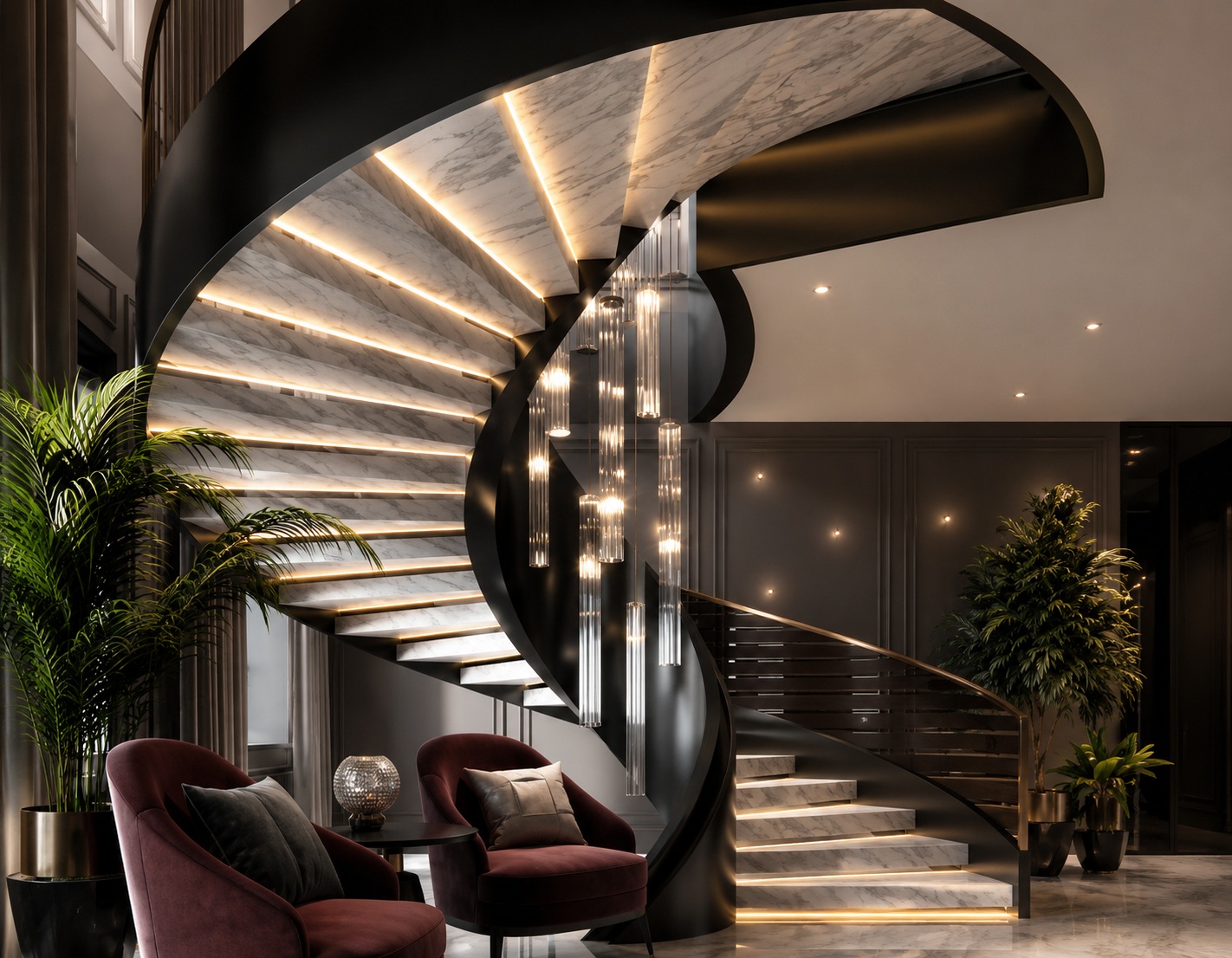
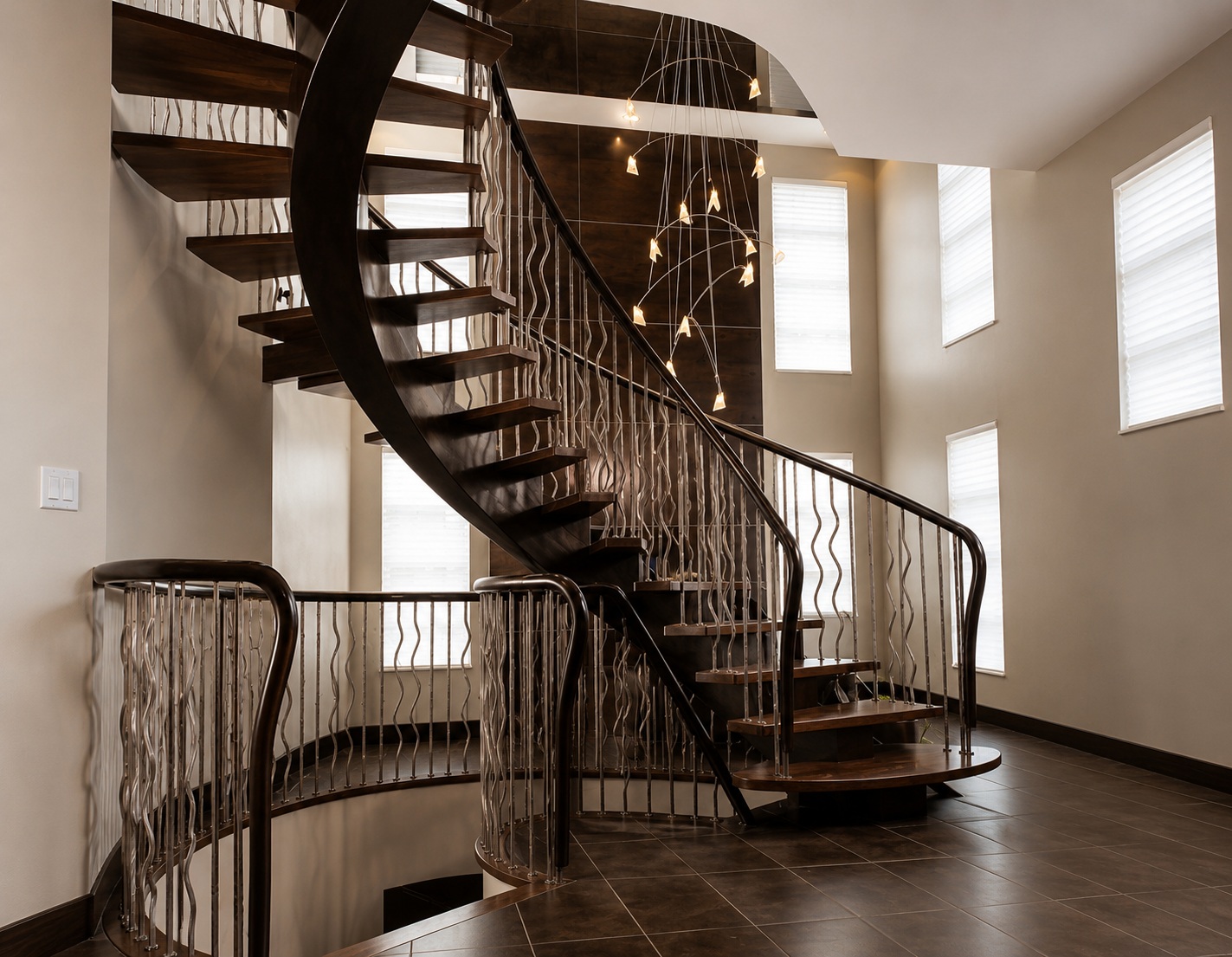
| Curved or helical | A sweeping arc built from shaped steel, minimal in finish but sculptural in form. The grandest option, asking for the most space and the most fabrication. |
A straight flight and a mono-stringer are where most modern homes begin, because they deliver the contemporary look with the least difficulty. A cantilevered float is the showpiece for an entrance that wants to make a statement, while a switchback earns its place where a straight run will not fit. We build across this whole range, and the right configuration depends on your floor-to-floor height, your floor area, and how bold a gesture the stair needs to make.
The Straight Steel Staircase
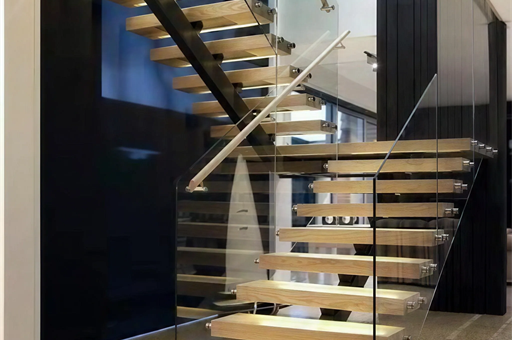
The straight steel staircase is the quiet workhorse of modern design, and it is often the most satisfying choice precisely because it does so little. A single uninterrupted run reads as one clean diagonal across a room, with no turn to break the line and no landing to interrupt the rhythm. When the structure is a slim steel stringer and the risers are left open, a straight flight becomes almost a piece of furniture, light enough that the wall and the floor behind it stay visible.
A straight flight is also the easiest stair to walk and to carry things up, which is why it remains the default where the floor plan allows it. Steel suits the straight format particularly well, because a long single span is exactly the kind of work steel does efficiently, so the stringers stay thin even over a generous run. The trade-off is floor length: a straight stair needs the most uninterrupted horizontal space of any configuration, so it favours an open-plan layout over a tight pocket.
Where a straight run will not fit, the same minimal language carries over into a switchback or an L-shaped flight with a steel landing. That folds the climb into less floor area while keeping the lines crisp. The straight version simply remains the purest. If you want to see the format on its own, our straight steel staircase page shows the range we build, from open-tread mono-stringers to slim twin-stringer flights.
Interior Steel Stairs Indoors
Indoors, interior steel stairs are about the interplay of the steel structure with everything around it. Because the metal frame is slim, the treads and the railing become the elements you actually see and touch, so they carry the warmth and the character. The most popular indoor combination pairs a steel structure with timber treads, marrying the strength and crisp lines of metal with the softness of wood underfoot. The result feels modern but never cold, which is what most owners are after at home.
A metal staircase indoor also has to work with the light and the sightlines of the room it sits in. Open risers let daylight pass through the flight so the stair never blocks a window or darkens a hallway behind it. A frameless glass balustrade keeps the view across an open-plan floor uninterrupted, while a slim cable or bar railing draws the lightest possible line. These moves are what make a steel stair feel like part of the architecture rather than an object dropped into it.
The finish ties the indoor stair to its setting. A matte black frame reads graphic and confident against pale walls and a timber floor, while a soft grey or off-white recedes into a quieter, more minimal scheme. Many modern interiors deliberately let the steel be the one dark line in an otherwise light room, so the stair becomes a deliberate accent. We help you settle the structure, the tread, and the railing together so the indoor stair sits comfortably in your space rather than fighting it.
Steel Staircase Outdoor Design
A steel staircase outdoor follows the same minimal language as its indoor cousin, but the priorities shift toward weather and longevity. The structure stays slim and the lines stay clean, yet every surface now has to shrug off rain, sun, and temperature swings for years. That changes the finish far more than the form, so an exterior modern steel stair often looks much like an interior one while being built to a different specification underneath the colour.
The treads are where outdoor design diverges most clearly. Open metal grating or perforated plate treads let rain drain straight through and give grip when the surface is wet. That is why they are common on a deck stair or a roof-terrace route. Solid treads with a slip-resistant surface are an option where the look matters more than drainage. The railing usually stays minimal too, with a slim metal balustrade or a marine-grade cable run that reads almost transparent against the sky.
Corrosion protection is the part that decides how long an outdoor steel stair lasts, and it is worth getting right from the drawing. Hot-dip galvanising followed by a powder-coat top layer is a common, durable approach, and stainless steel is used where a bright, low-maintenance finish suits the setting. We confirm the protection system to suit your climate and the look you want, so the exterior stair keeps its clean lines well beyond its first season outdoors.
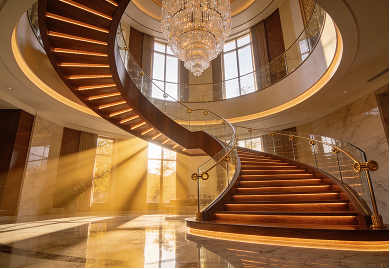
The ultimate centrepiece — modern custom stairs by Double Building Materials.
Finishes and Colours
On a modern steel staircase the finish does as much design work as the shape, because it sets the mood and the upkeep in one decision. Steel takes almost any colour, so the same flight can read as a graphic black statement, a soft industrial grey, or a near-invisible white edge. The choice also governs durability, since the coating is what protects the metal from wear indoors and from weather outside. The table below lays out the common finishes and the character each one brings.
| Finish | Character and best use |
|---|---|
| Matte black powder-coat | The signature modern finish. Reads graphic and confident, hides fingerprints, and pairs beautifully with timber treads and pale walls. |
| Grey or anthracite | A softer, more industrial tone that recedes into a muted scheme. Quieter than black while keeping the contemporary feel. |
| White or off-white | Lightens the whole flight so the structure almost disappears. Suits a bright, minimal interior where the stair should feel weightless. |
| Brushed stainless steel | A bright metallic surface with a fine grain. Low-maintenance and durable, equally at home indoors or in a sheltered exterior setting. |
| Hot-dip galvanised | A weatherproof base layer for outdoor stairs, often top-coated in colour. Tough and long-lasting where rain and sun are a factor. |
Matte black is the colour most people picture when they imagine a modern steel staircase, and it remains the safest choice for a confident, graphic result. Grey and white offer quieter alternatives for a more recessive scheme, while brushed stainless suits a brighter, more metallic palette. For anything exposed to the elements, a galvanised base under a powder-coat top layer is the durable route. Each option changes both the look and the maintenance, which is why we settle the finish alongside the structure rather than as an afterthought.
Pairing Steel with Glass, Cable and Wood
A modern metal staircase rarely stands as bare steel; its character comes from what the steel is paired with. The structure provides the strength and the crisp lines, and the railing and the treads provide the warmth, the transparency, and the texture. Getting these pairings right is what separates a stair that feels considered from one that feels merely industrial, and it is where most of the design conversation actually happens.
Glass is the partner that keeps a steel stair most open. A frameless glass balustrade guards the edge without a single post, so the eye travels straight through the flight and across the room beyond it. Cable railing does something similar with a different rhythm. A run of fine horizontal stainless cables reads as thin lines, light and contemporary, and it suits a long straight flight well. Both let the slim steel structure remain the only real line in the design. That is exactly the minimal effect a modern stair is reaching for.
Wood is the partner that warms the whole composition. Timber treads on a steel frame are the most popular modern pairing of all. The contrast of a dark steel structure with a warm oak or walnut tread feels both contemporary and inviting. The choice between steel, glass, cable, and wood is really a choice about how warm or how cool the finished stair should feel. A steel structure is happy to carry any of them. We explore the wider material question in our guide to metal versus wood staircases.
From Idea to a Working Drawing
A modern steel staircase looks effortless, but that lean result is earned on the drawing long before any steel is cut. At Double Building Materials a steel stair starts as a working shop drawing, not a kit. We take your floor-to-floor height, the size of your floor opening, your chosen configuration, and the finish you want, then resolve every stringer, tread, and railing connection on paper. The slimmer the design, the more precisely those connections have to be worked out, because a minimal stair leaves nowhere to hide a rough joint.
From the approved drawing we fabricate the steel structure, weld and grind the joints clean, and apply the finish you selected. We then trial-assemble the whole flight on our Guangdong factory floor to confirm the rise, the run, and the fit of every tread before anything ships. Once it passes, we crate the staircase for export in the order your installer will need it. Your own contractor fits it on site from our drawings, and we can help you find one where local installation is available. We do not install on site or sign off local code; that stays with your local team. For the wider material picture, our guide to steel staircases sets out how steel stairs are built and where they fit.
Modern Steel Staircase FAQ
What makes a steel staircase look modern?
The modern look comes from restraint rather than ornament. Slim steel profiles, open risers, a minimal railing such as frameless glass or thin cables, and a monochrome finish like matte black together reduce the stair to its cleanest lines. Steel makes that possible because it carries the load on a thin section, so the structure recedes and the geometry becomes the design.
Are steel stairs good for modern homes indoors?
They are one of the most popular indoor choices for a contemporary home, particularly with timber treads on a steel frame. The metal structure stays slim, open risers let daylight through, and a glass or cable balustrade keeps sightlines open across an open-plan floor. A matte black or grey finish lets the stair read as a deliberate accent rather than an obstruction.
What colour are most modern steel staircases?
Matte black is the most common, because it reads graphic and confident and pairs beautifully with timber treads and pale walls. Soft grey and white are quieter alternatives that let the structure recede, and brushed stainless suits a brighter, metallic palette. The colour is usually a durable powder-coat, which protects the steel as well as setting the mood.
Can a steel staircase be used outdoors?
Yes, and it is common for deck and roof-terrace stairs. An outdoor steel stair keeps the same slim, modern lines but adds weather protection, typically hot-dip galvanising under a powder-coat top layer, or stainless steel for a bright low-maintenance finish. Open grating or perforated treads let rain drain and give grip, so the stair stays safe and clean in wet weather.
Which railing suits a modern steel staircase?
It depends on how open you want the flight to feel. Frameless glass keeps the view completely clear, fine stainless cables draw the lightest possible line on a long straight run, and slim metal bars give a crisp, versatile look. All three suit the minimal language; the choice is mainly about transparency and the rhythm you prefer along the stair.
Start with the basics in our guide to steel staircases, and weigh the materials in metal versus wood staircases. Ready to see the format? Browse our straight steel staircase range.
Double Building Materials draws, manufactures, trial-assembles, crates, and ships your modern steel staircase. Your own contractor or installer handles on-site installation and local code sign-off — we can help you find one where available. Dimensions and code points above are common references (typical US residential figures, with AS/NCC noted where relevant); your local adopted edition governs, so confirm the current version with your local team.
Talk to us on WhatsApp →