

What Is a Steel Staircase? Complete Guide to Types, Parts & Design-Staircase Guides
Steel Staircase · Complete Guide
What Is a Steel Staircase? Complete Guide to Types, Parts & Design
A steel staircase is a stair whose structure uses steel rather than timber or concrete. A steel stringer carries the treads, which can be steel, wood, glass, or stone. Steel gives the slimmest, strongest sections of any common material, which is why it suits open, modern flights with long, lightweight spans.
That structural strength is the whole reason designers reach for a steel staircase. This guide explains what one is and why steel works so well, the parts that make it up, and the types you can choose. It then covers finishes, tread materials, and how a fabrication shop makes one, linking to a focused guide wherever a topic runs deep.
What a Steel Staircase Is
A steel staircase is any stair whose load-carrying structure is made from steel rather than from timber or poured concrete. The part that does the work is the stringer, the angled beam that runs the length of the flight and holds every tread. On a steel stair that stringer is fabricated steel, and the treads it carries can be steel as well, or wood, glass, or stone laid on a steel frame. People often call it a metal staircase, a steel stair, or a fabricated steel staircase, and the terms all point at the same idea.
The appeal of steel is mostly about how little of it you need. Because steel is far stronger than wood for its size, the beams and treads can be slim, and the whole flight reads as light and open rather than heavy. That lets a steel staircase span a long way between supports, cantilever from a wall, or rise as a single ribbon of metal with no visible framing. It is the material behind almost every open, modern staircase you admire in a magazine.
It helps to be clear on one point early, because steel is a workshop material, not a site one. A steel staircase is cut, welded, and ground in a fabrication shop, then delivered as finished components for assembly on site. That gives crisp welds and a controlled finish, but it also means the stair is engineered and made to a drawing well before it arrives. Understanding that workshop origin explains most of what follows, from the parts to the finishes to the way one is built.
Why Build a Staircase in Steel
Steel earns its place on four counts, and the first is strength. A steel section carries far more load than a timber one of the same size, so the structure can be slim and the spans long. That strength is what makes the open, airy look of a modern stair possible at all, because a slender steel stringer can do the job that a bulky timber one cannot. The second count is that slimness itself, since thin sections read as elegant and let light pass through the flight.
The third count is the modern look that steel allows. Clean lines, open risers, and a single central beam are all natural in steel, and they suit the contemporary interiors many owners want. The fourth count is fire performance, because steel does not burn and is classed as non-combustible, which is one reason steel stairs are common in commercial and shared buildings. Steel does lose strength in a severe fire, so protection is sometimes added, but it never feeds the flames.
Set against those strengths, steel asks for two things in return. A shop must fabricate it rather than a crew cutting it on site, and bare steel will eventually corrode without a finish, which the finishes section below addresses. Neither is a drawback so much as a characteristic, and both are routine for a stair manufacturer. For most owners the trade is well worth it, because no other common material gives the same slim, strong, modern result.
Parts of a Steel Staircase
The parts of a steel staircase are easy to name once you see them in order, and the same handful appears on almost every flight. The stringer is the spine; the treads are what you step on; the risers close the gap between treads; and the railing keeps you safe at the edge. On a steel stair each of these can be steel, or a mix of steel and another material, but the roles never change.
| Part | What it does |
|---|---|
| Stringer | The angled steel beam that runs the length of the flight and carries every tread down to the floor. A stair may use one central stringer, two outer stringers, or a hidden one. |
| Tread | The horizontal surface you stand on. It can be steel plate, a steel frame holding wood, glass, or stone, or open steel grating for outdoor flights. |
| Riser | The vertical face between two treads. Many modern steel stairs leave it out for an open-riser look, while a closed riser gives a more solid, enclosed flight. |
| Railing & balustrade | The handrail and the infill below it. Steel pairs naturally with glass panels, slim metal verticals, or tensioned cable for the guard. |
| Connections | The welds, bolts, and base plates that join the parts and fix the stair to the floor and the supporting wall. |
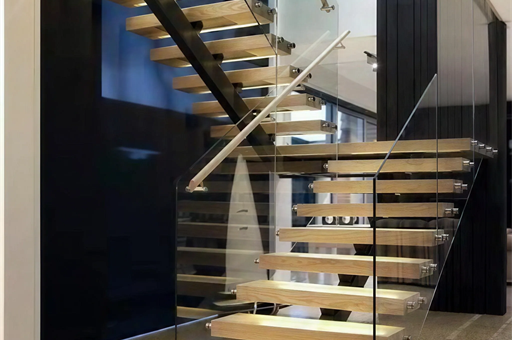
The stringer is the part that defines the character of a steel staircase, because the number and position of the beams changes the whole look. A single central beam gives the floating, sculptural mono-stringer; a pair of outer beams gives a more conventional, robust flight. The treads, risers, and railing then dress that structure to taste. We unpack the structural beam in detail in our steel stair stringer guide.
Steel Staircase Types
Steel suits almost every staircase shape, so the steel staircase types below are really the standard stair forms expressed in metal. What changes between them is how many stringers carry the load and how the flight is arranged, and that in turn sets the look. The four below cover the great majority of what owners and architects specify, and steel handles each one comfortably.
| Type | How it works and where it suits |
|---|---|
| Straight flight | The simplest run, carried on one or two steel stringers. Easy to walk, easy to make, and the natural home for slim steel sections and open risers. |
| Mono-stringer | A single central steel beam carries the treads, which appear to float on either side. The most architectural steel stair, and a steel-only structure by nature. |
| Double or twin stringer | Two outer steel beams flank the treads. More conventional and robust than a mono-stringer, and a strong choice for wider or busier flights. |
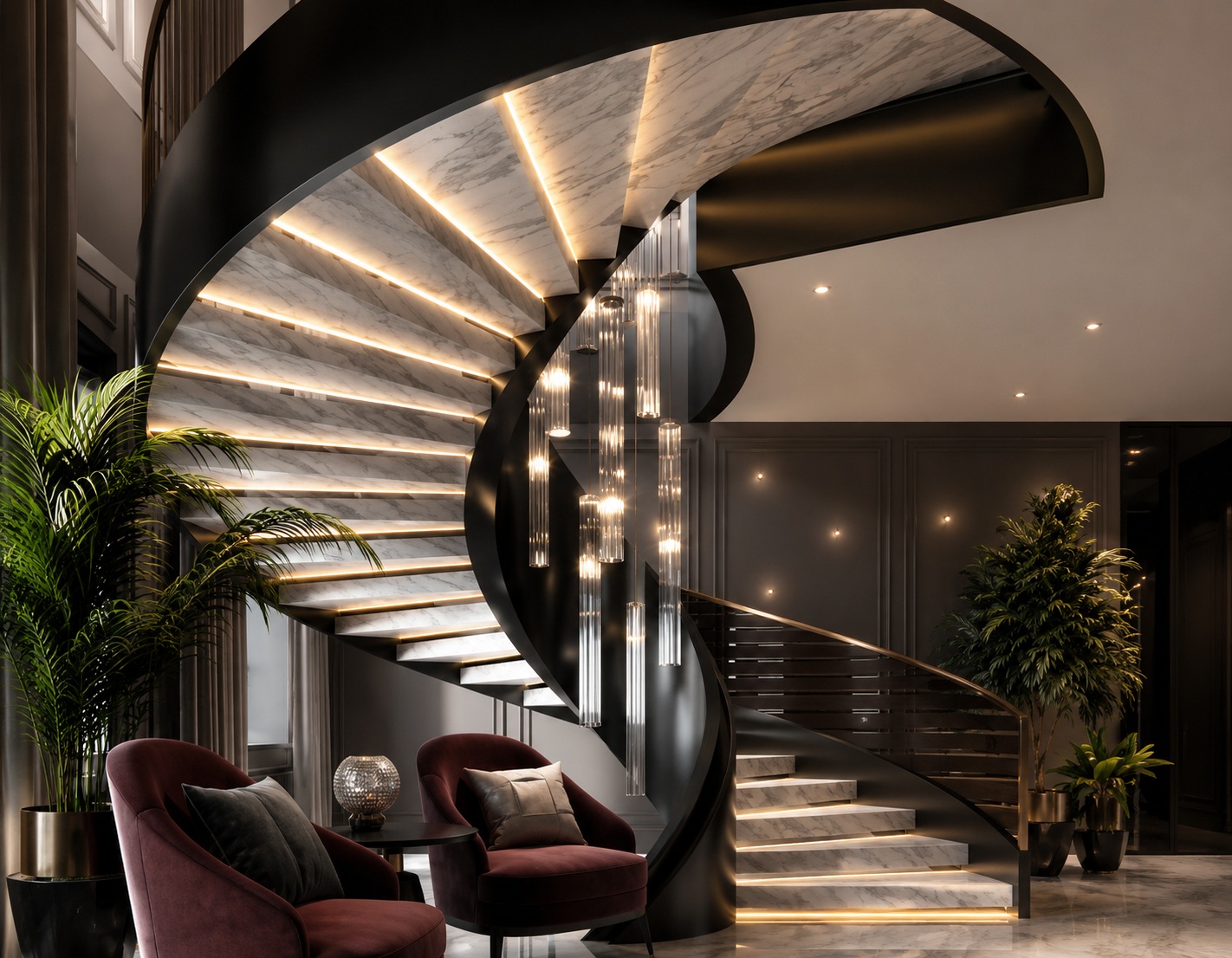
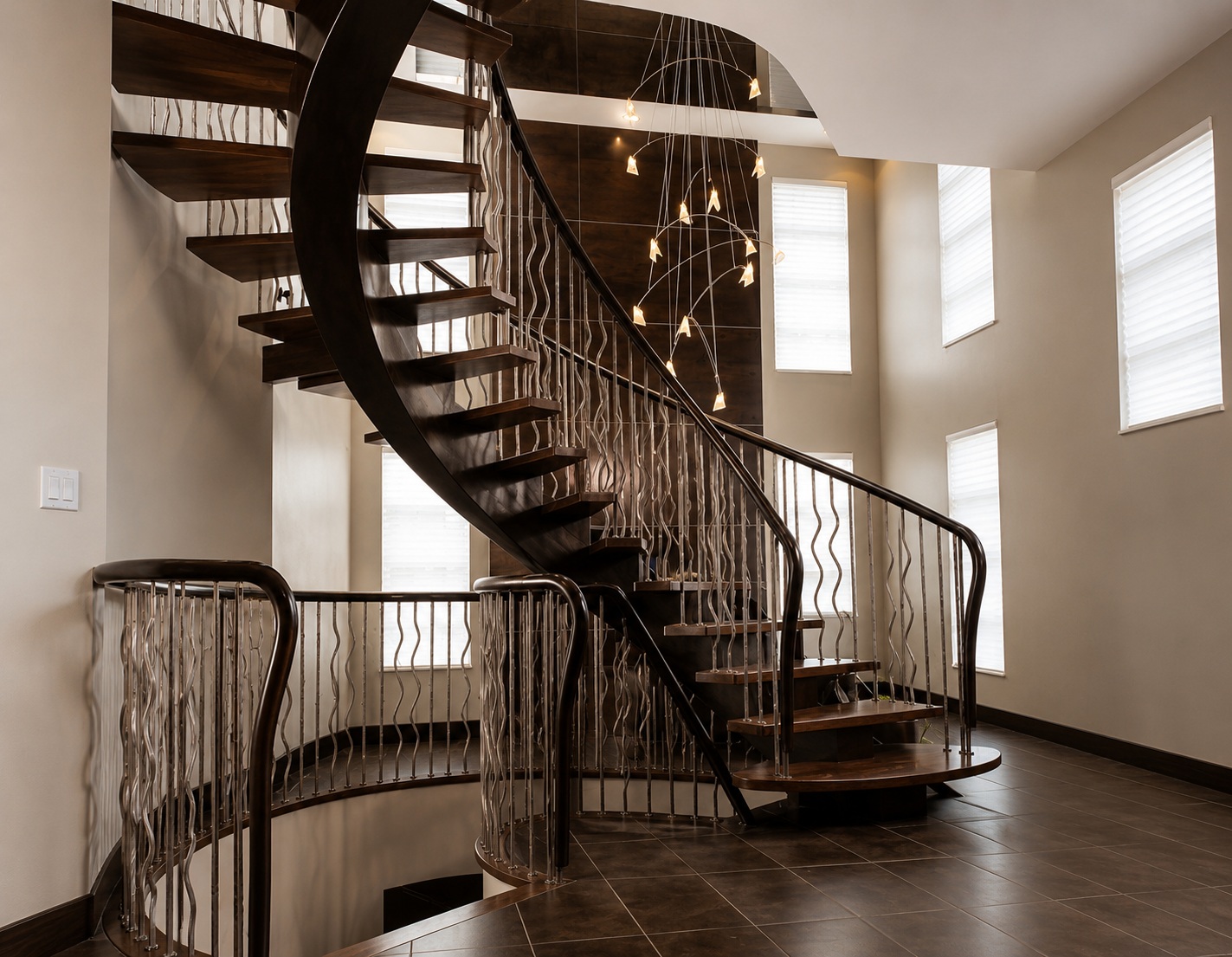
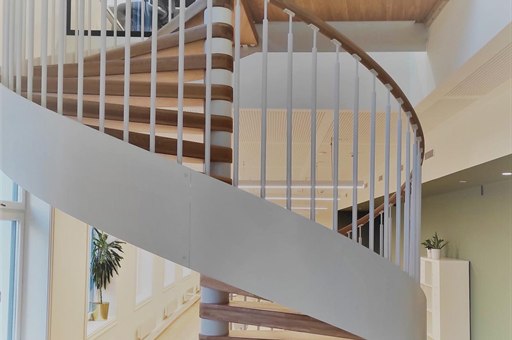
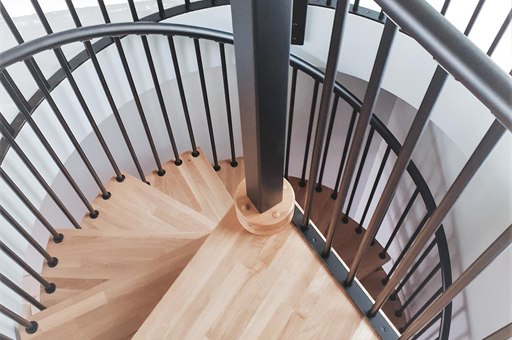
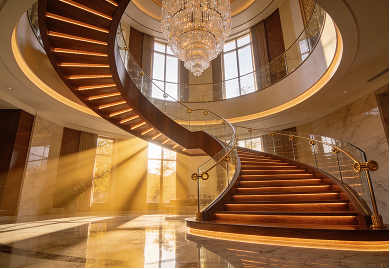
| Spiral and curved | Steel rolls and welds into a tight helix or a sweeping curve far more readily than timber, which is why most spiral and curved stairs have a steel core. |
The mono-stringer is the type people picture first when they think of a modern steel staircase, because a single central beam reads as the cleanest and most sculptural of all. A double-stringer flight is the steadier, more traditional cousin, and it shines where a stair is wide or carries heavy traffic. We compare these structural choices closely in the stringer guide, and you can browse the flights we make on our steel staircase range.
Steel Plus Other Tread Materials
One of the quiet strengths of a steel staircase is that the structure and the surface can be different materials. The stringer stays steel for its strength, while the treads can be almost anything you like the look of. That mix is where most of the design personality of a stair comes from, because the treads are what you see and touch on every step.
| Tread on steel | Character |
|---|---|
| Steel tread | A folded steel plate, fully industrial and seamless with the structure. Slim, strong, and finished in any colour you choose. |
| Wood on steel | The most popular mix. Warm timber treads on a slim steel stringer soften the metal and match a wooden floor beautifully. |
| Glass on steel | Laminated glass treads give the most open, light-filled look. They need a slip-resistant surface and careful detailing. |
| Stone on steel | Marble or stone treads on a steel frame read as solid and luxurious, and the steel below carries their considerable weight. |
| Steel grating | Open steel grating treads drain rain and shed debris, which makes them the usual choice for outdoor and industrial flights. |
A steel stringer with warm wood treads suits most indoor homes, and it is the combination owners ask for most often. Glass treads open the flight up further and suit a light-filled hall, while stone treads bring solidity and a sense of permanence. For an exterior route, steel grating sheds rain and stays safe underfoot. Each choice changes the price, which the cost section below picks up.
Finishes for Steel Stairs
Bare steel needs a finish, both to stop it corroding and to give it the colour and texture you want. The finish is not an afterthought on a steel staircase; it is part of the design, and you choose it for the setting. An indoor feature stair, a busy commercial flight, and an outdoor stair each ask for a different approach, and the three most common finishes cover almost every case.
Powder coating is the usual choice indoors. The shop cleans the steel, then sprays on a dry powder and bakes it to a tough, even colour in any shade from matte black to a soft grey. It wears well, asks for little maintenance, and lets the stair match a colour scheme exactly. For most interior steel stairs, a powder-coated finish is what you will see and touch.
Galvanising is the choice where weather or wear is harsh. The shop dips the steel in molten zinc that bonds to the surface and shields it from rust for decades, which is why galvanised steel suits outdoor and industrial stairs as standard. A raw or blackened steel finish takes the opposite path, leaving the metal honest and unpainted for a deliberately industrial, loft-style look, sealed with a clear lacquer so it ages gracefully rather than rusting freely.
Steel Staircase Design Choices
Good steel staircase design is mostly about a few decisions made early and made together. The structure comes first, since choosing a mono-stringer, a twin-stringer, or a hidden support sets the whole character of the flight. The tread material comes next, because warm wood, open glass, or solid stone each pull the design in a different direction. The railing then ties it together, and steel pairs cleanly with frameless glass, slim verticals, or tensioned cable.
Proportion is the part that separates a good stair from an ordinary one. The thickness of the stringer, the depth of each tread, and the gap left by an open riser all read at a glance. Getting them into balance is what gives a steel flight its poise. Because steel can be made so slim, there is real scope to refine these proportions until the stair looks effortless. We explore the contemporary look in depth in our guide to modern steel staircase design.
It is also worth weighing steel against the warmer, more traditional feel of timber before you commit, since the two materials suit different homes and different budgets. A steel stair gives slim lines and a modern edge; a wood stair gives warmth and a softer, classic character. We set the two side by side, with their honest trade-offs, in metal vs wood staircases.
A custom steel staircase in factory pre-assembly — tap to play.
How a Steel Staircase Is Fabricated
At Double Building Materials, a fabricated steel staircase starts as a drawing, not a kit. We take your floor-to-floor height, the size of your opening, and your chosen structure, then turn them into a working shop drawing. That drawing fixes every stringer, tread, and connection before any steel is cut, and we cut nothing until you approve it, because steel leaves little room to correct a welded part on site.
From there our shop cuts and welds the stringers, forms the treads, and grinds every joint, then trial-assembles the whole stair on our 4,500 square metre floor in Guangdong, China. That trial build is where we confirm the rise, the run, and the fit of every part before anything ships. We have made it a habit over more than twenty-five years and many hundreds of delivered projects. Once the stair passes, we apply the chosen finish and crate it for export in the order your installer will need.
Your own contractor or steel erector then assembles the stair on site from our drawings, bolting and fixing the components we have already trial-fitted. We can help you find a local installer where that service is available. We do not install on site ourselves, and we do not sign off your local code; that stays with your local team. This drawing-first, trial-assembled approach is what lets a steel stair travel across the world and still fit on arrival.
What Drives the Cost
A steel staircase covers a wide price range, and because every one is made to order there is no single price tag, only drivers. The structure is the first driver, since a simple straight flight uses less fabrication than a sweeping curved or helical stair. The tread material is the second, because steel treads sit at the affordable end while glass or stone treads add real cost.
The finish is the third driver, as a standard powder coat differs from a hot-dip galvanised or a hand-finished blackened surface. The railing is the fourth, since frameless glass panels cost more than slim metal verticals. Size and weight come into it too, because a taller floor-to-floor height adds treads and steel, and a wider flight needs heavier sections. We price each project from its drawing rather than a list, and any cost figures you read elsewhere are best treated as third-party market estimates, not our quote.
Code and Safety
A steel staircase follows the same stair geometry rules as any other material, because the code cares about how you walk it, not what it is made from. Under common US residential references, the rise and the going of each step, the headroom above the flight, and the height and infill of the guard all have to fall within set limits. Those figures are widely used reference values rather than a single global standard.
Your local adopted code edition is what actually governs, whether that is the IRC or IBC in the United States or an equivalent elsewhere, so confirm the current version with your local team. Steel does bring one extra consideration in commercial and shared buildings, where fire rules sometimes call for the steel to be protected so it keeps its strength for a set time in a fire. A well-made steel stair is a safe, durable stair; the rules simply keep the geometry and the structure honest.
Steel Staircase FAQ
What is a steel staircase made of?
A steel staircase has a steel structure, usually one or two steel stringers that carry the treads. The treads themselves may be steel, or wood, glass, or stone laid on a steel frame. The railing, base plates, and connections are typically steel too, finished with a coating to protect the metal and set its colour.
Is a steel staircase better than a wooden one?
Neither is simply better; they suit different aims. Steel gives slim sections, long spans, and a modern, open look, and it does not burn. Wood gives warmth and a softer, traditional feel. Many stairs combine the two, with steel structure and wood treads. Our metal vs wood guide compares them in full.
Are steel staircases noisy to walk on?
Bare steel treads can sound hard underfoot, but it is easily managed. Wood or stone treads on a steel frame deaden the sound, and rubber or acoustic pads between the treads and the stringer cut it further. A well-detailed steel staircase is no louder in everyday use than a timber one, so the material need not feel cold or noisy.
Do steel staircases rust?
Bare steel will corrode in time, which is why a steel staircase always carries a finish. Powder coating protects an indoor stair, and hot-dip galvanising shields an outdoor one from rust for decades. A clear lacquer seals a blackened or raw finish. With the right finish for its setting, a steel stair stays sound for the life of the building.
Can a steel staircase be made to a custom design?
Yes, and most are. Because a steel staircase is fabricated to a drawing, the structure, the tread material, the finish, and the railing are all chosen for your project. We work from your floor-to-floor height and opening to a shop drawing you approve before any steel is cut, so the stair is made to fit your space rather than bought off a shelf.
Go deeper into the cluster: steel stair stringers, modern steel staircase design, and how steel compares in metal vs wood staircases. Or browse the full steel staircase range.
Double Building Materials draws, manufactures, trial-assembles, crates, and ships your steel staircase. Your own contractor or steel erector handles on-site installation and local code sign-off — we can help you find one where available. Dimensions and code points above are common US residential references; your local adopted edition governs, so confirm the current version with your local team. Any cost figures are price drivers only, not a quote.
Talk to us on WhatsApp →