

Mono Beam vs Center Stringer Stairs: Where the Single Beam Sits-Staircase Guides
Mono Stringer Staircase · Mono Beam
Mono Beam Stairs vs Center Stringer Stairs: Where the Single Beam Sits
Mono beam stairs and center stringer stairs are the same staircase described two ways. One steel beam runs down the centre of the flight, and the treads sit across it and cantilever out to each side. The single central beam carries the whole load, leaves both edges open, and gives the stair a clean, floating-looking line.
The single central beam is the whole idea behind this stair, so two trades simply name it from different angles. This guide explains where that beam sits and how the treads span to each side. It compares the layout with a side-stringer and a double-stringer stair, covers the look, the span, materials, and code, and links to deeper guides where a topic runs further.
Mono Beam and Center Stringer: One Stair, Two Names
A stringer is the structural spine that the treads of a staircase sit on. Most stairs carry two of them, one under each end of every step. This stair carries only one, and it runs straight down the middle of the flight. That single spine is why the same staircase answers to several names at once, depending on which trade is describing it.
Joiners and steel fabricators tend to say center stringer stairs, because they are naming the part that does the work. Designers and homeowners more often say mono beam stairs or a mono beam staircase, because the slim beam is what you actually see. You may also hear central beam stairs or a centre stringer staircase in the United Kingdom and Australia. Every one of those terms points at the same thing, which is a single beam down the middle carrying the treads.
It is worth settling the language early, because the rest of this guide uses the words interchangeably. When we say mono beam stairs, we mean the same staircase a steel shop would call a center stringer stair. The distinction sits in the vocabulary, not in the structure, and the structure is what the next section opens up.
Where the Single Beam Sits on Mono Beam Stairs
On mono beam stairs, one beam runs from the lower floor to the upper landing along the exact centreline of the flight. It is usually a deep rectangular steel section, set on edge so its depth gives it stiffness over the full diagonal span. The beam takes the entire load of the stair and carries it down to a fixing at the bottom and a connection at the top, with nothing under the outer edges of the steps.
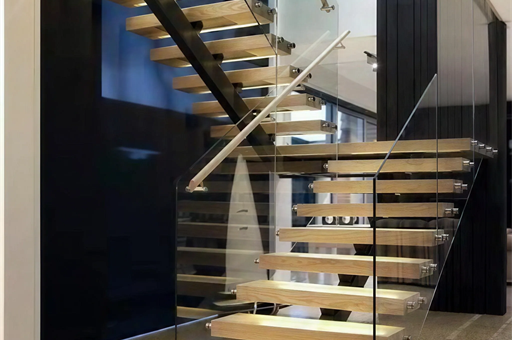
Because the beam sits centrally, the treads bridge across it and reach out symmetrically to the left and the right. Each step is fixed to the top of the beam, often through a hidden bracket or a welded plate, so the connection disappears from view. From the side, the eye reads a single clean line of steel with the steps stacked along it, which is the signature of a center stringer arrangement and the reason designers reach for it.
That central position is also what sets the engineering apart. A two-stringer stair shares the load between two outer spines, while a mono beam staircase concentrates everything into one. The beam therefore has to be deeper and stronger than either of a matching pair would be. Its depth, its steel grade, and its fixings all follow from the span and the load it has to carry.
How the Treads Span and Cantilever
With the support down the middle, each tread behaves like a small bridge balanced on a single point. The part of the step that reaches out past the beam to each side is a cantilever, which simply means it is supported at one end and free at the other. The further a tread reaches, the more leverage it places on that central fixing, so the width of the stair and the strength of each connection are closely linked.
This is why treads on a center stringer stair are built to be stiff in their own right. A solid hardwood tread, a thick steel plate, or a steel pan filled with timber or stone all resist flexing as you step toward the open edge. A good design keeps each tread feeling solid right out to its tip, with no spring or bounce, even though only the centre is held. Getting that balance right is the core of the engineering.
The cantilever is also what gives the staircase its lightness. Because the steps float out to open edges with no visible support beneath them, the flight reads as a series of planks hovering along a single line. It is a close cousin of the cantilevered look you see on a floating stair, but the load here travels through a central beam rather than into a wall.
Mono Beam vs Side-Stringer vs Double-Stringer
The clearest way to understand a mono beam staircase is to set it beside the two arrangements it competes with. A side-stringer stair carries its load on a spine under each outer edge, the most traditional layout. A double-stringer stair uses two beams set in from the edges. The mono beam keeps just one, dead centre. The table below shows where the support sits, the look each gives, and how each handles span.
| Arrangement | Where the support sits | Look & span |
|---|---|---|
| Mono beam (centre stringer) | One deep beam on the centreline; both outer edges open. Treads cantilever to each side. | Lightest, most sculptural. The beam must be deep, so the span it can hold depends on its depth and the tread stiffness. |
| Side-stringer (two outer) | A spine under each outer edge of every tread; both edges closed in. | The most traditional, solid look. Shares the load over two members, so each can be shallower for a given span. |
| Double-stringer (twin inner) | Two beams set in from the edges, often close together; a short overhang at each side. | A clean industrial look that keeps an open edge while spreading the load over two beams. |
In short, the support moves from the edges inward as you read down that list, and the staircase grows lighter and more open as it does. A side-stringer flight feels grounded and conventional. A double-stringer flight keeps an open edge while sharing the load. The mono beam takes the idea to its limit with a single line of steel, which is why it carries the most striking look of the three and the most demanding engineering.
The Look a Central Beam Gives
The reason most owners choose central beam stairs is the way they look in a room. With the structure gathered onto one slim line down the middle, the staircase stops reading as a heavy object and starts reading as a piece of sculpture. Light passes straight through the open edges, sightlines stay clear, and the steps seem to hang in the air rather than sit on a frame.
That openness is a gift in a modern interior. A mono beam staircase suits a double-height entrance, an open-plan living space, or any room where you want the stair to be a feature rather than a divider. Paired with a frameless glass or a slim metal balustrade, the flight almost disappears, leaving the treads and the daylight to do the work. It is a confident, contemporary statement that still feels warm when the treads are timber.
A mono-stringer wood staircase by Double Building Materials.
Materials and Finish
The central beam on these stairs is almost always steel, because steel packs the most strength into the slimmest section, and a slim beam is the entire point. The beam is then finished to suit the room, most often in a powder-coated matte black or a soft grey. On some projects it is clad in timber or wrapped in a steel skin, so it reads as a continuous solid form rather than a structural member.
The treads are where the staircase finds its character, and they are what you touch every day.
| Tread material | Character on a mono beam |
|---|---|
| Solid timber | The most popular choice. A thick hardwood tread feels warm, stays stiff to the open edge, and softens the steel. |
| Steel plate | A folded or solid steel tread keeps the whole stair industrial and monolithic, finished to match the beam. |
| Steel pan + infill | A steel tray filled with timber or stone marries a crisp edge with a natural top surface and good stiffness. |
| Stone or porcelain | A slim stone tread on a steel sub-frame gives a rich, solid feel; it needs careful detailing for weight and grip. |
Most indoor projects pair a powder-coated steel beam with solid timber treads, which is the combination in the video above. An all-steel flight reads more industrial, while a stone tread feels the most luxurious. Each choice changes the weight a tread places on the central beam, so the material is settled at the drawing stage, not after the steel is cut.
How We Build One
At Double Building Materials, a mono beam staircase begins as a drawing rather than a catalogue part. We take your floor-to-floor height, the run you have to work with, and the tread material you want, then turn them into a working shop drawing. That drawing fixes the depth and grade of the central beam, every tread connection, and the balustrade before any steel is cut, because a single-beam stair leaves little room to correct a connection on site.
Once you approve the drawing, we fabricate the beam and the treads and trial-assemble the whole flight on our 4,500 m² factory floor in Guangdong. That trial build is where we confirm the rise, the run, and the fit of every cantilevered step before anything ships, drawing on more than 25 years and 800-plus delivered projects across 60-plus countries. We then crate the staircase for export in the order your installer will need it.
Your own contractor or installer fits the stair on site from our drawings, and we can help you find one where local installation is available. We do not install on site or sign off your local code; that responsibility stays with your local team. For the wider family of single-spine stairs, see our complete mono-stringer staircase guide, and for the single-stringer layout in detail, read single-stringer staircases explained.
Code and Safety
A center stringer stair follows the same everyday stair rules as any other flight, with extra attention paid to the open edges. Under common US residential references, the rise and the run of each step, the headroom over the flight, and the handrail height are all governed in the usual way. The two figures owners ask about most are the railing height, which is commonly around 36 inches in a home, and the guard spacing, which typically stops a four-inch sphere from passing through.
Because both edges of a mono beam staircase are open, a guard and a handrail are essential rather than optional, and they are designed in from the start. Those numbers are widely used reference values, and your local adopted code edition is what actually governs, so confirm the current version with your local team. A well-engineered central beam stair is a safe, comfortable stair; the open sides simply make the balustrade part of the structure rather than an afterthought. You can see the straight flights we build on our straight staircase page.
Mono Beam Stairs FAQ
Are mono beam stairs and center stringer stairs the same thing?
Yes. They are two names for one staircase with a single beam running down its centre. Steel fabricators tend to say center stringer because they are naming the structural part, while designers and owners say mono beam because the slim beam is what you see. The construction is identical either way.
How does a single central beam hold up the whole stair?
The beam is a deep steel section set on edge, which makes it stiff over the full diagonal span. Each tread is fixed to the top of it and cantilevers out to each side. Because one beam carries everything, it is built deeper and stronger than either member of a matching pair would be.
Do mono beam stairs feel stable to walk on?
A well-engineered one does. The central beam and stiff treads are sized so each step feels solid right out to its open tip, with no spring or bounce. The handrail and guard add a sense of security on the open sides. As with any stair, the comfort comes from the engineering behind the drawing.
What is the difference between a mono beam and a double-stringer stair?
A mono beam uses one beam on the centreline, so the steps cantilever to both sides. A double-stringer uses two beams set in from the edges, which shares the load and leaves a shorter overhang. The mono beam looks lighter; the double-stringer can be slimmer in beam depth for the same span.
Can a mono beam staircase be made to any width?
Within reason. The wider the stair, the further each tread cantilevers from the centre, so the beam and the tread connections grow stronger to suit. There is a practical balance between width and beam depth, which is settled on the drawing for your span before any steel is cut.
Read more in the cluster: the full mono-stringer staircase guide and single-stringer staircases explained. Or browse the straight staircase range we build.
Double Building Materials draws, manufactures, trial-assembles, crates, and ships your mono beam staircase. Your own contractor or installer handles on-site installation and local code sign-off — we can help you find one where available. Dimensions above are common references and code values are typical US residential figures; your local adopted edition governs, so confirm the current version with your local team.
Talk to us on WhatsApp →