

Single Stringer Stairs Explained: How One Central Beam Carries the Flight-Staircase Guides
Mono Stringer Staircase · Single Stringer
Single Stringer Stairs Explained: How One Central Beam Carries the Flight
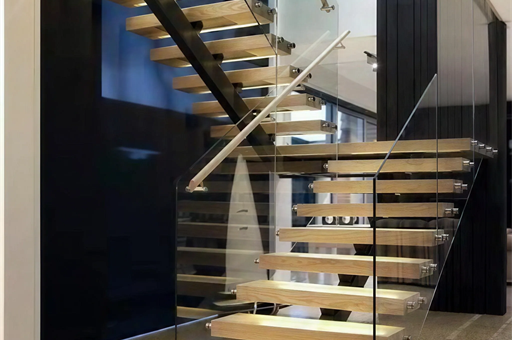
Single stringer stairs carry the whole flight on one central beam that runs up the middle of the staircase. Each tread bolts onto that beam and cantilevers out to both sides, so no support shows along the edges. The look is light and minimal, yet the single beam and its tread connections need real structural engineering.
A single central beam is the entire idea behind this staircase, and it is what gives the stair its clean, almost weightless line. This guide explains how single stringer stairs work, how the treads attach and cantilever to each side, and why a stair that looks so simple still demands careful engineering. It then compares the single-beam approach with double, twin, and side-stringer stairs so you can see where each one belongs.
What Single Stringer Stairs Are
A stringer is the structural spine of a staircase, the member that carries the treads and transfers their load down to the floor. Most ordinary stairs use two of them, one under each end of every tread. Single stringer stairs do the same job with just one, placed up the centre of the flight, so the structure runs down the middle instead of along the two edges.
That single central beam is the whole point. With nothing under the outer ends, each tread reaches out into open air on both sides, and the staircase reads as a row of steps floating above one slim spine. People also call this a single stringer staircase, a mono stringer stair, or a central stringer stair, and all of those names describe the same arrangement of one beam down the middle. It is a defining feature of modern, open-plan interiors, where the stair is meant to be seen rather than tucked away.
It helps to separate two ideas that often get confused. A single stair stringer describes where the support sits, in the centre rather than at the sides. A floating stair describes a look, where the risers are open and the support is hidden. Many single stringer stairs do float, but the two terms answer different questions, and keeping them apart makes the rest of this guide clearer.
The Single Central Beam
The beam is what makes single stringer stairs possible, and it is almost always steel. A hollow rectangular section, a deep flat plate, or an I-beam runs at an angle from the lower floor to the upper landing, following the pitch of the flight. Steel is the natural material here because it can carry the full load of the staircase in one slim member, where timber would have to be much bulkier to do the same work.
Because the support is concentrated in a single line, that one beam does a great deal of work. It resists the downward weight of people on the steps, and it also resists twisting, because every tread loads it off to the side rather than straight down. A central stringer stair therefore tends to use a stout, carefully sized section, often boxed for stiffness, anchored firmly at the top and bottom so the whole flight stays rigid underfoot. The slimness you see is the result of engineering, not an absence of it.
The beam can be celebrated or quietened depending on the look you want. Some owners leave it raw or powder-coated as a bold dark spine; others wrap it in timber or clad it to match the floor so it almost disappears. Either way, that single beam is the structural heart of the staircase, and every other decision works around it.
How the Treads Attach and Cantilever
The defining trick of single stringer stairs is the cantilever. Each tread sits on top of the central beam and reaches out past it to both sides, carried only at its middle. A cantilever is simply a beam or platform supported at one end while the rest projects unsupported, the same principle as a diving board, and here each step cantilevers left and right from the spine.
Treads usually attach through a bracket or a stub plate sitting on top of the beam, commonly welded or bolted there, and the tread then seats and fastens down onto it. That connection does the hardest job in the whole staircase. It has to hold each step level, stop it tipping when you stand near an outer edge, and resist the small flex and bounce that any cantilever wants to make. For that reason the bracket, its welds, and its bolts demand as much care as the beam itself.
This is also why the steps feel reassuringly solid on a well-built stair and slightly springy on a poorly built one. The longer a tread reaches past the beam, the more leverage it puts on that central connection, so wider single stringer stairs ask for stiffer treads and stronger brackets. Get the connection right and the cantilever is invisible in use; get it wrong and you feel it on every step.
Why a Minimal Stair Needs Real Engineering
Single stringer stairs look effortless, and that appearance can hide how much structure is at work. A conventional two-stringer stair shares each tread between two supports close to its ends, which is forgiving. A single-beam stair concentrates everything onto one central line and asks each tread to cantilever, which is far less forgiving and rewards precise design.
| What is engineered | Why it matters on a single beam |
|---|---|
| The beam section | Sized to carry the load and resist twisting, since every tread loads it off-centre. Too light and the flight feels lively underfoot. |
| The tread connection | Each bracket and weld holds a cantilevered step level and steady. This is the most worked detail on the staircase. |
| Top and bottom anchors | The beam must connect to sound structure at both ends, so the load has a clear path into the building. |
| Railing coordination | A glass or metal balustrade often adds stiffness and must be detailed into the treads from the start, not added later. |
None of this should put you off a single-beam stair. It simply explains why one is engineered from a drawing rather than assembled from a kit. When the beam, the connections, and the anchors are sized properly, single stringer stairs are quiet, firm, and long-lived; the engineering is what buys that calm everyday feel.
Single vs Double, Twin and Side Stringer Stairs
Knowing the alternatives makes the single-beam choice clearer. The difference between them is simply how many stringers carry the treads and where those stringers sit, and that one decision shapes the look, the cost, and the engineering of the staircase.
| Type | How it carries the treads |
|---|---|
| Single (mono) stringer | One central beam; treads cantilever to both sides. The most minimal look, and the most demanding to engineer. |
| Twin (double) central stringer | Two beams run up the centre, side by side. Still slim and modern, but the pair shares the load, so each tread cantilevers less. |
| Side stringer (closed) | A stringer runs along each outer edge of the flight, fully under the treads. The familiar, economical, traditional stair. |
| Cantilevered (hidden) | No visible stringer at all; treads anchor into a structural wall. The most dramatic, and tightly tied to the wall behind it. |
A twin or double central stringer is the close cousin of the single beam and is often chosen for a wider flight, because two spines share the cantilever and calm any bounce. A side-stringer stair is the most familiar and the most economical, but it shows its structure. A wall-anchored cantilever stair drops the visible beam entirely. We compare the single-beam and twin-beam approaches in detail in our guide to mono-beam versus centre-stringer stairs.
Spans, Widths and Where It Suits
Because the load funnels through one central beam, the width of the flight is the figure that matters most. A narrow-to-moderate domestic width is the comfortable home for a single beam, where each tread cantilevers a modest distance and the steps stay firm. As the staircase grows wider, the cantilever grows with it, and at some point a twin beam or an extra support becomes the sounder choice.
The rise between floors follows the usual pattern, with the beam taking the pitch and the floor-to-floor height setting the number of treads. A taller storey simply adds steps along the same spine. The honest summary is that single stringer stairs suit an open, modern interior of typical domestic width, where the floating line is the whole point and the spans are within easy reach of one beam. Push the width hard, and the design wants more structure to stay as quiet as it looks.
This is also why a single-beam stair is so often a straight flight or a gentle L-shape rather than a tight, complex turn. A straight run lets the beam do its job in one clean line, which is exactly the look most owners are after. You can see the straight single-beam stairs we build on our straight staircase page.
A U-shaped mono-stringer staircase coming together in factory assembly — tap to play.
Materials and Finishes
The beam sets the structure, but the treads and railing set the character. Because the spine is almost always steel, the choices that people actually see and touch are the tread material and the balustrade, and those are where a single-beam stair takes on its personality.
| Element | Common choices and character |
|---|---|
| Central beam | Steel box section, plate, or I-beam. Powder-coated dark for a bold spine, or clad to disappear. |
| Timber treads | Solid oak, walnut, or ash. Warm, popular, and an easy match to a wood floor. |
| Stone or porcelain treads | Marble or large-format porcelain for a solid, architectural feel. Heavier, so the connection is detailed to suit. |
| Steel treads | Folded or solid steel for an all-metal, industrial-modern stair that reads as one material. |
| Railing | Frameless glass keeps the open look; slim metal posts give a lighter, more linear line. |
A dark steel spine with warm timber treads and a frameless glass balustrade is a popular combination, because it keeps the floating look while feeling solid underfoot. Heavier stone treads change the connection detailing, which is one more reason we design the staircase as a whole rather than picking it part by part. The right mix depends on the floor it meets and the feeling you want the stair to give the room.
How We Make One
At Double Building Materials, single stringer stairs start as a drawing, never a kit. We take your floor-to-floor height, the width you want, and the look you are after, then turn them into a working shop drawing. That drawing fixes the beam section, every tread bracket, and the railing connections before any steel is cut, because a single-beam stair leaves little room to correct a connection once it is welded.
From there we fabricate the central beam and the tread brackets, then trial-assemble the whole flight on our 4,500 m² Guangdong floor. That trial build is where we confirm the pitch, the tread spacing, and the fit of every cantilevered step before anything ships. Once it passes, we crate the staircase for export in the order your installer will need it. Your own contractor fits it on site to our drawings, and we can help you find an installer where local fitting is available. We do not install on site or sign off local code; that stays with your local team. Our mono stringer staircase guide walks through the wider family of single-beam stairs.
Single Stringer Stairs FAQ
Are single stringer stairs strong enough?
Yes, when the beam and the tread connections suit the job. The whole load travels through one central beam, so that beam needs a stout section and the brackets must hold each cantilevered tread steady. A properly designed single-beam stair feels firm and quiet underfoot; the strength comes from the engineering rather than from extra visible structure.
What is the difference between a single and a double stringer staircase?
A single stringer staircase uses one central beam, so every tread cantilevers to both sides. A double or twin stringer runs two beams up the centre, side by side, and they share the load, which calms any bounce and suits a wider flight. The single beam looks the most minimal; the twin beam trades a little of that for added stiffness.
Do single stringer stairs need a wall?
No. Because the support sits in the central beam, single stringer stairs stand on their own and do not need a wall to lean on, which is part of their open appeal. The beam does have to be anchored firmly to sound structure at the top and the bottom. That is different from a wall-anchored cantilever stair, where the treads themselves are built into a wall.
Are the open gaps between the treads safe?
Open risers are common on single-beam stairs, and a frequently cited US residential reference limits the gap so that a small sphere of about four inches cannot pass through, which keeps it child-safe. Your local adopted code edition is what actually governs, so confirm the current version with your local team. A glass or metal balustrade runs alongside the treads to complete the safe enclosure.
Where do single stringer stairs work best?
They suit open, modern interiors of typical domestic width, where the floating line of treads is meant to be seen. A straight flight or a gentle L-shape lets the central beam work in one clean line. For a very wide flight, a twin central beam or an added support is often the sounder choice, so the steps stay as firm as the look is light.
Read more in the cluster: the full mono stringer staircase guide, and our side-by-side on mono-beam versus centre-stringer stairs. Or browse the straight staircase range we build.
Double Building Materials draws, manufactures, trial-assembles, crates, and ships your single stringer staircase. Your own contractor or installer handles on-site installation and local code sign-off — we can help you find one where available. Any dimensions above are common references and the code figure is a typical US residential value; your local adopted edition governs, so confirm the current version with your local team.
Talk to us on WhatsApp →