




Space-Saving Spiral Staircases for Small Spaces, Lofts & Narrow Layouts-Staircase Guides
Spiral Staircase · Small Spaces
Space-Saving Spiral Staircases for Small Spaces, Lofts and Narrow Layouts
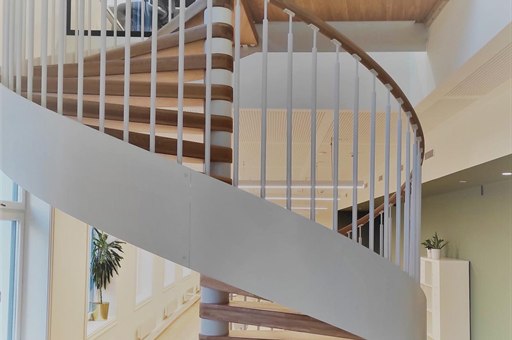
A space-saving spiral staircase coils a full flight around a single central column. It folds the entire climb into the smallest footprint of any stair. A compact circle, commonly three and a half to six feet across, fits where a straight flight cannot. That makes the spiral the natural answer for a loft, mezzanine, basement, or narrow layout.
Floor space is the whole reason a spiral exists. This guide explains how it earns that reputation. We compare its footprint against a straight flight and work through the smallest practical diameter. We set out the rooms where a compact spiral shines. Then we give the honest picture on the comfort trade-off and on moving furniture. The aim is a stair that fits your space without letting you down in daily use.
Why a Space-Saving Spiral Staircase Has the Smallest Footprint
The reason a spiral wins on floor area comes down to its geometry. The entire climb stacks vertically around one central column rather than travelling forward across the room. Every other staircase needs horizontal length to gain height. A straight flight in particular marches the full run from bottom to top, consuming a corridor of floor the whole way. A spiral turns that run into a tight circle, so the stair occupies roughly the area a small round table would take.
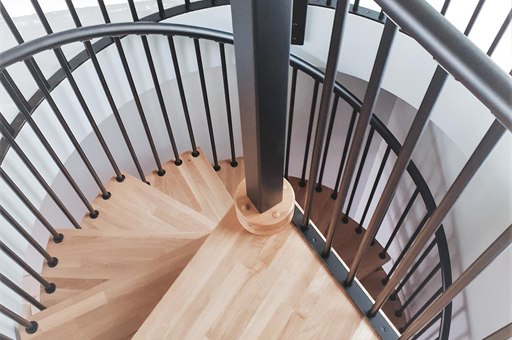
That single difference makes a space-saving spiral staircase so valuable in a constrained home. The treads radiate from the column like the spokes of a wheel, and the structure carries its load straight down through that one slim post. The footprint stays compact from the bottom step to the top. You are not trading away strength for the small footprint; you are simply choosing a shape that gathers the climb into a circle rather than a line.
There is an aesthetic dividend with the practical one. A compact spiral reads as a sculptural object rather than a passage, so the very feature that saves the space also becomes a centrepiece in the room. Picture a tight loft or a narrow plan. That combination is exactly why the spiral keeps being chosen: a real staircase, a small footprint, and a striking silhouette.
Footprint: Spiral vs a Straight Flight
It helps to picture the contrast directly, because the saving is dramatic once you compare the two side by side. A straight staircase rising a normal storey needs a long, uninterrupted run of floor, plus clear landing space at the top and the bottom. That run cannot bend around anything in the way. A compact spiral folds the same vertical rise into a circle, and the circle is the only floor it consumes. The numbers below are common references, not fixed figures. Your floor-to-floor height, your local code edition, and your chosen diameter all move them.
| Stair type | Approximate floor area it occupies |
|---|---|
| Straight flight | A long rectangular run, commonly several feet wide by ten to fourteen feet long, plus landings. The most comfortable to walk. The hungriest for floor. |
| L-shaped or curved stair | Folds the run around a corner. This trims the length but still claims a sizeable corner of the room. More generous underfoot than a spiral. |
| Compact spiral | A single circle the width of its diameter, commonly three and a half to six feet across. The smallest footprint of any full staircase. It fits where the others cannot. |
Read the table as direction, not as exact specification, because every project differs and the right answer always comes from your own drawing. The pattern is consistent across homes. A spiral occupies a fraction of the floor a straight flight demands, and that fraction is what lets a staircase exist in a room that could not otherwise hold one. We work through the underlying numbers in the spiral staircase dimensions guide: the diameters, the floor opening, and the headroom.
The Smallest Practical Diameter
A natural question follows: how small can a small spiral staircase actually go? The lower limit is set by the walking width, not the steel, which is the clear space your foot has on the wide outer part of each tread. Under common US residential references, that clear width is around 26 inches, pointing to an overall diameter near three and a half to four feet at the very tight end. Go narrower than that and the treads become too shallow to climb with confidence.
Those values are widely used reference figures, and your local adopted code edition is what actually governs the minimum. So confirm the current version with your local team before you commit to the tightest size. The practical takeaway is simple. A genuinely narrow spiral staircase, sized near that limit, fits an astonishingly small opening, while a slightly more generous diameter repays you with an easier climb. The smallest spiral staircase the rules allow is rarely the most pleasant to live with.
For an owner, the sensible approach is to treat the minimum as a floor, not a target. Find the smallest circle that physically fits the room, then open the diameter up as far as the space comfortably permits. That single decision shapes the whole experience of the stair. It is the first thing we settle together when a compact spiral begins as a drawing.
Best Uses for a Compact Spiral
A space-saving spiral staircase comes into its own where floor area is precious. It works best as a secondary route rather than the grand main staircase. The shape suits a defined set of situations. Recognising yours among them is the quickest way to know whether a compact spiral is the stair you want. The table gathers the most common ones, with the reason each fits the geometry so well.
| Where it fits | Why a compact spiral suits it |
|---|---|
| Loft conversion | A loft rarely has room for a straight run. A tight circle reaches the upper level without losing a bedroom to the stair. |
| Mezzanine level | A mezzanine is itself a space-saving idea. A slim spiral keeps the floor below open beneath it. |
| Basement access | A basement stair often lands in a tight corner. A compact spiral drops cleanly into it and frees the floor around it. |
| Compact second home | A holiday cottage or small apartment cannot spare floor for a full flight. The small footprint preserves living area. |
| Rooftop or terrace access | An outdoor spiral gives a compact, weatherproof route to a roof terrace or raised deck. A sprawling stair would dominate it. |
The common thread is the same across all of these. The spiral lets a real, permanent staircase occupy a space that could not hold a conventional flight. You can see the indoor and outdoor compact spirals we manufacture on our spiral staircase page. There the diameter, the tread material, and the railing are all chosen to suit the room.
The Loft and Mezzanine Case in Detail
The loft deserves a closer look, because it is the single most common reason owners come to us for a space-saving spiral staircase. A loft conversion turns an unused roof void into a bedroom, a studio, or a quiet retreat, and the whole project succeeds or fails on how little floor the access stair consumes. Give the staircase a long straight run and you give back much of the space the conversion was meant to win. Give it a compact spiral and the new room keeps almost all of its area.
The mezzanine works on the same principle from the opposite direction. A loft adds a room above; a mezzanine adds a floating platform within an existing volume, often over a living room or a workshop, and the floor beneath it must stay usable. A slim central column lands lightly in that lower space, so the spiral threads up to the platform without planting a bulky structure in the middle of the room. The result feels deliberate rather than imposed, which is exactly what a thoughtful owner is after.
For both, headroom is the detail to watch carefully, because the stair has to pass cleanly through the opening in the floor above. You need enough clear height where a person on the upper treads emerges, so that nobody is ever ducking under a beam. That clearance, alongside the diameter, is one of the first things we fix on the drawing. It is covered fully in the dimensions guide.
A compact outdoor spiral staircase we built and trial-assembled before crating.
The Comfort Trade-Off, and How a Bigger Diameter Softens It
Every space-saving decision carries a trade-off, and honesty about it is the whole point of this guide. The compact footprint of a spiral is bought with a tighter, turning climb, so the steps are wedge-shaped and you ascend in a curve rather than a straight line. On a very narrow spiral, the treads are shallow toward the central column, the turn is sharp, and two people pass each other less easily than on a straight flight. None of this makes the spiral a poor choice; it simply describes the character of a tight circle.
The good news is that the most effective remedy is also the simplest. A larger diameter widens the comfortable outer part of every tread, where your foot naturally lands, so the climb feels much more relaxed without changing anything else about the design. Move from the tightest permissible circle to a slightly more generous one and the everyday experience is transformed, turning a careful, deliberate climb into an easy one. This is why we steer owners toward the largest diameter their space will accept.
A continuous handrail that follows the outer edge does the rest of the work. Pair a generous diameter with a proper handrail to guide the hand, and the spiral becomes a comfortable, confident stair for most people in daily use. The compact footprint and an agreeable climb are not opposites; they are simply two dials you balance against the room you have.
Moving Furniture: the Honest Caveat
There is one practical limitation worth raising plainly before you decide, because it surprises some owners after the stair is in. A spiral staircase is genuinely awkward for moving large, rigid furniture between floors. A sofa, a wide wardrobe, or a king mattress cannot follow a tight turning curve the way it would travel up a straight flight. The central column and the curving railing leave no straight diagonal path for a bulky item. That is a property of the geometry, not a flaw in any particular stair.
In practice this matters far less than it first appears, and most owners plan around it without difficulty. Lofts, mezzanines, and second-floor retreats usually receive their large pieces another way: through a window, up an exterior route, or flat-packed and assembled in the room. Often a spiral is a secondary stair, and a straight or curved flight handles the main floors, so the question rarely arises at all. The honest rule is simple. If you expect to move large furniture up and down often, weigh that need before you make a spiral the only route to a floor.
Choosing the Right Size for Your Space
Pulling the threads together, sizing a space-saving spiral staircase is a single balanced judgement: fit the room, but stay as generous as the room allows. Begin by measuring the floor area you can devote to the stair and the matching opening you can make in the floor above, then identify the diameter that fits both. If that diameter sits comfortably above the tight minimum, you have an easy, pleasant climb. If the room forces you toward the smallest permissible circle, you accept a more careful climb in return for a staircase that fits where nothing else could.
At Double Building Materials, every compact spiral begins as a drawing rather than a catalogue item. We take your floor-to-floor height, the size of your floor opening, and the diameter your space permits, then turn them into a working shop drawing. That drawing fixes the central column, each tread, and the railing before any steel is cut. We fabricate the column and the treads, then trial-assemble the whole spiral on our Guangdong floor to confirm the rise and the turn. Then we crate it for export in the order your installer will need it. Your own contractor fits it on site from our drawings, and we can help you find one where local installation is available. We do not install on site or sign off local code; that stays with your local team. To start with the cluster, read the pillar guide on what a spiral staircase is, then browse our compact spiral staircase range.
Space-Saving Spiral Staircase FAQ
What is the smallest spiral staircase you can install?
Common US residential references set a clear walking width of around 26 inches. That points to an overall diameter near three and a half to four feet at the tight end. Below that the treads become too shallow to climb safely. Your local adopted code edition governs the true minimum. So confirm the current version with your local team before sizing the tightest circle.
How much floor space does a small spiral staircase save?
A compact spiral occupies only a circle the width of its diameter, commonly three and a half to six feet across. A straight flight needs a long run of floor plus landings. The spiral therefore frees a substantial area of usable floor. That is why it suits a loft, a mezzanine, or any narrow layout where a conventional staircase would not fit.
Is a narrow spiral staircase hard to climb?
A very tight spiral asks for a little more care, particularly on the descent. The treads are shallow toward the central column. A more generous diameter widens the comfortable outer part of each tread and softens the climb considerably. With a sensible diameter and a continuous handrail, a spiral is comfortable for most people in everyday use.
Can you move furniture up a spiral staircase?
Large rigid furniture is genuinely awkward to move up a spiral. A tight turning curve leaves no straight diagonal path for a sofa or a wide wardrobe. Most owners plan around it with a window, an exterior route, or flat-packed pieces. Weigh this caveat carefully if a spiral would be the only stair to a floor you use often.
Is a spiral staircase a good idea for a loft?
A spiral is one of the most popular choices for a loft. A loft rarely has room for a straight run, and the compact footprint preserves the new floor area. The main points to settle are a comfortable diameter and enough headroom where the stair passes through the floor opening. Our dimensions guide works through both.
Continue through the cluster: start with the pillar on what a spiral staircase is, then size yours with the spiral staircase dimensions guide. When you are ready, browse the full spiral staircase range for compact indoor and outdoor models.
Double Building Materials draws, manufactures, trial-assembles, crates, and ships your spiral staircase. Your own contractor or installer handles on-site installation and local code sign-off — we can help you find one where available. Dimensions above are common references and code values are typical US residential figures; your local adopted edition governs, so confirm the current version with your local team.
Talk to us on WhatsApp →