

Commercial Handrail Guide: Heights, Codes & Design - Railing Guides
Commercial Railing · Handrail Guide
Commercial Handrail Guide: Heights, Codes & Design for Public Spaces
A commercial handrail is the graspable rail people hold along stairs and ramps in buildings the public uses, such as hotels, condos, and lobbies. Common US references put its top between 34 and 38 inches above the stair nosing, with a continuous, easy-to-grip profile. Your local adopted code edition governs the exact figures.
Get a commercial handrail right and most guests never notice it. Get it wrong and an inspector certainly will. This guide walks through what counts as commercial, the heights and grip rules that recur across the codes, and how a handrail reads in a boutique hotel, a condo corridor, or a mixed-use lobby. We keep the numbers as common references and link to the deeper guides where a topic runs long.
What a Commercial Handrail Is
A handrail is the rail your hand holds as you walk a stair or a ramp. It runs along the flight at a height set for a comfortable grip, and it gives you something to steady against on the way up or down. The word commercial means the building is one the public uses or works in, not a single private home. A boutique hotel, a condo lobby, a mixed-use ground floor, and a restaurant terrace all fall under commercial rules.
That public setting is why a commercial handrail follows tighter rules than one at home. More people use it, and a wider range of people, so the codes ask for a continuous rail, a grippable shape, and an easy reach. The result feels generous rather than restrictive: an older guest, a child, or someone carrying luggage can all use it with confidence. A good handrail does its safety job quietly while still reading as part of the design.
It helps to separate two ideas that people often blur. The handrail is the graspable rail for your hand, while the guardrail is the taller barrier that stops a fall at an open edge. They are often built into one assembly, but they answer different rules and sit at different heights. We untangle the two later in this guide, because mixing them up is one of the most common reasons a commercial railing fails its first review.
Commercial Handrail Height
Height is the number everyone asks first, and the codes agree more than you might expect. Across the common US references, a commercial handrail sits with its top between roughly 34 and 38 inches. You measure straight up from the leading edge of each stair tread. That band suits different rail shapes and still keeps the grip within easy reach for most adults. The same band applies along the sloped run of a ramp.
| Common US reference | Typical handrail height (top above nosing) |
|---|---|
| IBC (commercial buildings) | Commonly 34 to 38 inches, measured from the tread nosing along the stair. |
| ADA (accessible routes) | Commonly 34 to 38 inches, with continuity and extensions added for reach. |
| OSHA (workplace stairs) | Often 36 to 38 inches on stairs staff use, such as back-of-house routes. |
The figures above are widely cited reference values, not the final word for your project. Your local adopted code edition is what governs. A city can also amend the model code. So treat this table as a starting point and confirm the current version with your local team. The cluster pillar on commercial railing height requirements shows how guard height and handrail height stack together on one stair.
Graspability and Profile
Height alone does not make a good handrail. The rail also has to be easy to wrap a hand around, which the codes call graspability. A round rail roughly one and a quarter to two inches across is the classic answer, because most hands close around it naturally. A rectangular or shaped rail is allowed too, as long as its size and edges keep that easy, secure grip for a wide range of users.
There is a second rule that designers sometimes forget: a small gap between the rail and the wall behind it. That gap, commonly around one and a half inches, lets fingers curl right around the rail rather than scrape the wall. It sounds minor, yet an inspector checks it, and a guest feels the difference every time. A handrail can be the right height but too fat to grip, or pinned too tight to the wall, and either way it can still fail a review.
For an owner, the lesson is to settle the shape early, alongside the look. A slim, well-shaped metal rail can be both beautiful and easy to grip. A chunky timber section may look the part yet be too wide to pass. We resolve this on the drawing, before anything is cut. So the rail you approve is the rail that gets built. The deeper rules sit in our commercial railing code overview.
Continuity, Extensions and Both Sides
In a commercial setting the handrail usually has to be continuous, which means your hand can slide the whole flight without lifting off at the turns. Where a stair has a landing or changes direction, the rail carries through rather than stop and restart. This matters most for an older guest, or anyone who leans on the rail for balance, because a break in the rail is exactly where a stumble happens.
Accessible routes add handrail extensions, where the rail runs a short distance past the top and bottom steps. That gives a steadying hold before you reach the first riser and after you clear the last one, which is where many trips occur. On wider commercial stairs the codes also commonly call for a handrail on both sides. Very wide flights may need a rail down the middle too, so no one is ever far from a grip.
For the owner, none of this needs to feel clinical. A continuous rail with neat returns and a clean extension reads as careful design. It does not read as a compliance afterthought. The trick is to plan continuity and extensions into the drawing from the start. Adding them to a finished stair later is awkward and rarely looks good. Accessibility details live in our ADA railing requirements guide.
Handrail vs Guardrail
The single most useful distinction in this whole topic is handrail against guardrail. The handrail is the graspable rail your hand holds, set in that 34 to 38 inch band. The guardrail is the barrier at an open edge, such as a balcony, a landing, or the open side of a stair. It sits higher, commonly around 42 inches in commercial buildings, to stop a fall. They do different jobs, so they answer different rules.
| Element | Job | Typical commercial height |
|---|---|---|
| Handrail | Graspable rail for the hand on stairs and ramps. | Commonly 34 to 38 inches above the nosing. |
| Guardrail | Barrier that stops a fall at an open edge. | Commonly around 42 inches in commercial buildings. |
On a typical open commercial stair, both come into play at once: a tall guardrail closes the open edge, and a handrail at grip height runs along it for the hand. Designers usually merge the two into one elegant assembly, and this is where a fabricator earns its keep, since the rail has to satisfy two heights and two rule sets in a single clean line. Setting the only rail at guard height is a classic way to fail a review.
Materials and Finishes
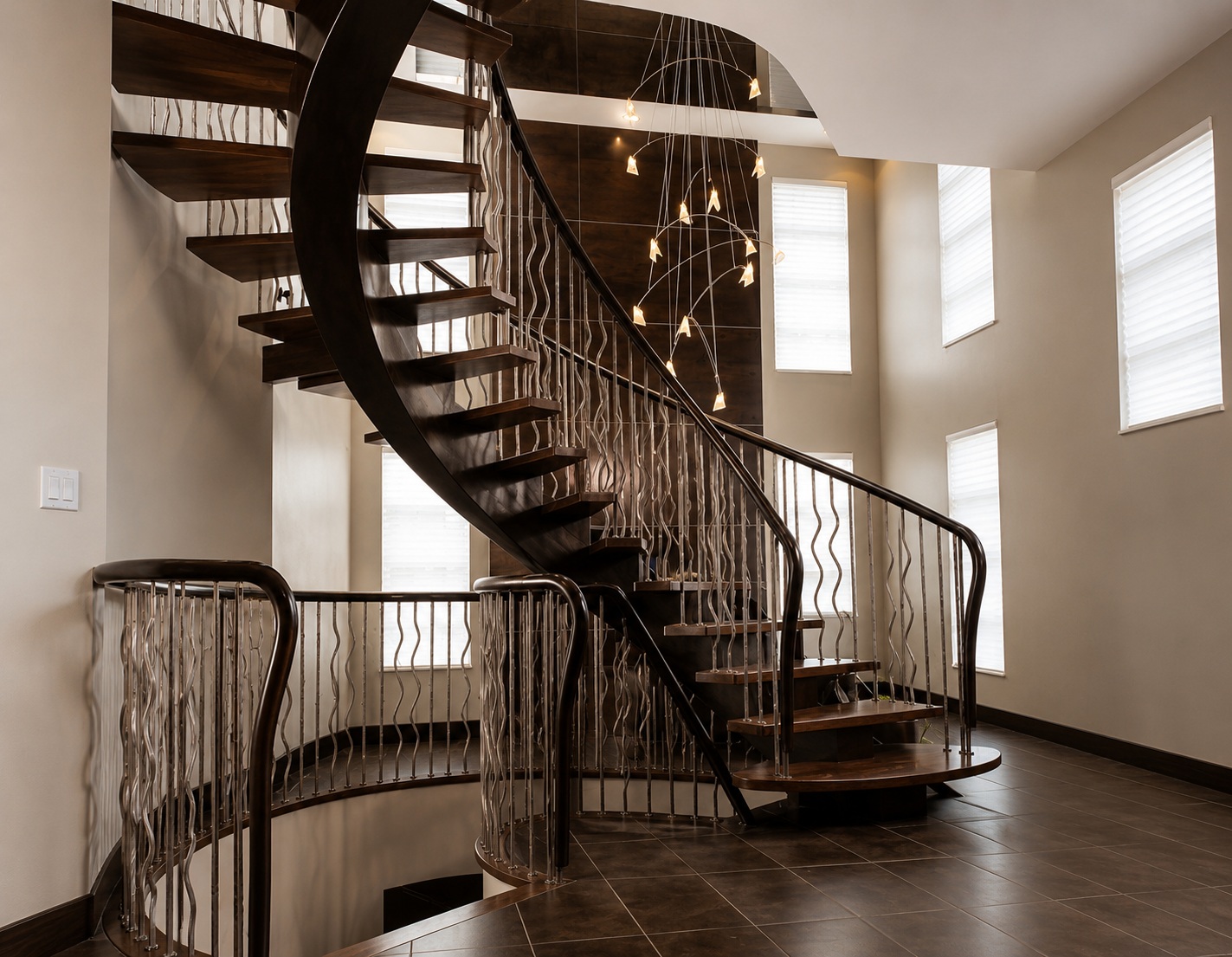
The material sets how the handrail looks, how it ages, and how it feels under a moving hand. Stainless steel is the workhorse of commercial work, because it shrugs off heavy traffic and cleans up easily, which matters in a lobby or a hotel that sees hundreds of hands a day. Powder-coated aluminium gives the same low upkeep in a lighter, more colourful form, and is a frequent choice for outdoor terraces and balconies.
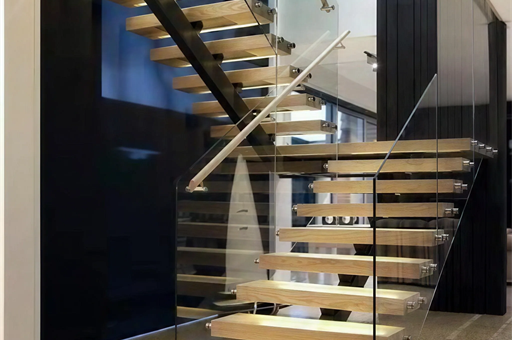
Timber and timber-capped metal rails warm up a hospitality space, where a guest expects something inviting to hold rather than a bare industrial tube. Glass infill below a metal handrail keeps a view open while the rail itself stays easy to grip, a mix that suits a modern condo or a mixed-use lobby. The point is simple: code and a high-end look are not at odds, because the rail can be the design feature and still pass its review.
Finish choice is also a durability call, above all outdoors and near the coast, where salt air is hard on metal. A marine-grade stainless or a quality powder coat lasts far longer in those settings. We help you weigh the look against the setting and the long-term upkeep. Then we carry the agreed material through the drawing into fabrication. Browse the range on our commercial railing and balustrade systems page.
Handrails in Real Project Types
Codes feel abstract until you place a handrail in a real building, so it helps to picture a few. On a boutique-hotel terrace, the rail has to read as part of the design, meet commercial heights, and stand up to weather. A slim powder-coated rail with glass infill often wins there. In a condo corridor and stair, continuity and an easy reach matter most. Residents of every age use it daily, year after year.
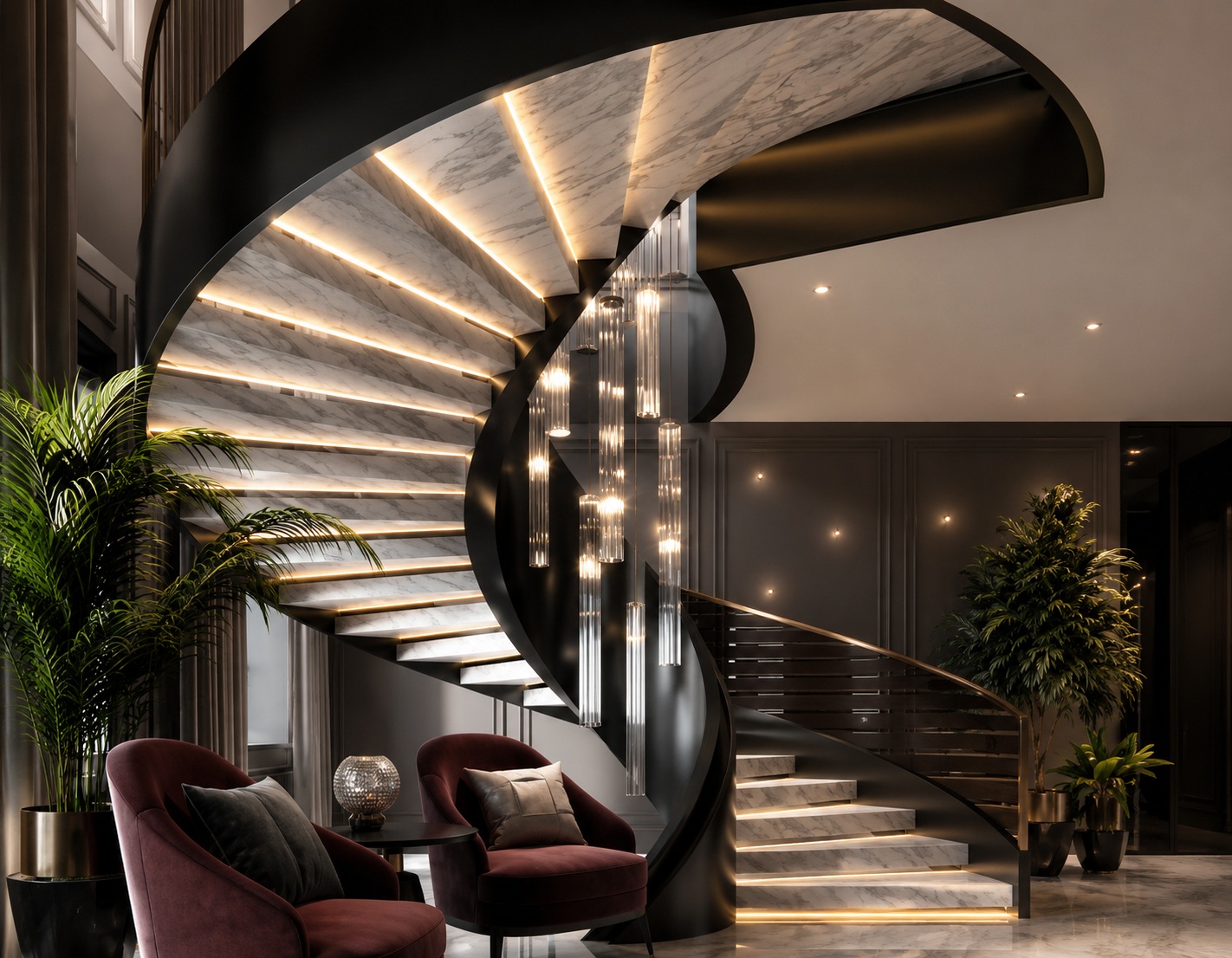
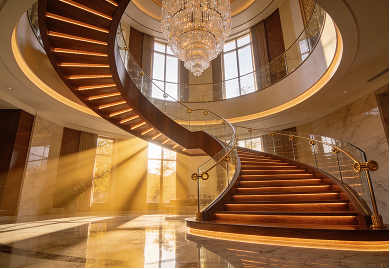
A mixed-use lobby is the showcase case. The stair is the centrepiece, and the handrail is part of the first impression. Here a polished stainless or timber-capped rail can be both a design statement and a code-ready grip. A villa with public frontage, or a small clubhouse, sits on the line between home and commercial. That is exactly where confirming the governing code early saves a costly change later. Our commercial stair railing guide goes deeper on stairwell layouts.
Across all of these, the handrail does the same quiet job. It is a safe, comfortable, good-looking grip that fits the building it serves. The differences are in the setting, the traffic, and the finish, not in the basic idea. Settle the project type early, and the rail can be designed for it from the first sketch. That is how a handrail ends up feeling effortless rather than bolted on.
Standard handrail height explained — how the IBC, ADA, and OSHA references compare. Double Building Materials.
Commercial Handrail FAQ
What is the required height of a commercial handrail?
Across the common US references, a commercial handrail sits with its top between roughly 34 and 38 inches, measured up from the leading edge of each stair tread. That band suits most adults and most rail profiles. Your local adopted code edition is what governs, so confirm the exact figure with your local team before you build.
What is the difference between a handrail and a guardrail?
A handrail is the graspable rail your hand holds on a stair or ramp, set around 34 to 38 inches high. A guardrail is the taller barrier at an open edge that stops a fall, commonly around 42 inches in commercial buildings. On an open stair you often need both, frequently combined into one assembly.
Do commercial stairs need a handrail on both sides?
Commonly yes. Many commercial stairs are required to have a handrail on both sides, and very wide flights may also need an intermediate rail down the centre so no one is far from a grip. The exact trigger depends on the stair width and the building use, so confirm it against your local adopted code edition.
What does graspable mean for a handrail?
Graspable means the rail is easy to wrap a hand around for a secure hold. A round rail roughly one and a quarter to two inches across is the classic choice, and shaped or rectangular rails are allowed within set limits. A small clearance to the wall, commonly about one and a half inches, lets fingers curl right around it.
Are ADA handrail rules different from the building code?
They agree closely on height. But ADA adds accessibility detail, such as continuous rails and extensions past the top and bottom steps. A commercial project usually has to satisfy both the building code and the accessibility rules at once. The two largely agree. Where they differ, you design to whichever rule is stricter on that point.
Keep reading the commercial cluster: commercial railing height requirements, the commercial railing code overview, ADA railing requirements, and commercial stair railing for stairwells. Ready to specify? See our commercial railing and balustrade systems.
Double Building Materials draws, manufactures, trial-assembles, crates, and ships your commercial handrail and railing. Your own contractor or installer handles on-site installation and local code sign-off — we can help you find one where available. The heights and dimensions above are common US references and typical code values; your local adopted edition governs, so confirm the current version with your local team. With 25+ years of factory experience, a 4,500 m² facility in Guangdong, China, and 800+ projects shipped to 60+ countries, we coordinate drawing-first and trial-assemble before packing.
Talk to us on WhatsApp →