




Commercial Railing Code: Heights, Gaps & Loads Explained -Railing Guides
Commercial Railing · Code Guide
Commercial Railing Code: A Plain-English Guide for Owners and Their Teams
Commercial railing code sets the rules a railing must meet in a public or shared building. In the United States the IBC, ADA, and OSHA give the core figures: guards roughly 42 inches tall, infill that blocks a 4-inch sphere, and continuous handrails near 34 to 38 inches. Your local adopted edition always governs the final numbers.
A railing in a hotel lobby or a condo corridor carries far more than a private stair at home, so the code that shapes it is stricter and more detailed. This guide walks an owner through the rules in plain language, with the real reference figures laid out in tables. It explains why each number exists, then points you to the deeper guides where a topic needs more room.
What Commercial Railing Code Means
Commercial railing code is the set of rules a railing must meet when it sits in a building the public uses or shares. A hotel terrace, a condo corridor, a mixed-use lobby, an office mezzanine, even the frontage of a large villa let to guests all fall under it. The code asks one core question: will this railing keep a crowd of people safe at a height where a fall would hurt them?
A home railing answers to lighter residential rules. A commercial railing answers to a stricter family of codes, because more people lean on it, push against it, and rely on it every day. The figures cover three things at heart: how tall the railing stands, how small the gaps in it must be, and how hard it can be pushed before it gives. Each rule traces back to a real way people get hurt.
For an owner, the point is not to memorise the numbers but to know they exist and to design around them early. A railing chosen for its look that later fails a code check is an expensive lesson. The good news is that a clean, modern railing meets these rules comfortably when it is drawn correctly from the start, which is where a manufacturer's shop drawing earns its keep.
The Codes That Apply, and Who Writes Them
In the United States, a commercial railing usually answers to three documents at once. The IBC is the main building code for commercial work, and it sets guard height, infill, and the loads a railing must hold. The ADA adds accessibility rules, mainly for handrails people grip on a ramp or a stair. OSHA covers workplaces and back-of-house areas where staff work, such as a plant platform or a service mezzanine.
| Code | What it governs, and where it lands |
|---|---|
| IBC | The core commercial building code. Sets guard height, the four-inch sphere rule, and the load a railing must resist. Most public buildings start here. |
| ADA | Accessibility law. Mainly shapes handrails on ramps and stairs — the gripping height, the continuous run, and the extensions at each end. |
| OSHA | Workplace safety. Applies to staff-only areas such as roof access, plant platforms, and service stairs, where the figures differ from public space. |
| Local edition | Each city or state adopts a specific year of the IBC, sometimes with changes. This local edition is the version that actually governs your job. |
These figures are widely used references, but your local adopted edition is the one that controls the final job, so confirm the current version with your local team. Outside the United States, an Australian project leans on the NCC and on AS 1288 for glass, and other regions have their own books. The principle holds everywhere: a public railing is tested harder than a private one, and the local code is the last word.
Guard Height and the Figures You Will See
A guard is the barrier along an open edge that stops a person falling. In commercial work, the common reference height is around 42 inches measured from the walking surface to the top of the rail. That is taller than the typical 36 inches used in homes, and the extra height reflects the crowds and the higher drops in public buildings. A boutique-hotel terrace and a condo balcony both read against this 42-inch figure.
| Common US reference | Typical figure |
|---|---|
| Commercial guard (IBC) | About 42 in. minimum from the walking surface to the top. |
| Residential guard (IRC) | About 36 in., used in single-family homes, lower than commercial. |
| When a guard is required | Commonly where a walking surface sits about 30 in. or more above the level below. |
| OSHA workplace guard | Around 42 in. for staff platforms and service walkways. |
The 30-inch trigger matters more than people expect. A raised lobby floor, a sunken lounge, or a planter edge can cross that line and turn a low decorative rail into a required guard overnight. We map every open edge on the drawing first. The rail that the design wants and the guard that the code wants then turn out to be the same piece of steel, not two arguments at the end of the job.
Infill, Gaps, and the Four-Inch Sphere
Height keeps an adult from going over the top. Infill keeps a child from slipping through the side. The classic test in commercial code is the four-inch sphere: a ball four inches across must not pass through any opening in the guard below the required height. That single rule shapes how close balusters sit, how tight cable rows run, and how a glass panel meets its frame.
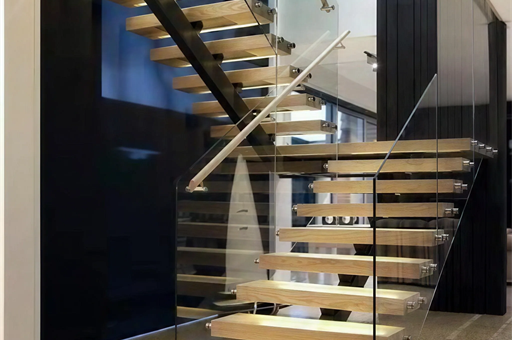
The four-inch sphere is why cable railing on a commercial job runs its cables closer together than many owners first picture. It is also why a glass guard is so often the cleanest answer: a solid panel has no gap to test at all. A condo corridor with a glass balustrade keeps the view open and passes the sphere rule by design. A cable rail on a terrace reaches the same safety with tight, evenly tensioned rows. The look differs; the rule underneath is identical.
There are a few extra openings to watch. The triangle formed by a stair tread, a riser, and the bottom rail has its own limit, and the gap at the base of a guard is checked too. These are exactly the spots a clean drawing settles before fabrication, because a baluster spacing that looks right on a sketch can quietly fail the sphere once the real geometry is set. We resolve all of it on paper first.
Handrails and Accessible Reach
A guard stops a fall; a handrail gives a hand something to hold while moving. On a commercial stair or ramp, the two often sit together, and the handrail answers to the ADA as well as the building code. The common gripping height runs about 34 to 38 inches measured above the stair nosing or the ramp surface, lower than the 42-inch guard, so a tall guard frequently carries a graspable handrail set within it.
The ADA also asks a handrail to be continuous along the flight and to extend a little past the top and bottom steps, so a hand keeps its grip right to the end. The rail profile has to be easy to wrap a hand around, which rules out a sharp or oversized section. None of this is hard to build; it just has to be drawn in from the start, because adding compliant extensions to a rail already fabricated is awkward and rarely looks intentional.
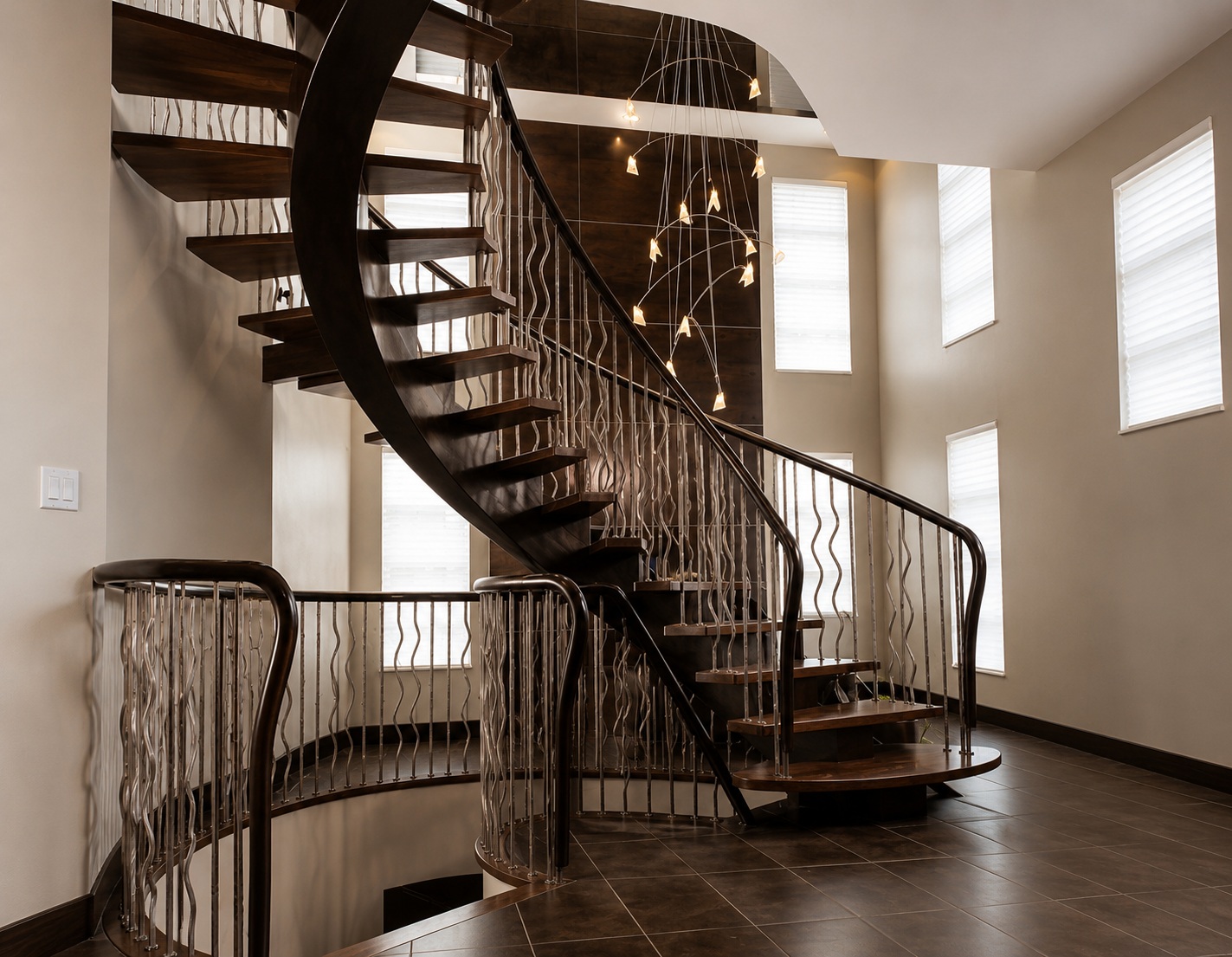
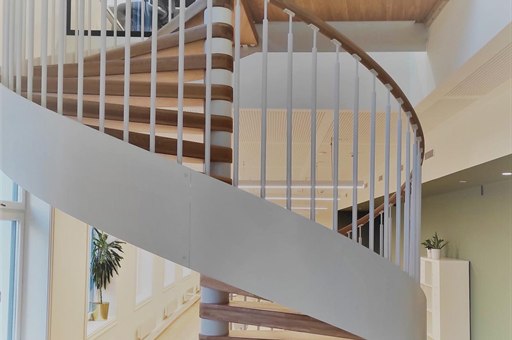
For an owner, the takeaway is simple: a public stair almost always needs a proper graspable handrail, not only the decorative top rail of a guard. A mixed-use lobby stair, a hotel feature stair, and a condo amenity level all read against the ADA here. We dig into the gripping rules, the extensions, and the profiles in the ADA railing requirements guide and the broader commercial handrail guide.
Load: the Strength a Railing Must Hold
Height and gaps are the visible part of the code. Strength is the part you cannot see but must never skimp. Commercial code requires a guard and a handrail to resist a real push from a crowd. The reference figures describe a concentrated load applied at the top, plus a spread load along the run. The railing has to take either one without bending past its limit or working loose at the base.
This is where the connection to the structure matters as much as the rail itself. A handsome guard bolted into a thin slab edge or a weak fascia is only as strong as its weakest fixing. That is a common failure point on jobs that treated the railing as a finish rather than a structural element. The fixings, the base plates, and the embed details all carry the load, so they belong on the engineered drawing from the outset.
At Double Building Materials, every commercial railing starts as a shop drawing that resolves the load path before any steel is cut. We size the posts, the base plates, and the fixings to the load the project calls for, then we trial-assemble the railing on our Guangdong floor so the connections prove out before it ships. We do not certify the load against your local code, since that sign-off belongs to the engineer of record on your project; we build to the drawing the team approves.
A general explainer of how IBC, ADA, and OSHA each treat handrail height — Double Building Materials.
How the Code Reads on Real Projects
The rules feel abstract until you set them on a real edge, so here is how they tend to land. A boutique-hotel terrace wants an open view, so a frameless glass guard at the 42-inch reference keeps the sightline and passes the sphere rule with no gaps to test. The same height, the same panel, and the look the owner asked for end up agreeing with the code rather than fighting it.
A condo corridor that overlooks an atrium reads the same way, often with a slim metal or glass guard that holds the line height while staying light. A mixed-use lobby stair adds the handrail layer, so a graspable rail with proper extensions sits inside or alongside the guard. A villa let to guests crosses into commercial territory at its frontage and terrace, where the public-building figures apply rather than the softer home ones.
The thread through all of them is the same: settle the height, the gaps, and the load on the drawing, and the railing the design wants is the railing the code allows. Where a project needs the exact guard-height figures for each setting, our commercial railing height pillar lays them out in full. When you are ready to specify the steel, browse our commercial balustrade and railing systems.
Commercial Railing Code FAQ
How tall does a commercial railing have to be?
The common US reference is about 42 inches from the walking surface to the top of the guard, taller than the roughly 36 inches used in homes. The extra height reflects the crowds in public buildings. Your local adopted code edition sets the figure that actually governs, so confirm the current version with your local team before you build.
What is the four-inch sphere rule?
It is the gap test in commercial railing code. A four-inch ball must not pass through any opening in the guard below the required height. The rule keeps a small child from slipping through, and it decides how close balusters sit, how tight cable rows run, and why a solid glass panel passes so cleanly.
When is a railing required on a commercial floor?
A guard is commonly required where a walking surface sits about 30 inches or more above the level below. A raised lobby, a sunken lounge, or a terrace edge can cross that line easily. Below the trigger a railing may still be wanted for comfort, but above it the guard becomes a code requirement rather than a choice.
Is the IBC the same as the ADA for railings?
No, they cover different things and often apply together. The IBC sets guard height, the gap rule, and the load a railing must hold. The ADA shapes the graspable handrail on a stair or ramp, including its height, its continuous run, and its end extensions. A commercial stair usually has to satisfy both at once.
Does my railing supplier handle code compliance?
A manufacturer like us draws and builds the railing to the figures your team specifies, and trial-assembles it before it ships. The code sign-off itself stays with the engineer of record and the local authority on your project. Bring the code targets to us early and we design the railing to meet them, then your local team certifies the finished job.
Keep reading the cluster: the commercial railing height pillar, the ADA railing requirements, the commercial handrail guide, and commercial stair railing for stairwells. Ready to specify? See our commercial balustrade and railing systems.
Double Building Materials draws, manufactures, trial-assembles, crates, and ships your commercial railing. Your own contractor or installer handles on-site installation, and the engineer of record plus the local authority handle code sign-off — we can help you find an installer where available. Code figures above are common US references (IBC, ADA, OSHA; NCC and AS 1288 where relevant); your local adopted edition governs, so confirm the current version with your local team.
Talk to us on WhatsApp →