

Cable Railing Kits vs. Custom-Built Sets: How to Choose for Decks and Stairs
Railing Guides · Kit vs. Custom Buyer Triage
Retail cable railing kits come either as wire-and-fitting spools or as fixed 6-foot post cartons built for simple level decks. Custom-built sets ship matched to your exact deck spans, stair pitch, and side mounts, pairing numbered posts, top rails, 316 wires, and ends after shop trial assembly so crews skip saw cuts.
Search online for wire railing and three very different offers show up under the same name. One listing sells only a coil of wire and a bag of studs. Another sells a 6-foot post box from a home store. The third builds a full railing set around your house plan. Knowing where stock boxes shine—and where they leave your crew cutting rails and fighting stair holes—protects both your look and your labor budget. For system basics first, read our complete cable railing guide.
What Comes Inside Retail Cable Railing Kits vs. Custom Sets
Before you compare supplier quotes, check what actually lands on your driveway. Many owners researching cable railing kits online assume every box packs structural posts, continuous top rails, and sloped stair parts—only to find half the frame missing at delivery.
- Tier 1 — Wire-and-stud spools: You receive stainless wire rolls, crimp sleeves or swageless jaws, and pull bolts, while buying posts locally and drilling every plumb or angled hole yourself.
- Tier 2 — Stock 6-ft or 8-ft post boxes: Pre-drilled metal posts ship in standard 36-inch or 42-inch heights with straight rails, working fine until your deck hits odd lengths or stairs.
- Tier 3 — Custom project sets (how DBM builds): Double Building Materials never sells loose spare parts or DIY wire bags. Instead, we fabricate complete project-matched sets pairing corner posts, stair posts, intermediate spreaders, continuous rails, and 316 wires.
Why does building complete project sets improve alignment and structural stiffness? Frame strength lives at the joints—where side brackets clear roof gutters, where level rails meet sloped stair beams, and where end posts hold cumulative wire tension. View full post, rail, and wire sets on our stainless steel cable balustrade page.
Where Stock Box Kits Hit Layout Walls on Real Homes
Stock 6-foot post cartons bolt up fast when a deck edge happens to measure an exact multiple of 6 feet with zero stairs. Custom residential layouts rarely match stock carton math.
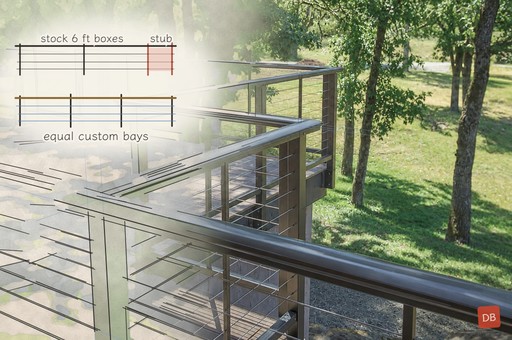
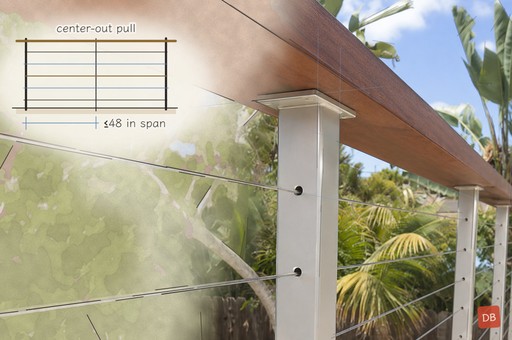
Take a 19-foot-4-inch deck overlooking your garden. Three 6-foot cartons span 18 feet and leave an awkward 16-inch stub bay right beside your sliding glass door. Either you stare at a cramped stub panel in your main view, or your crew saws down all four rail tubes outdoors, dabs touch-up paint on raw cuts, and scraps paid offcuts. When our engineering team draws a custom set for that 232-inch span, we split the edge into five equal 46.4-inch bays so every bay stays under the 48-inch deflection limit.
Sloped stair flights expose modular carton limits even faster, since universal stair posts punch wide elongated slots so cables can tilt anywhere from 28 to 38 degrees. Up close, those elongated slots leave visible gaps around each cable while beveled washers rest on narrow shoulders. On a custom stair assembly, CNC machinery bores circular holes matched to your exact step rise and run while keeping proper ADA and residential handrail clearance. Review slope geometry in our stair cable railing guide.
Bay spacing on a 19 ft 4 in deck: three 6-ft stock boxes leave an awkward 16-in stub at the end (A), while a custom set spaces five equal 46.4-in bays with zero saw cuts (B).
Site Sawing and Drilling Hours vs. Shop Dry-Fit Checks
Published carton tags reflect raw hardware packages alone, whereas jobsite installation hours determine your actual completed investment. Every miter cut, fascia shim, and stainless hole shifted from factory CNC equipment onto a residential sawhorse multiplies carpentry labor and coastal corrosion exposure—a factor examined in our cable railing cost breakdown.
Imagine hand-drilling forty-four angled holes through heavy stainless stair posts outdoors, where cobalt bits overheat rapidly, internal burrs snag wire strands during installation, and one misaligned hole ruins an expensive termination post. Sawing powder-coated aluminum top rails on site also strips baked factory seals right where coastal moisture enters connection sleeves. Inside our Foshan facility, every miter, welded flange, side bracket, and angled hole is completed before architectural coating or 316 brushing, followed by full trial assembly before packing to verify alignment.
Bracket shape changes site speed too. Stock boxes pack one flat plate for every house, leaving crews to stack shims around stone columns, flashing, or gutters. In a drawn project set, side standoffs fit your exact overhang clearance, and posts near house walls use hidden inner pull bolts so crews never run out of wrench space. Even gate latches and top-of-stair gates integrate cleanly into the same top-rail line when planned on one master drawing instead of bolted on as an afterthought.
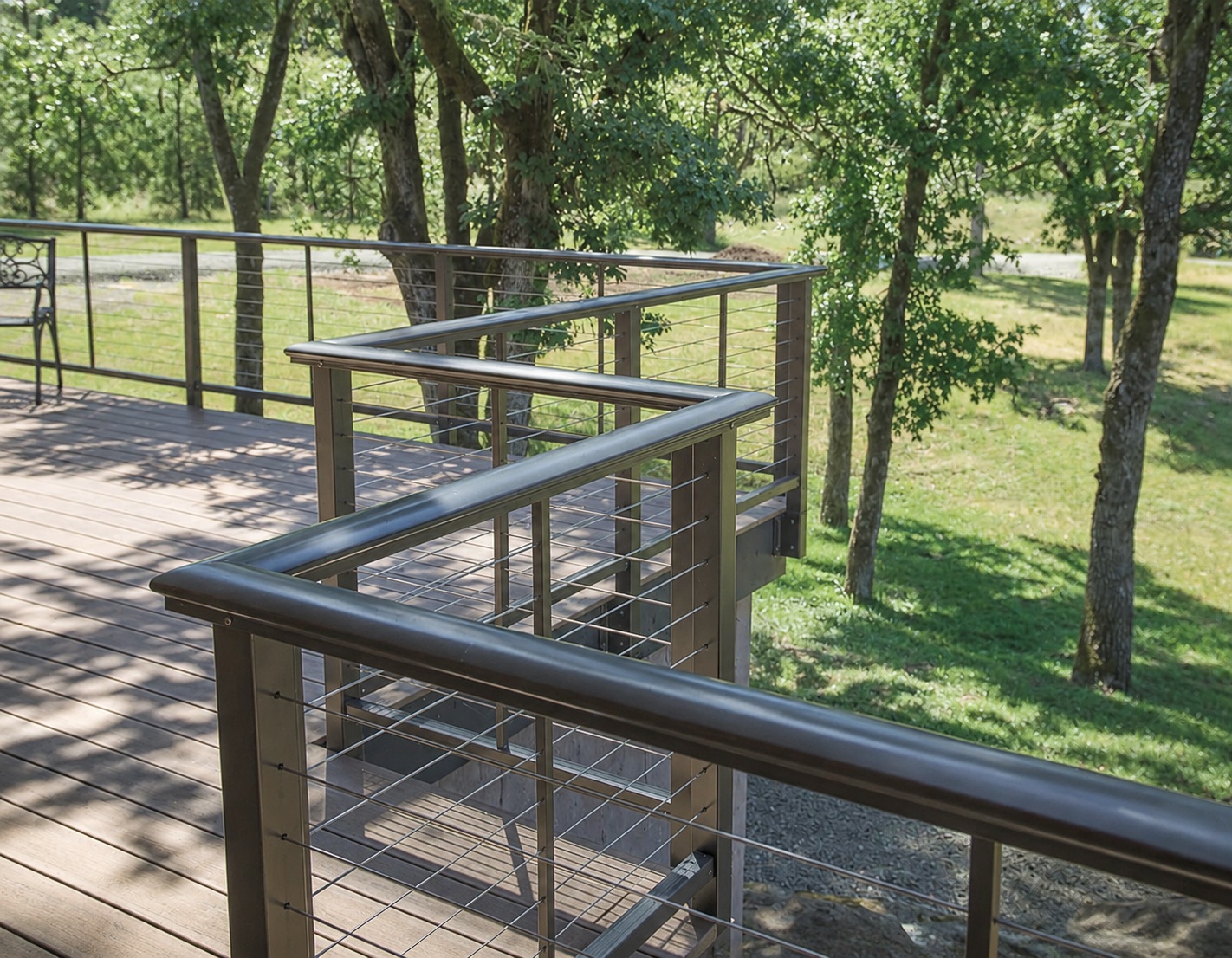
Made-to-order porch and deck set: balanced post bays and factory-welded corners bolt down cleanly without field cut-downs.
Side-by-Side Table: Wire Spools, Post Boxes, and Custom Sets
Compare wire-only bags, fixed-length post cartons, and custom project sets across the six points that decide site fit and finish life.
| Check Point | Wire-Only Hardware Bags | Stock 6-ft / 8-ft Post Kits | Custom Project Sets (DBM) |
|---|---|---|---|
| What ships to you | Wire spool plus swage or jaw ends only. | Stock-height posts, straight 6 or 8 ft rails, and wire. | Tagged posts, rails, mid bars, 316 wires, and tension ends. |
| Odd deck lengths | Fits if you buy and bore your own posts. | Leaves short stub bays or forces saw cuts on every rail. | Drawn to exact inches for equal bays under 48 in. |
| Stair slope fit | Hand-drilled on site using a clamp jig. | Wide oval slots plus loose angled adapter washers. | CNC-bored to your exact rise and run; checked in dry-fit. |
| Side fascia mounts | Depends on whatever posts you find locally. | Mostly flat top plates; tricky around gutters or trim. | Top plates or custom side brackets sized to clear trim. |
| Coating at cut ends | Wood posts weather; site-drilled steel stays bare. | Sawed rail ends lose baked coating inside slip joints. | Cut, welded, and bored before baked coating or 316 finish. |
| Right project match | Adding wire inside a sound existing steel frame. | Small, flat rectangular deck needed this weekend. | Custom homes, multi-turn stairs, side mounts & full villas. |
When a Retail Box Kit Makes More Sense Than Going Custom
Counter-question: when should you buy retail cable railing kits locally instead of ordering a custom set from our factory? Pick a local stock kit whenever you have a small, flat rectangle on a tight two-week clock, or when you only need a short straight repair.
Honest triage saves both sides wasted effort. Custom building covers CAD shop drawings, custom cutting and welding, full shop trial assembly, and ocean freight crating. Suppose you are listing your home for sale next month and just need 12 feet of straight 36-inch rail across a small flat back landing with no steps. Buying two stock cartons locally finishes that small job right away without waiting on custom production and sea transit.
Once your plan grows to wrap-around decks, L-corners, sloped stairs, side fascia mounts, custom black or bronze coatings, or a combined stair-and-railing order, the trade-off flips. Rather than paying skilled local carpenters for days of metal cutting and layout fixes, your tagged set lands ready to bolt down. Read our cable installation pre-production guide to see how those six site steps run from chalk line to final pull.
Multi-family balconies and coastal vacation homes amplify that gap even more. When ten apartment terraces or three stacked oceanfront decks need identical tension, matching finish batches, and labeled crate staging by floor, piecing together dozens of retail boxes creates inventory chaos. One factory schedule keeps alloy heat numbers, powder-coat gloss levels, and post heights uniform from the ground veranda to the rooftop terrace.
Inside a custom-drawn project set: tagged end posts, mid spreaders, continuous mitered top rails, and sloped stair bores match one master shop drawing.
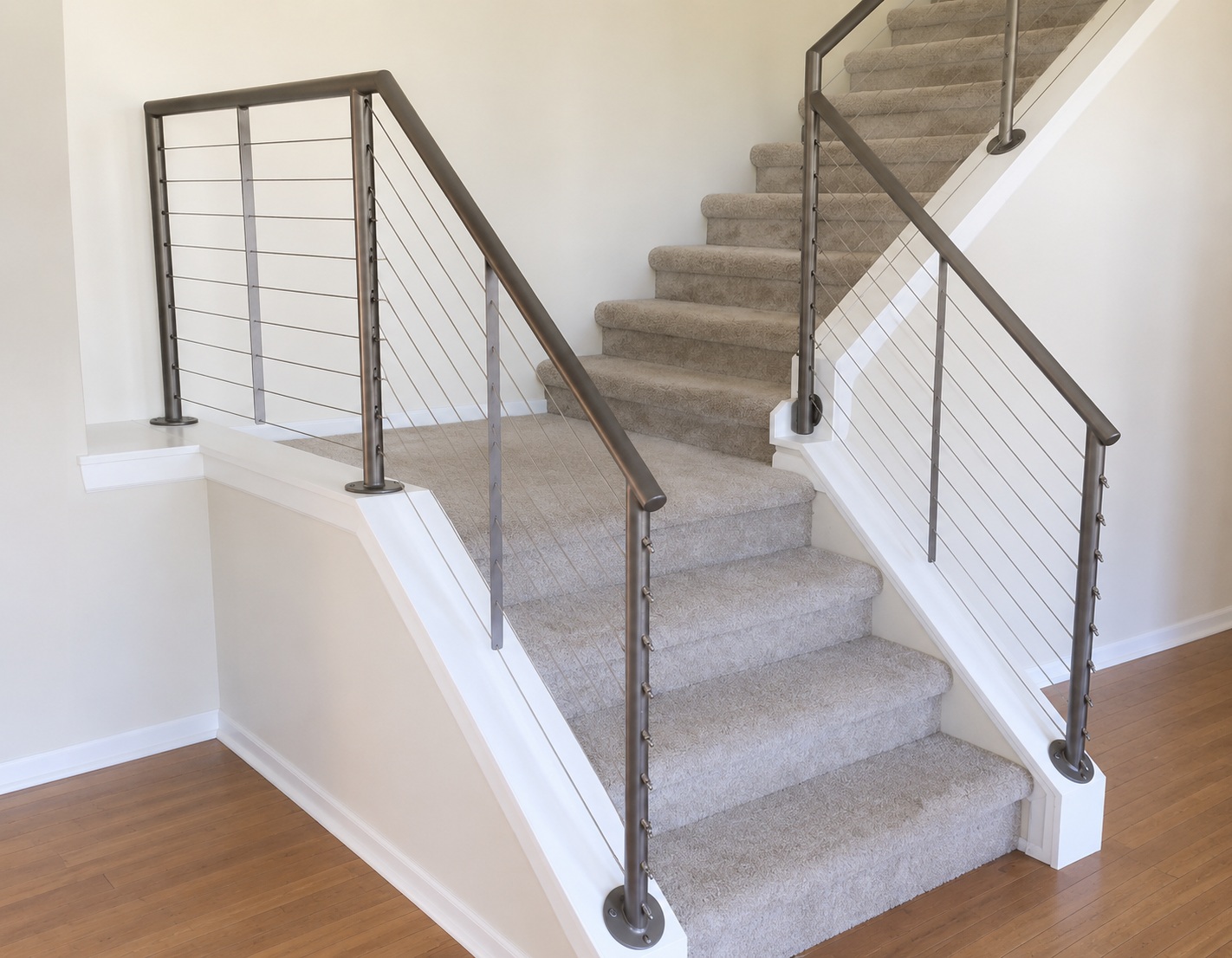
Custom multi-turn stair set: CNC-angled landing and flight posts keep cable spacing crisp across turns without oval-slot gaps.
How a Custom Set Moves From Rough Sketch to Labeled Crates
Ordering a custom cable set follows the same disciplined four-stage process we run across more than 800 staircase, railing, and whole-home projects worldwide:
- 1. Share a plan sketch and framing photos: Send deck edge lengths, rim joist photos, and stair rise and run numbers—a neat hand sketch works great.
- 2. Approve CAD shop drawings: Our team maps equal post spans, plumb corner pairs, spreader bars, 1/8-in or 3/16-in 316 cable runs, and 34-to-38-in stair rail heights.
- 3. CNC boring and shop trial assembly: We cut, weld, pre-bore, coat, and dry-fit your bays in our 4,500 m² Guangdong plant, sharing check photos and video before crating.
- 4. Tagged export crates and install choice: Parts ship numbered by bay for your builder to bolt down, or with separate install quotes across the USA, Australia, and Canada.
Every project crate also packs UV-stable isolation grommets, thread paste to stop stainless galling when pulling tight, and matching fasteners sorted by bay tag. Instead of sorting mystery boxes across a driveway or running to local stores for metric bolts, your crew opens neat bundles matched straight to the approved shop plan. Clear stamped tags on every post flange keep multi-level deck installation moving steadily without guesswork or spare-part delays.
Buyer Questions on Cable Kits and Made-to-Order Sets
Does DBM sell five spare turnbuckles or a lone roll of wire?
No. We build complete, project-matched railing sets for homes and commercial jobs rather than selling loose retail parts. Every full set ships with extra grommets and fasteners matched to your order.
Can we choose between aluminum posts and stainless steel posts?
Yes. We build brushed or coated 316 stainless steel frames for salt air and slim lines, as well as heavy coated aluminum frames—see our aluminum deck railing options for color-matched metal styles.
How does a custom set join a 36-inch stair rail to a 42-inch high deck guard?
Instead of clunky add-on brackets, our shop drawings detail either a neat twin-post step break or a welded gooseneck return at the top landing post so both heights look clean and pass grip checks.
Do wires arrive pre-cut to exact inches or with trim room on one end?
Usually one end arrives factory-swaged with a slim machine stud while the pull end leaves planned trim room for a swageless lock jaw or turnbuckle take-up, giving your crew stress-free slack removal.
Can we ship a custom indoor stair and outdoor deck cable set together?
Yes. Many villa owners bundle stairs, deck railings, and custom cabinets into one drawing package and one sea container to match finishes. Check our deck cable railing guide for exterior planning notes.
Keep reading: Custom Stainless Cable Balustrade · How to Install Cable Railing: Pre-Order Checks · Cable Railing Cost Drivers · Complete Cable Railing Guide
Scope note: Double Building Materials prepares shop drawings, manufactures complete project sets, trial-assembles before packing, and ships export-crated orders. Local authorities confirm code compliance; setup is completed by your contractor or separately quoted partner crews in the USA, Australia, and Canada.
Talk to us on WhatsApp →