

Curved vs Spiral Staircase: Whats the Difference?-Staircase Guides
Curved Staircase · Comparison
Curved vs Spiral Staircase: What’s the Difference?
In a curved vs spiral staircase comparison, the difference is the geometry. A curved staircase sweeps its treads along one wide, continuous radius and needs a large footprint. A spiral staircase winds its treads tightly around a central column and fits the smallest footprint of any stair. Curved reads grand; spiral saves space.
Both are turning staircases, so people mix them up, yet they behave very differently in a home. This guide sets them side by side on the things owners actually weigh: footprint, comfort underfoot, look and feel, cost drivers, and where each one belongs. By the end you will know which shape suits your space and your priorities.
The Core Difference
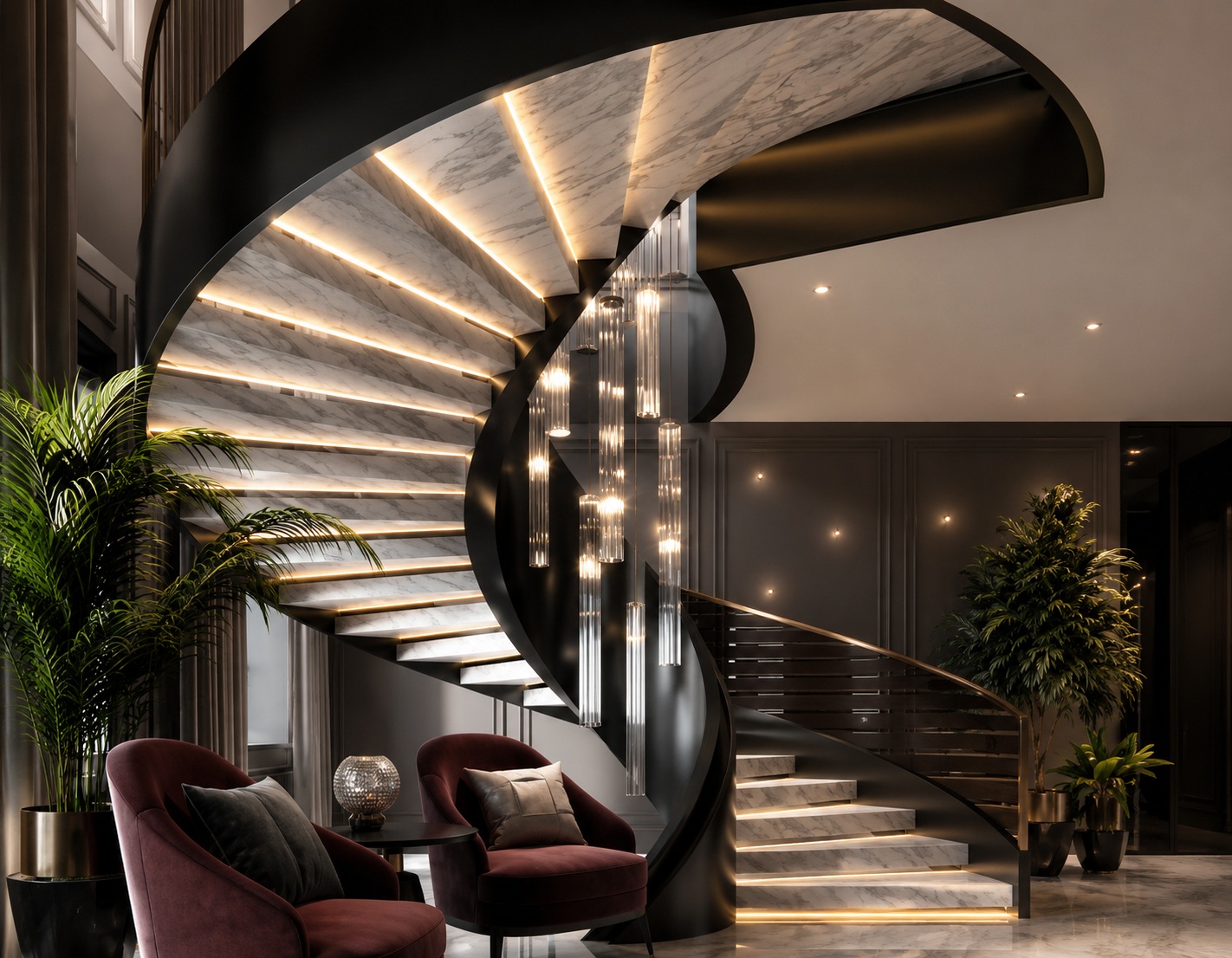
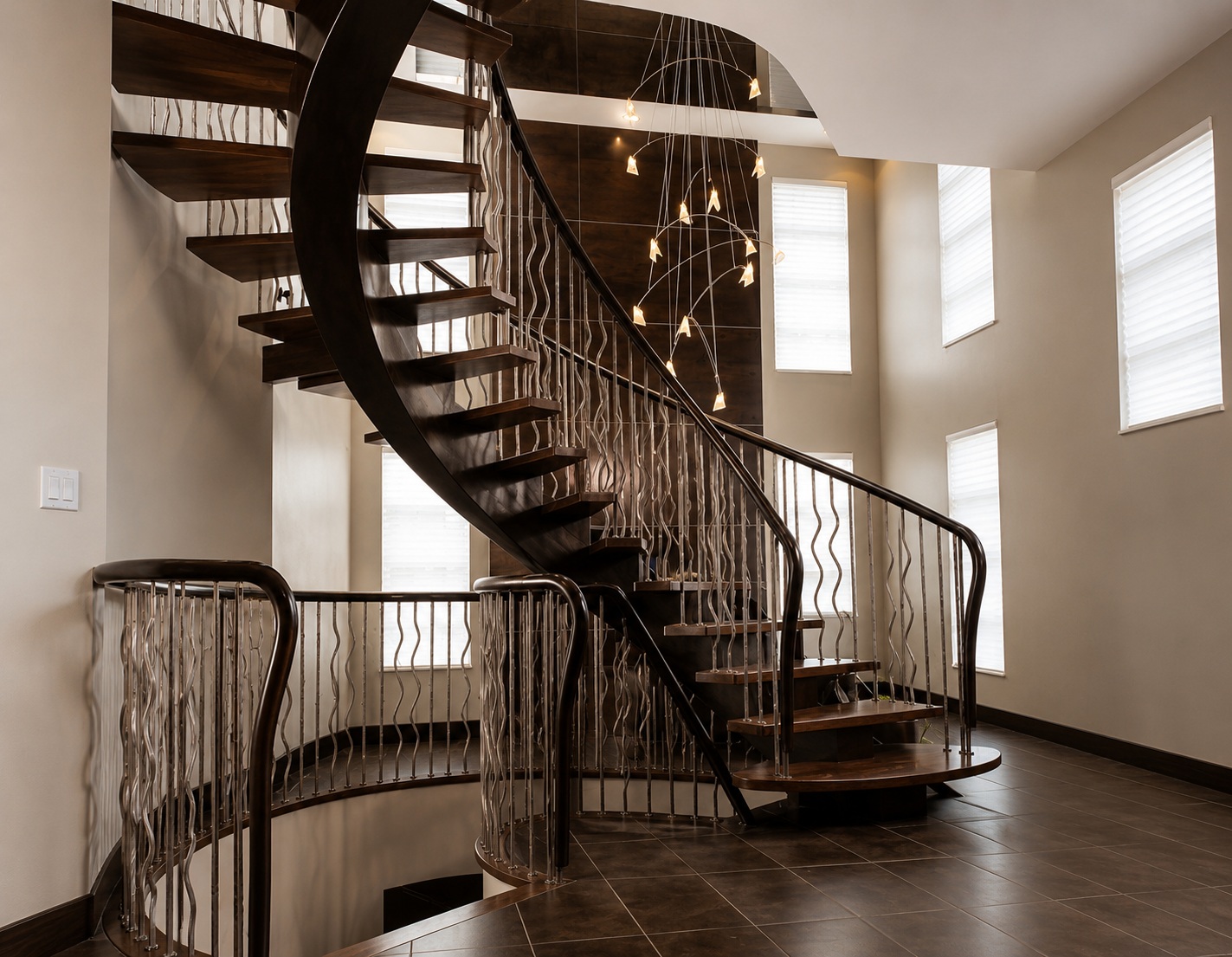
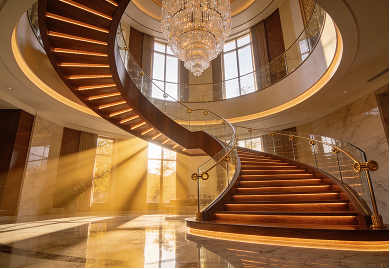
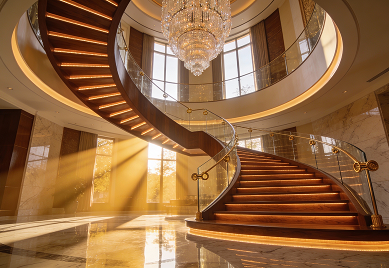
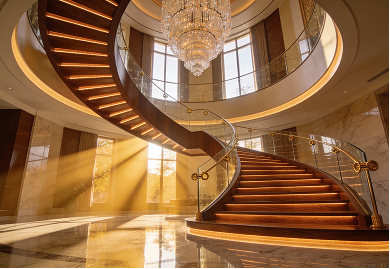
The whole curved vs spiral staircase question comes down to one thing, which is how the treads turn. A curved staircase sweeps along a single wide radius, like a gentle arc cut from a large circle, and it rarely closes that circle. There is no central pole; curved stringers run along the inside and the outside, and the treads bridge between them in a flowing line.
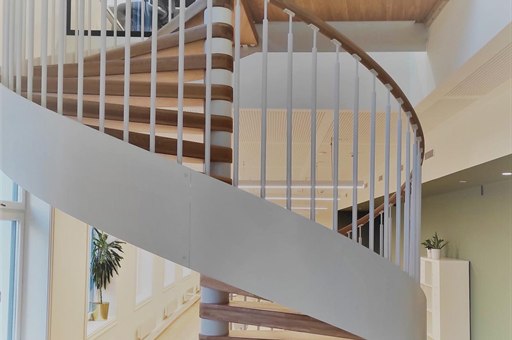
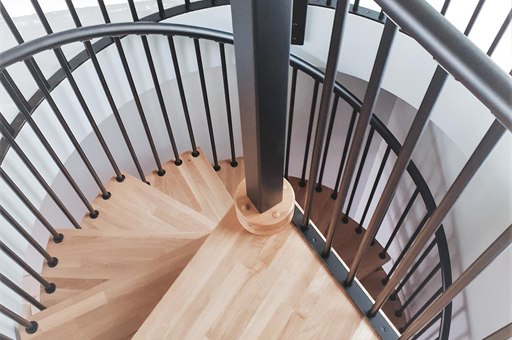
A spiral staircase turns far more tightly, and it winds around a central vertical column in a compact circle. Each tread is wedge-shaped, wide at the outer edge and narrow where it meets that post. You climb in a turning motion within a small diameter, often little more than the space a small table would occupy on the floor below.
So the simplest way to tell them apart is the central column and the radius. A spiral has a post at its heart and a tight turn; a curved stair has an open, sweeping arc and no central support. People sometimes ask what a curved staircase is called, and the formal name is a helical staircase, while curved and circular are the everyday terms for the same sweeping shape.
Curved vs Spiral Staircase at a Glance
The table below sets the two shapes against each other on the points owners ask about most. Read it as a quick orientation; the sections that follow then unpack each row in plain language so you can weigh the trade-offs against your own room and your own priorities.
| Factor | Curved staircase | Spiral staircase |
|---|---|---|
| Geometry | Wide, continuous radius; sweeping arc; no central pole. | Tight circle winding around a central column. |
| Footprint | Large; needs a generous floor area to sweep. | Smallest of any stair; fits a corner or a loft. |
| Treads | Full-depth and even; both feet land naturally. | Wedge-shaped; you walk the wide outer edge. |
| Walking comfort | Easy and gentle; two people pass without strain. | Tighter turn; one person at a time, more care. |
| Look and feel | Grand and sculptural; a centrepiece statement. | Compact and sculptural; a neat feature object. |
| Cost driver | Higher; complex curved fabrication and material. | Often lower; less material on a simple steel core. |
| Suits | A wide foyer or open hall that can hold a grand stair. | A tight room, a loft, a mezzanine, a second route. |
Footprint and Space
Footprint is the first place the two shapes separate, and it is usually the deciding factor. A spiral staircase folds a full storey into a small circle, commonly around five feet across, plus a matching opening in the floor above. That tiny plan is exactly why owners reach for a spiral when floor area is scarce, such as a loft conversion, a mezzanine, or a compact holiday home where every square foot counts.
A curved staircase asks for the opposite. Its wide radius needs a generous run of floor to complete the sweep, so it belongs in a roomy foyer, a double-height hall, or an open-plan space with room to spare. The reward for that floor area is a gentle, easy gradient. If your space is tight, the spiral usually wins on plan; if you have a grand entrance to fill, the curved stair earns its room.
It also helps to picture how each stair lands on the floor above. A spiral needs only a modest round or square opening, which keeps the ceiling cut small and the structure above largely intact. A curved staircase typically meets the upper floor along a longer, curving edge, so the opening is bigger and the surrounding structure works harder. That opening size feeds straight back into how much room each shape truly costs you. We go deeper on the sweeping shape in our pillar guide to what a curved staircase is.
Comfort and Walking
Comfort underfoot is where a curved staircase pulls ahead, because its wide radius gives full-depth treads that stay an even width across the whole step. Both feet land naturally on every tread, the gradient feels relaxed, and two people can pass without anyone turning sideways. For a main stair that the whole household uses every day, that easy, predictable rhythm matters a great deal.
A spiral staircase asks for a little more attention. Its treads are wedge-shaped, so you walk the wide outer third where the step is deepest, and a tight diameter means one person climbs at a time. None of that makes a spiral uncomfortable; a generous diameter and a continuous handrail keep everyday use smooth. It simply means a spiral rewards careful sizing, while a curved stair is forgiving by nature. Moving large furniture is also easier on the open sweep of a curved flight, and the same gentle gradient suits young children and older family members alike.
Look and Feel
Both shapes are sculptural, yet they make very different statements in a room. A curved staircase is the classic grand gesture. Its long, flowing arc draws the eye upward and gives a foyer a sense of arrival, which is why it appears so often in villas, large new homes, and signature commercial lobbies. The sweep itself becomes the architecture, and the railing line follows it like a ribbon.
A spiral staircase makes a tighter, more compact sculptural statement. Coiled into a small circle, it reads as a crafted object rather than a grand sweep, and it suits a modern room where space is precious but presence still matters. Choosing between them is partly a question of scale. The curved stair commands a large room; the spiral turns a small one into a feature. Material, from steel and timber to glass and stone, then tunes either look to the interior around it.
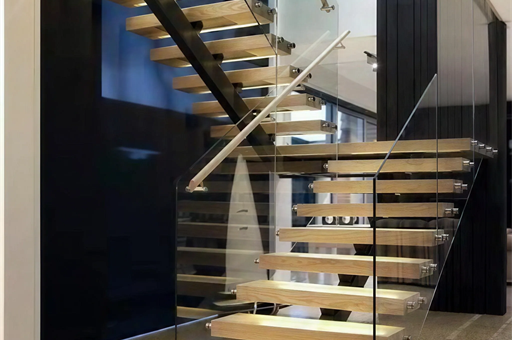
A curved steel staircase with timber treads — factory assembly. Tap to play.
Cost Drivers
Cost is where many owners expect the spiral to be cheaper, and as a general pattern it often is, though the reason matters more than the headline. A simple steel spiral uses less material and turns on one straightforward central column, so it tends to sit at the gentler end of custom-stair budgets. A curved staircase carries more material and far more complex fabrication, because every curved stringer and radiused tread is shaped to one continuous arc.
That curved geometry is the real cost driver. Bending stringers to a precise radius, matching every tread to the sweep, and coordinating the whole assembly take more engineering and more workshop hours than a compact spiral. Third-party market write-ups commonly place curved staircases above spirals on price for this reason, though those are industry estimates, not our quote. The honest drivers for either shape are the size, the structure, the tread material, and the railing. Because every stair is made to order, we price each project from its own drawing rather than from a list.
Material then layers on top of the shape, and it moves the budget on either staircase. A plain steel structure with timber treads is the everyday choice and the gentlest on cost. Glass or stone treads, a forged-iron balustrade, or a frameless glass railing all add to the figure, whether the stair curves or coils. So the curved-versus-spiral decision sets the baseline, while your finishes fine-tune it. Picture the daily traffic, the look you want, and the room you can spare, and the right combination usually becomes clear well before any drawing is priced.
How to Choose Between Them
Choosing curved or spiral staircase comes down to two questions: how much floor space you can give the stair, and what you want it to say in the room. If space is tight, and you need to thread a stair into a corner, a loft, or a second route, the spiral is the natural answer. It asks for the least floor and still climbs a full storey. It is also a sensible choice for a secondary stair, where comfort matters less than fit and the priority is simply to connect two levels neatly.
If you have a generous foyer or a double-height hall and you want a grand, easy, sweeping centrepiece, the curved staircase is the one to specify. It gives the most comfortable climb and the strongest sense of arrival, in exchange for the floor area and the higher fabrication cost. At Double Building Materials we draw, fabricate, and trial-assemble both, then crate them for export so your installer can fit them from our drawings. Browse the curved staircase range, or the spiral staircase range, to see how each shape comes together.
Curved vs Spiral Staircase FAQ
What is the difference between a curved and spiral staircase?
The difference between a curved and spiral staircase is the turn. A curved staircase sweeps along a wide, open radius with no central pole, so it feels gentle and grand. A spiral staircase winds tightly around a central column in a small circle, so it saves space. Curved needs room; spiral fits a corner.
What is a curved staircase called?
A curved staircase is formally called a helical staircase, and the words curved and circular describe the same sweeping shape in everyday use. Unlike a spiral stair, a helical or curved stair has no central post; it relies on curved stringers and radiused treads to carry the flowing arc from one floor to the next.
Is a spiral staircase cheaper than a curved one?
As a general pattern, a simple steel spiral often costs less than a curved staircase, because it uses less material and a straightforward central column. A curved stair needs complex curved fabrication, which usually places it higher on price. Real cost tracks size, material, and railing on either shape, so we price each project from its drawing.
Which takes less space, circular vs spiral staircase?
A spiral staircase takes less space than a circular or curved one. A spiral folds a full storey into a tight circle commonly around five feet across, while a circular or curved stair needs a wide radius and a generous floor run to complete its sweep. For a small footprint, the spiral is the space-saving choice.
Which is safer to walk on, spiral vs curved stairs?
For spiral vs curved stairs, a curved staircase is generally the easier walk, because its full-depth treads stay an even width and the gradient is gentle. A spiral has wedge-shaped treads and a tighter turn, so it asks for more care, especially when sized small. A generous diameter and a continuous handrail keep a spiral comfortable too.
Read more in the cluster: start with what a curved staircase is, then see the full curved staircase range. Leaning toward the tighter shape instead? Our spiral staircase guide covers it in full, and you can browse the spiral staircase range.
Double Building Materials draws, manufactures, trial-assembles, crates, and ships your curved or spiral staircase. Your own contractor or installer handles on-site installation and local code sign-off — we can help you find one where available. Dimensions above are common references and any market figures are third-party estimates, not our quote; your local adopted code edition governs, so confirm the current version with your local team.
Talk to us on WhatsApp →