

Plywood vs MDF vs Particleboard for Kitchen Cabinets
Cabinet Guides · Kitchen Board Comparison
For kitchen cabinets, no single board wins everywhere. Plywood is the right choice for boxes near the sink and dishwasher, and wherever screws sit close to an edge. MDF makes the smoothest painted or lacquered doors. Particleboard works well for dry interiors when every edge is sealed. Solid wood belongs in frames and shaker doors.
If you are comparing quotes, the material line on each one probably reads differently: "all-plywood box", "MDF doors", "furniture board". This guide explains what each board is, what it does well and badly in a kitchen, and five questions that show whether a quote is specified well. It is written for homeowners first, with the details your contractor will want; for every cabinet material, including melamine and PVC faces, start with our cabinet materials guide.
Which Board Goes Where in a Kitchen?
A good kitchen uses more than one board, and the trick is to put each one where its strengths count and its weaknesses never get tested.
| Part of the kitchen | Board that fits | Why |
|---|---|---|
| Sink base and dishwasher sides | Plywood | Swells very little at a wet edge and holds screws close to the edge. |
| Tall pantry and island boxes | Plywood | Strong in both directions, so long sides stay true under shelves and stone. |
| Wall cabinets and dry interiors | Melamine-faced particleboard or plywood | Flat, even and economical, as long as every edge is sealed. |
| Painted or lacquered doors | MDF | A smooth face with no grain, and edges that can be shaped and coated in one piece. |
| Wood-grain slab doors | Wood veneer on MDF or plywood | Real grain on a core that stays flat across a wide door. |
| Shaker frames and face frames | Solid wood | Long grain is strong along its length and can be refinished. |
What Are Plywood, Particleboard and MDF?
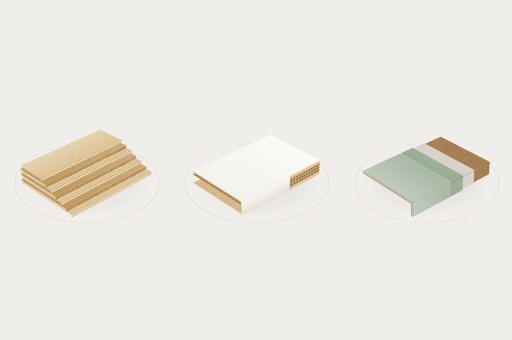
The descriptions below follow the US Forest Products Laboratory's Wood Handbook, the standard US reference on wood-based panels. The animations build a sample of each board layer by layer.
Plywood
Thin wood veneers glued in an odd number of layers, with the grain of each layer turned 90 degrees to the next. That cross-grain build makes the panel strong both along and across its length, gives it excellent dimensional stability, and resists splitting, so fasteners can go close to an edge. If it gets wet, it shows minimal edge swelling and little permanent swelling in thickness.
Particleboard
Wood particles bonded with resin under heat and pressure, usually in three layers: fine particles on both faces and coarser ones in the core. The fine faces give a smooth, flat surface for laminating, overlaying or veneering, and boards made for quality furniture use a tighter core that leaves a cleaner edge. It is widely used in furniture, usually under a decorative face.
MDF (medium-density fiberboard)
Wood refined into fibers, mixed with resin and pressed into a uniform panel with no grain, knots or voids. MDF often replaces solid wood or plywood in furniture, and its edges can be shaped and finished like its face, so it is the usual base for painted and lacquered doors.
Solid wood
Sawn timber such as oak, white oak, walnut, maple or ash. It gives real grain that can be sanded and refinished. Its one rule is movement: wood shrinks and swells with humidity mostly across the grain and only slightly along it, so it has to be built in a way that lets it move.
Is MDF or Plywood Better for Kitchen Cabinets?
Both are good boards, but they are good at different things, and the table below compares them on the points that matter most in a kitchen.
| Question | Plywood | MDF |
|---|---|---|
| Near water | Swells very little at a wet edge | A raw edge that soaks up water can swell, so MDF parts must be fully sealed |
| Painted finish | Wood grain can show through paint | Smooth and even, the usual choice for painted doors |
| Screws near an edge | Holds well; the crossed layers resist splitting | Needs care at edges and is better with the right fixings |
| Shaped edges and profiles | Shows its layers at a cut edge | Shapes cleanly; the coat wraps the profile |
| Weight | Lighter for the same thickness | Heavier panel for panel |
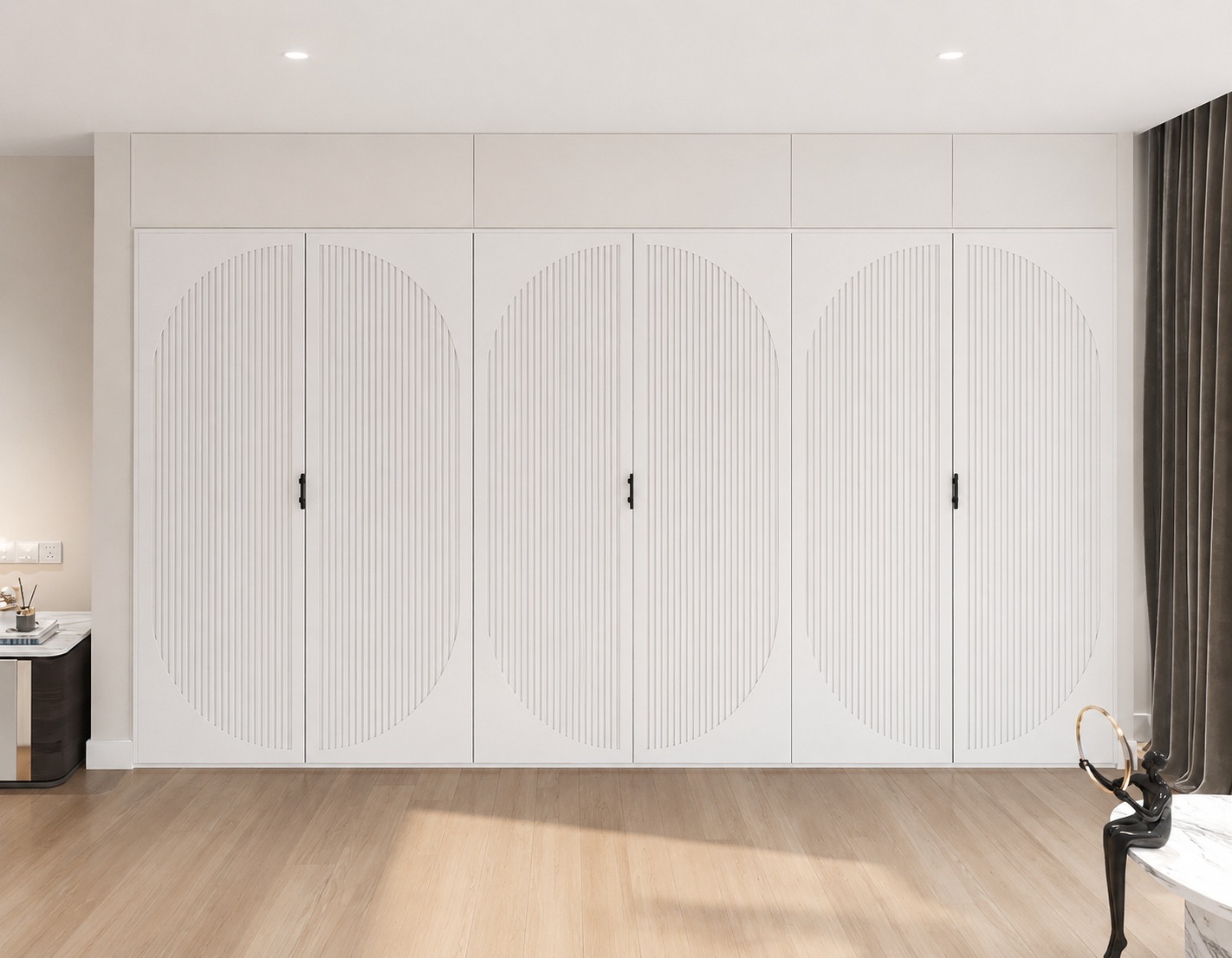
So the honest answer to "plywood or MDF?" is usually "both": plywood for the boxes, especially near the sink, and MDF for doors that will be painted or lacquered. Our white kitchen cabinets page shows the lacquer build on MDF step by step.
Is Particleboard Bad for Kitchen Cabinets?
Particleboard has a poor reputation, and some cabinet makers sell "no particleboard" as a feature. The board itself is not the problem; where it goes and how its edges are sealed are what matter.
Its strength is a very flat, even face that is ideal under melamine, while its weakness is an open edge that meets water. Unlike plywood, panels made from particles can swell in thickness when wet and may not fully recover, and that shows first at a cut edge by the sink. Wax added during manufacture only improves short-term moisture resistance.
The practical rule is simple: use melamine-faced particleboard for wall cabinets, shelves and dry interiors, band every edge, and keep it out of the sink base. Our melamine cabinets guide covers the face in more detail.
When Is Solid Wood the Right Choice?
Because solid wood moves across its grain, a wide flat panel of solid wood can cup, open at the joints or crack its finish as the seasons change. Cabinet makers have solved this for centuries with the frame-and-panel door: stiles and rails run their grain lengthwise, where movement is small, and the center panel floats in a groove with room to move.
That makes solid wood the right choice for shaker doors, face frames, end panels and details you touch. For wide slab doors, the better build is the same wood as a veneer on a stable MDF or plywood core: real grain, no movement. Our solid wood kitchen cabinets, white oak and walnut pages and our shaker vs flat panel guide show both builds.
Which Board for Cabinets Under the Sink and in Humid Climates?
The sink base is the hardest-working box in a kitchen: it sits under a tap, next to a dishwasher that releases steam when it opens, and around pipes that can drip. Choose a plywood box there, with PUR-glued or laser edges, and keep particleboard out of it.
In humid regions such as Florida and the Gulf Coast, indoor air carries more moisture for much of the year, and wood-based panels respond to that moisture. The same rules simply matter more: plywood boxes near water, every cut edge sealed, and doors finished on all faces, with a balancing layer on the back of wide slabs so they stay flat.
Why Does the Edge Matter as Much as the Board?
Most cabinet failures start at an edge, not on the face, so the edge should be chosen by location, cabinet by cabinet. Research on furniture panels finds that edge banding limits water absorption and swelling, and that zero-joint edges swell less after moisture exposure.
| Where the cabinet stands | Edge | Why |
|---|---|---|
| Sink base, dishwasher sides | PUR-glued band or laser (zero-joint) edge | Moisture-curing PUR glue and glue-free laser edges stand up to water and steam better than standard hot-melt. |
| Next to the cooktop and oven | PUR or laser edge | Standard hot-melt glue softens with heat. |
| Matte slab doors | Laser (zero-joint) edge | No visible glue line between face and band. |
| Lacquered MDF doors | No band | The coat wraps the shaped edge. |
| Wood-veneer doors | Matching veneer edge | Grain carries around the corner. |
| Dry wall runs and shelves | PVC or ABS band | Proven and clean where water never reaches. |
PVC is also used as a face material on some doors; our PVC cabinets guide explains where that works.
Do Kitchen Cabinets Contain Formaldehyde, and What Should the Label Say?
In the United States, the EPA's TSCA Title VI rule caps formaldehyde emissions from the three composite boards used in cabinets. California's earlier CARB Phase 2 rule set the same limits, and solid wood, which is not a composite board, is outside the rule.
| Composite board | EPA emission limit |
|---|---|
| Hardwood plywood | 0.05 ppm |
| Particleboard | 0.09 ppm |
| MDF | 0.11 ppm |
| Thin MDF | 0.13 ppm |
Finished cabinets sold in the US must carry a label. It shows the fabricator's name, the month and year of manufacture, and a statement that the cabinets are TSCA Title VI compliant (EPA, TSCA Title VI frequent questions). Before you buy, ask to see the label or the certificates for the panels inside the cabinets.
What Should You Ask a Cabinet Maker Before You Order?
These five questions work for a homeowner comparing quotes and for a contractor checking a specification, and a clear answer to each is a good sign.
- Which board is in each part? Ask about box sides, bottoms, backs, shelves and doors separately; a good answer names a board for each part, not one word for the whole kitchen.
- How are the edges sealed near the sink and dishwasher? Listen for PUR glue or laser edges at wet locations; "standard edge banding everywhere" means the wet zone was not planned.
- Are the composite panels TSCA Title VI certified, and do the cabinets carry the label? The answer should be yes, with a certificate available, and any hesitation here is a warning sign.
- Face-frame or frameless, and why for this kitchen? Both are sound, but the reason should fit your door style and storage, such as frameless for slab doors and wider drawers.
- Is the run assembled and checked before it ships? For an order made overseas, ask whether boxes and doors are put together and aligned in the factory, and how each part is labelled for the installer.
How Did a Real Florida Kitchen Mix These Materials?
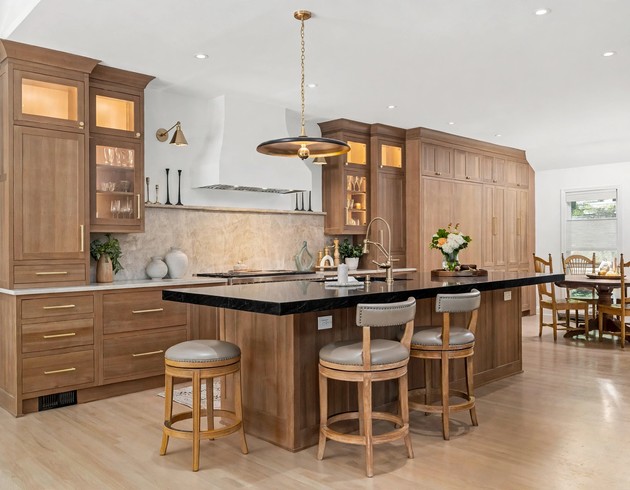
In a recent kitchen we built for a home in Florida, every box is plywood, and the faces you see every day are walnut veneer and light matte lacquer. Inside the cabinets and on rarely seen faces, walnut-grain and light decor panels carry the same look for less, so the budget went where it shows, and our US team installed it. The Florida walnut kitchen case shows the finished room and the build in more detail.
More Questions Owners Ask
Is MDF or plywood better for kitchen cabinets?
For cabinet boxes, especially under the sink, plywood is the better choice because it swells very little at a wet edge and holds screws near its edges. For painted or lacquered doors, MDF is better because it gives a smooth face with no grain.
Which board suits painted kitchen cabinets?
MDF, because it has no grain to show through the paint and its edges can be shaped and coated in one piece. Our white kitchen cabinets page shows how the coats build up.
What are the highest quality kitchen cabinets made of?
Quality is the right board in each place, sealed edges where water reaches, certified panels and careful assembly. Plywood boxes with MDF, veneered or solid wood doors is a common high-end build.
Which material works well for drawer boxes?
Plywood or solid hardwood drawer boxes hold their joints and runners well under daily use, while melamine-faced boxes are an economical option for lighter loads.
Does plywood contain formaldehyde?
Hardwood plywood is one of the three boards covered by TSCA Title VI, with the lowest limit of the three, 0.05 ppm, so ask for certified panels and the label on the finished cabinets.
Are particleboard cabinets bad?
Not in dry places with every edge sealed, but they are a poor choice under the sink, where an open edge can meet water and swell.
Planning a kitchen and comparing quotes?
Send your kitchen layout and we will reply with shop drawings and a factory quote, with the board for each part explained.
Send Your Kitchen Layout →Related: Custom kitchen cabinets · Flat panel kitchen cabinets · Solid wood kitchen cabinets · Cabinet materials guide · Shaker vs flat panel
Sources: USDA Forest Products Laboratory, Wood Handbook (FPL-GTR-282), chapter 11 and chapter 4; US EPA, TSCA Title VI; Strength, Durability, and Aesthetics of Corner Joints and Edge Banding in Furniture Design: A Review, Applied Sciences, 2024.
Double Building Materials draws, builds, trial-assembles, crates and ships cabinetry from our factory in Guangdong, China. In the US, our crews and partner installers can install, quoted separately.