

Glass Deck Railing Ideas for Decks & Balconies -Railing Guides
Glass Railing Guides · Deck & Balcony Ideas
Glass Deck Railing Ideas for Decks & Balconies
A glass deck railing is a guard made from toughened safety glass panels that protect a deck or balcony edge while keeping the view wide open. The glass can sit in a continuous base channel, on individual spigots, or behind slim posts, so the design preserves sightlines, resists weather, and turns the railing into an almost invisible boundary.
For an elevated deck or a balcony, the railing is the one element you look through every day, so it deserves real thought. This guide walks through glass deck railing ideas by setting, the mounting systems behind each look, the framed versus frameless decision, and the design choices that keep an outdoor view clear. It closes on weather durability, code, and how a panel is actually made.
Why Glass on a Deck or Balcony
The reason owners reach for glass outdoors is almost always the view. A deck that looks out on a garden, a coast, a pool, or a city skyline loses much of its drama behind a row of solid balusters. A glass deck railing keeps the edge safe while letting that view fill the space. The deck feels larger, and the line of sight runs clear from the seats to the horizon. The barrier is there; it simply disappears.
Glass earns its place in other ways too. It blocks wind without blocking light, so an open balcony feels warmer to sit on through a breezy evening. It wipes clean fast, it does not trap leaves the way a slatted railing can, and it has no flat rails for children to climb. On a small balcony, a frameless panel reads as open air, not a cage. That is why it has become the signature look of modern decks and high-end homes.
Glass Deck Railing Ideas by Setting
The right glass deck railing idea depends on where the railing lives and what surrounds it. A raised timber deck behind a family home wants a warm, sturdy look. A slim apartment balcony wants the lightest frame it can get. A poolside terrace wants a panel as clear as the water. Matching the system to the setting is what sets a railing that merely passes apart from one that lifts the whole exterior.
| Setting | Idea that suits it |
|---|---|
| Elevated timber deck | Spigot-mounted frameless panels with a timber cap rail tie the glass into the deck colour while keeping the garden or water view wide open. |
| Apartment or condo balcony | A continuous base channel gives the slimmest, cleanest line and suits a compact balcony where every visible profile matters. |
| Poolside or rooftop terrace | Low-iron glass on stainless spigots reads almost colourless, so the pool or skyline stays the focus rather than the barrier. |
| Coastal or windy site | A solid framed or slim-post system in marine-grade stainless or powder-coated aluminium stands up to salt air and gusting wind. |
One thread runs through every idea above. Choose the most open system the setting can take. Then let the metal finish echo the rest of the exterior, whether that is the deck timber, the window frames, or the roofline trim. The glass itself stays the same calm, clear plane. The mounting and the cap rail are where a deck shows its character.
Mounting Systems and the Look They Give
Most of a glass deck railing’s character comes from how the panel is held, not from the glass. There are three families an owner meets again and again. Each one gives a different visual weight and a different fixing detail. Knowing them up front makes every later choice, from budget to upkeep, much easier to picture before a single panel is ordered.
Spigots are short metal feet, usually in polished or brushed stainless steel, that clamp the bottom edge of each panel and anchor into the deck or the fascia. They produce the open, floating appearance most people associate with a high-end frameless railing, with a clear gap between panels. A base channel, or U-channel, is one continuous slot that runs along the deck edge and grips the whole bottom edge of the glass. It conceals the fixings and delivers the cleanest, unbroken line. Post systems use slim uprights, in stainless or aluminium, with the glass infill clipped between them. They are economical, they tolerate an uneven substrate, and they perform strongly on an exposed, windy site. We compare the two leading outdoor configurations in our guide to glass railing spigot versus channel mounting.
Framed, Semi-Frameless, or Frameless
Once the mounting family is settled, the next choice is how much metal frames the glass. A fully framed system surrounds every panel with a top, bottom, and side rail. It sits at the affordable end and is the most forgiving of movement. It suits a classic deck or a windy site, where peace of mind matters more than a slim look. A frameless system drops the top and side rails, leaving only the base fixing. The glass then stands as a clear plane, with nothing above it but an optional slim cap.
Semi-frameless sits between the two. It keeps slender posts or a thin top rail while dropping the bulk. It is a smart middle ground for owners who want a light look without the higher cost of a fully frameless build. The fully open option is the most striking and the hardest to detail. Thicker glass and exact fixings carry the load that a frame would otherwise share. We walk through that choice in our guide to the frameless glass railing. It is worth a read before you commit to a frameless deck.
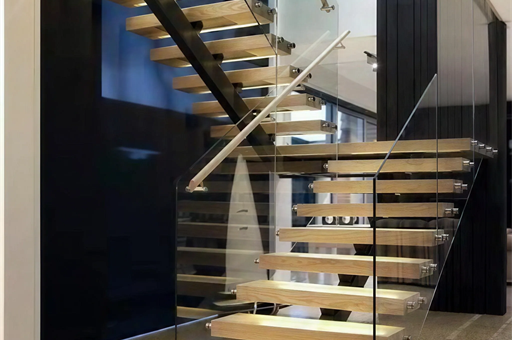
A real client project pairing a custom staircase with glass railing, built by Double Building Materials — tap to play.
Weather, Salt Air, and Upkeep
An outdoor railing lives a harder life than an indoor one, so wear matters from the start. The glass itself is the easy part. Toughened safety glass shrugs off rain, sun, and heat swings without fading or warping. The weak point is always the metal. The hardware faces steady damp and, on a coastal deck, salt in the air that attacks weaker alloys. The metal finish is the single biggest wear choice on an outdoor glass deck railing.
For a seaside or river-mouth site, marine-grade stainless steel, often grade 316, fights rust far better than the standard 304 grade used inland. Powder-coated aluminium is another tough, low-care option that holds its colour well. Upkeep is genuinely light. Glass panels wipe clean with water and a soft cloth, much like a window. A regular rinse keeps salt and dust off the hardware. Picking the right grade of metal at the start is what keeps an outdoor railing looking new for years, rather than streaked with rust after a few wet seasons.
Code, Height, and Safety Glass
A deck or balcony railing is a guard, and guards are governed by code because they prevent falls. The two numbers an owner meets most often are the guard height and the glass specification. Under common US references, a residential deck guard is generally required at a minimum height of 36 inches, while many commercial and balcony situations call for 42 inches. The glass used in any railing must be a recognised safety glass, meaning tempered, laminated, or laminated-tempered, never ordinary annealed glass.
| Requirement | Common reference value |
|---|---|
| Residential deck guard height | Commonly a minimum of 36 inches (IRC reference). |
| Commercial / many balcony guards | Commonly a minimum of 42 inches (IBC reference). |
| Glass type | Recognised safety glass — tempered, laminated, or laminated-tempered; annealed glass is not permitted. |
| Accessible-route handrail | Where ADA applies, a graspable handrail is commonly required at 34 to 38 inches; AS 1288 / NCC govern glass in Australian projects. |
Those figures are widely used reference values, and your local adopted code edition is what actually governs, so confirm the current version with your local team. A frameless deck panel often pairs with laminated glass so that, in the rare event a panel is broken, the interlayer holds the fragments in place rather than letting them fall. The thickness and the lamination then follow from the panel size, the wind exposure, and whether a top rail shares the load. We set out the safety side in our guide to tempered glass railing thickness and safety.
What Drives the Cost
A glass deck railing spans a wide price range, and the mounting system is usually the biggest single driver. A framed or post system sits at the more affordable end, because the metal frame shares the structural load and allows thinner glass. A fully frameless run sits higher, since it relies on thicker glass and precise base fixings to carry everything on its own. Because every railing is made to order, there is no single price tag; there are drivers an owner can weigh.
Beyond the mounting, the main drivers are the glass itself, the hardware grade, and the site. Low-iron or laminated glass costs more than standard toughened glass; marine-grade 316 stainless costs more than 304; and a long, exposed, or curved run needs more engineering than a short straight one. Independent market estimates for installed outdoor glass railing vary widely by region and specification, so treat any figure you read online as a third-party market estimate, not our quote. We break the drivers down properly in the glass railing cost guide. As a made-to-order manufacturer, we price each project from its drawing.
How a Glass Railing Is Made
At Double Building Materials, a glass deck railing starts as a drawing, not a catalogue item. We take your deck or balcony dimensions, the guard height your project needs, your chosen mounting system, and the look you are after, then turn them into a working shop drawing. That drawing fixes every panel size, every spigot or channel position, and the cap rail before any glass is toughened or any metal is cut. We cut nothing until you approve it, because a deck edge leaves little room to correct a mis-sized panel on site.
From there we fabricate the hardware and process the glass, then trial-assemble a representative run on our 4,500 m² Guangdong floor. That trial build is where we confirm the panel fit, the gaps, and the hardware alignment before anything ships. Once it passes, we crate the railing for export in the order your installer will need it, with the glass protected for the journey. Your own contractor fits it on site from our drawings, and we can help you find a local installer where that service is available. We do not install on site or sign off local code; that responsibility stays with your local team. Drawing-first coordination, trial assembly before packing, and export-ready crating are the three habits that, across 800+ projects in 60+ countries, keep a railing fitting the way the drawing promised. You can see the panels and hardware we make on our glass balustrade systems page.
Glass Deck Railing FAQ
Is a glass deck railing safe and strong enough?
Yes, when it is specified correctly. A glass deck railing uses toughened safety glass, often laminated, that is many times stronger than ordinary glass and engineered to take the loads a guard must resist. The strength comes from matching the glass thickness, the mounting, and the panel size to the span and the wind load. A panel built to spec meets the same guard rules as any other railing.
Does a glass railing block the wind on a balcony?
It does, and that is one of its quiet advantages. A solid glass panel acts as a windbreak while letting light and the view through, so an exposed balcony or rooftop terrace becomes far more comfortable to sit on. A slatted or cable railing lets the wind whistle straight through, whereas glass calms the air behind it without darkening the space.
How do you clean an outdoor glass railing?
Much like a window. Water with a little mild detergent and a soft cloth or squeegee removes most marks, and a periodic rinse keeps salt and dust from building up on a coastal deck. The hardware needs only an occasional wipe. Choosing marine-grade stainless or powder-coated aluminium keeps that hardware looking clean with very little effort.
Frameless or framed glass railing for a deck?
Frameless gives the most open, view-first look and suits a sheltered deck with a strong outlook. Framed or post systems are more affordable, kinder to an uneven base, and stronger on an open, windy site. The right answer follows your view, your exposure, and your budget rather than fashion alone. The frameless guide above weighs the trade-offs in full.
How tall does a deck or balcony glass railing need to be?
Under common US references, a residential deck guard is generally a minimum of 36 inches, while many commercial and balcony guards call for 42 inches. These are widely used reference values rather than universal law, so your local adopted code edition governs the exact requirement. Confirm the current figure with your local team before you finalise a panel height.
Start with the full glass railing guide for the complete picture, then compare the frameless glass railing look and weigh the glass railing cost drivers. Ready to specify? Browse our glass balustrade systems.
Double Building Materials draws, manufactures, trial-assembles, crates, and ships your glass deck and balcony railing. Your own contractor or installer handles on-site installation and local code sign-off — we can help you find one where available. Heights and glass references above are common US values; AS 1288 / NCC govern Australian projects, and your local adopted edition governs in every case, so confirm the current version with your local team.
Talk to us on WhatsApp →