

Frameless Glass Railing: Complete Owners Guide-Railing Guides
Glass Railing Guides · Frameless Systems
Frameless Glass Railing: The Complete Owner's Guide to a Seamless Glass Barrier
A frameless glass railing is a glass guard whose tempered or laminated panels stand without vertical posts or a top frame, anchored only at their base by spigots or a continuous channel. The result is an almost invisible barrier that protects an edge while keeping the view, the light, and the architecture completely open.
That uninterrupted sweep of glass is the entire reason owners specify it. This guide explains how a frameless glass railing actually works, what holds the panels, and which glass keeps it safe. It walks through where the look belongs, what drives the budget, and how the code rules apply, then ends with the honest answers most buyers ask before they commit.
What a Frameless Glass Railing Is
A frameless glass railing is a guard built almost entirely from structural glass. The panels stand upright with nothing framing their sides or their top edge. So the eye reads a single clear plane, not a fence of posts. Engineers call the glass "structural" because each panel carries its own load straight down into the floor. It does not lean on a metal frame. That one idea, glass doing the structural work, is what sets a frameless system apart from a normal railing.
The appeal for an owner is almost all visual. The glass guards a stair, a balcony, a terrace, or a pool edge while leaving the sightline truly open. Light passes straight through, a small room feels larger, and a long view stays whole. The building, the garden, or the water beyond the edge becomes the feature. The barrier itself fades back until you almost forget it is there.
It is worth being honest about the trade-off early. Frameless glass shows fingerprints and water spots more readily than a metal rail, so it asks for the odd wipe to stay clean. It is also harder to engineer and build, because the glass and its anchors must do all the structural work alone. None of that hurts the look. It simply shows why frameless glass is a premium choice, not a default one.
How the Panels Are Held
With no frame, every frameless glass railing leans on its base fixing, and two systems lead the market. The first uses spigots. These are stainless steel clamps, bolted to the floor, that grip the bottom corners of each panel. The second uses a base channel. This is a slim aluminium or stainless profile that runs the whole edge and clamps the glass in one clean line. Both hold the panel like a cantilever, so the fixing alone resists the push of anyone who leans on the rail.
| Mounting system | How it works and where it suits |
|---|---|
| Spigots | Discreet stainless clamps at intervals along the base. They leave a small gap of floor visible under the glass, which suits a pool surround, a deck, or a balcony where a light, floating look is wanted. |
| Base channel (U-channel) | A continuous profile clamping the full edge. It gives the cleanest, most minimal line with no visible hardware, and it suits an interior staircase or balcony where the seamless look is the priority. |
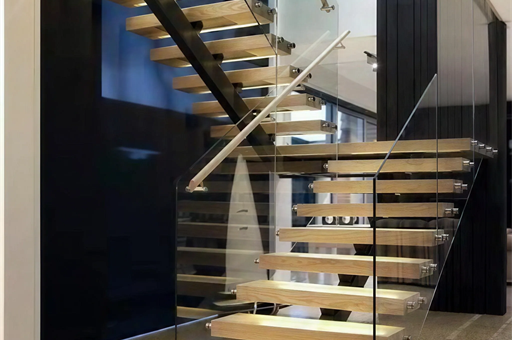
| Standoffs / patch fittings | Round buttons or plates that fix the glass to a wall face or fascia from the side. They suit a stair where the glass mounts to the stringer rather than sitting on the floor. |
An owner rarely needs to specify the fixing alone, because the right choice follows from the setting and the finish. A continuous channel reads as the most refined and most minimal; spigots give that lighter, floating impression and let a little floor show beneath the glass. We size the fixing, the glass, and the anchor together so the assembly works as one. The full comparison sits in our guide to glass railing spigot and channel mounting systems.
The Glass and Why It Is Safe
The biggest choice in a frameless glass railing is the glass itself, because the glass is the barrier. Two types come up again and again. Toughened, or tempered, glass is heat-treated to be far stronger than normal glass. If it ever fails, it crumbles into small, blunt pieces rather than sharp shards. Laminated glass bonds two panes with a tough plastic layer, so a broken panel holds together and stays in place rather than dropping out of the opening.
For a frameless system, the safest and most common panel is toughened-laminated glass, which does both jobs. It is strong, it breaks safely, and it stays in the opening even after a knock. That matters a great deal on a balcony or above a stair. Thickness is set by the height and the span of each panel. A frameless panel usually needs thicker glass than a framed one, because the glass carries the whole load.
Owners do not need to memorise the glass specs, but it helps to know the terms on a drawing. We size the glass type and the thickness to the panel and its anchoring on every project. The reasoning, the common reference figures, and the hedging all sit in our dedicated guide to tempered glass railing thickness and safety.
Where a Frameless Glass Railing Works Best
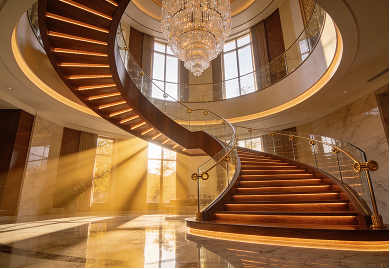
A frameless glass railing earns its place wherever a view is the reason you are standing there. On a balcony that looks over water or a city skyline, the glass holds the edge and lets the panorama fill the whole opening. On an interior staircase it keeps a stairwell bright and open-plan, so the stair feels like sculpture rather than a divided corridor. Around a pool it gives the legally required barrier without breaking the line of the deck or hiding the water.
The look suits modern and transitional homes especially well, where clean lines and big openings already define the architecture. A frameless glass railing reinforces that language instead of fighting it. It also lifts a renovation. Swapping a solid balustrade for clear glass can transform how large and how light a room feels, often more dramatically than any other single change to a stair or a terrace.
There are settings where it is less ideal, and saying so is only fair. A very exposed coastal balcony will spot with salt and need frequent cleaning, and a household that cannot face the upkeep may prefer a metal or cable rail. For deck and balcony schemes specifically, we gather worked examples in our glass deck and balcony railing ideas collection.
Frameless vs Framed and Semi-Frameless
Glass railings come in three broad families, and knowing the difference helps an owner choose deliberately. A framed system surrounds each glass panel with a metal frame on all four sides, which is the most economical and the most forgiving to install, but it interrupts the view with visible members. A semi-frameless system keeps slim posts at intervals while dropping the top rail, striking a middle ground between cost and openness.
A frameless glass railing removes the posts and the surrounding frame entirely, leaving only the glass and a discreet base fixing. It is the purest expression of the look and, predictably, the most demanding to engineer and the most premium to build. The choice is genuinely about priorities. If an uninterrupted sightline matters most, frameless is the answer; if budget leads, a framed or semi-frameless system delivers most of the brightness for less. We can build any of the three, and we will tell you plainly which suits your opening, your budget, and your maintenance appetite.
For the wider picture across the whole glass family, including the framed and semi-frameless options, start with our complete glass railing guide, which serves as the hub for this entire topic.
How a Frameless Glass Railing Is Made and Shipped
At Double Building Materials, a frameless glass railing starts as a drawing rather than a catalogue item. We take your opening, your floor build-up, your fixing preference, and the height your project requires, then turn them into a working shop drawing. That drawing fixes every panel size, every spigot or channel position, and every cut-out before any glass is toughened. We cut nothing until you approve it, because a frameless panel allows no trimming once it leaves the furnace.
From there we fabricate the glass and the stainless or aluminium hardware, then trial-assemble the run on our 4,500 m² Guangdong floor. That trial build is where we confirm that the panels align, the gaps are even, and the fixings land exactly where the drawing says, before anything is packed. Once it passes, we crate the glass and hardware for export so the panels survive the journey and reach your site in fitting order.
Your own contractor or glazier installs the system on site from our drawings, and we can help you locate a local installer where that service is available. We do not install on site or sign off your local code; that responsibility stays with your local team and the project engineer. Over 25+ years and 800+ projects across 60+ countries, this drawing-first sequence is how we keep a precise, frameless product fitting correctly thousands of miles from the workshop.
A glass stair railing fit-up and site-coordination review from one of our projects — tap to play.
What Drives the Cost of a Frameless Glass Railing
A frameless glass railing sits at the premium end of the railing spectrum, and the reasons are structural rather than decorative. Because the glass does all the work, the panels are thicker, the glass specification is higher, and the base fixings are heavier than a framed system would need. Add the precision fabrication and the careful crating that fragile glass demands, and the total naturally runs above a metal or cable alternative. Since every run is made to order, there is no fixed price tag; there are cost drivers.
| Cost driver | Why it moves the price |
|---|---|
| Glass type and thickness | Toughened-laminated costs more than plain toughened, and a taller or longer panel needs thicker glass, which lifts the price. |
| Mounting system | A continuous stainless channel generally costs more than individual spigots, and a stainless finish costs more than aluminium. |
| Total length and panel count | A long terrace run uses more glass and more fixings than a short balcony return, so the linear length drives the material cost. |
| Edge work and corners | Polished edges, mitred corners, and cut-outs for a handrail all add fabrication time over a plain straight panel. |
| Interior vs exterior | An exterior installation adds weatherproof finishes and, for coastal sites, a marine-grade stainless that costs more. |
Published market figures vary widely by region and specification, so any range you read online is a third-party market estimate rather than our quote. As a made-to-order manufacturer, we price each run from its own drawing once the glass, the fixing, and the length are settled. The dedicated glass railing cost guide walks through every driver in detail. When you are ready to commit, the easiest next step is to browse our frameless glass balustrade range and send us the opening.
Code and Safety
A frameless glass railing must satisfy the same guard requirements as any other barrier, so the absence of a frame never relaxes the rules. Under common US references, a residential guard along an open edge is generally about 36 inches tall, and a commercial guard is generally about 42 inches. The opening below a rail is also limited, so a small sphere cannot pass through. Australian projects work to AS 1288 for the glass selection and the NCC for the guard, where the locally adopted edition governs.
| Common reference | Typical guidance (confirm local edition) |
|---|---|
| Residential guard height (IRC) | Commonly about 36 inches along an open edge. |
| Commercial guard height (IBC) | Commonly about 42 inches along an open edge. |
| Glass type for a barrier | Safety glass, commonly toughened-laminated for a frameless guard so a broken panel holds in place. |
| Glass standard (AU) | AS 1288 for glass selection; NCC for the guard requirement, local edition governs. |
Those figures are widely used reference values, and your local adopted code edition is what actually governs, so confirm the current version with your local team and your project engineer. A well-detailed frameless glass railing is a thoroughly safe barrier; the rules simply keep the height, the glass type, and the gaps honest. We design every run to suit the codes a buyer cites, but we do not certify compliance for your jurisdiction, which remains your local responsibility.
Frameless Glass Railing FAQ
Is a frameless glass railing safe?
Yes, when it is specified and built correctly. A frameless glass railing uses safety glass, commonly toughened-laminated, so a panel is strong, breaks into blunt pieces rather than shards, and stays in the opening even after an impact. The glass thickness and the base fixing are engineered to the height and the load. Confirm the glass specification and the guard height against your local adopted code.
What glass is used for a frameless glass railing?
The most widely specified panel is toughened-laminated glass, which is heat-strengthened and bonded with a tough interlayer. It combines high strength, safe breakage, and the ability to stay in place if it ever cracks. Plain toughened glass is sometimes used in lower-risk interior settings, but laminated remains the safest choice for a balcony or above a stair.
Does a frameless glass railing need a top handrail?
Not always. A true frameless system can stand without a top rail, which is exactly the seamless look most owners want. Some projects still add a slim metal or timber cap rail for comfort, for grip on a stair, or because a local code calls for a continuous handrail. Whether one is required depends on the setting and the locally adopted edition, so confirm it with your local team.
How do you clean a frameless glass railing?
A frameless glass railing cleans like a large window. A microfibre cloth with a mild glass cleaner or warm soapy water keeps it clear, and a quick squeegee after rain stops water spots on an exterior balcony. There are no joints or frames to trap dirt, so cleaning is simple, just more frequent than for a metal rail if you want the glass to stay flawless.
Is frameless glass railing more expensive than framed glass?
Generally yes. A frameless system uses thicker, higher-specification glass and heavier base fixings because the glass carries the whole load, so it costs more than a framed panel of the same length. A framed or semi-frameless system delivers much of the same brightness for less. Price tracks the glass, the fixing, and the length rather than the look alone — see the cost guide for the breakdown.
Read the hub first: the complete glass railing guide. Then go deeper on spigot vs channel mounting systems, tempered glass thickness and safety, deck and balcony ideas, and the honest cost drivers. Or browse our frameless glass balustrade range.
Double Building Materials draws, manufactures, trial-assembles, crates, and ships your frameless glass railing. Your own contractor or glazier handles on-site installation and local code sign-off — we can help you find one where available. Dimensions and code figures above are common references (IRC / IBC / ADA / OSHA; AS 1288 / NCC where relevant); your local adopted edition governs, so confirm the current version with your local team.
Talk to us on WhatsApp →