

Tempered Glass Railing: Thickness, Safety Glass Types & Owner Guide -Railing Guides
Glass Railing Guides · Thickness & Safety
Tempered Glass Railing: Thickness, Safety Glass Types & What Owners Should Know
A tempered glass railing uses heat-treated safety glass that breaks into blunt bits, not sharp shards. Most projects pick laminated tempered panels, often around 12mm to 21.52mm thick based on the mounting and the railing height. The bonded inner layer keeps a broken panel standing until it is swapped out.
Glass is the clearest way to enclose a stair, balcony, or terrace, and a tempered glass railing is how that open look becomes strong and safe. This guide explains the safety glass types and the panel thicknesses owners actually meet, then shows how the mounting and the height drive the spec. We keep the figures as common references, and where a topic runs deep we link to a focused guide.
What a Tempered Glass Railing Is
A tempered glass railing is a guard built from safety glass, not the plain glass you find in a window. The panels are reheated and then cooled fast in a tempering furnace. That step locks the surface into compression and makes the glass far stronger. The real benefit, though, is how it breaks. A tempered panel breaks into small blunt cubes rather than long sharp shards, which is exactly why codes class it as safety glazing for railings.
For an owner, the appeal is plain long before any engineer joins the talk. Glass wraps a stair, a balcony, or a terrace without blocking the view, so a tempered glass railing reads as a sheet of light rather than a barrier. It suits a modern villa, an open-plan new build, or a remodel where you want the room and the view to lead, not the railing. The clear view is the whole point, and the safety glass simply makes that view safe to lean on.
It helps to split two ideas early, since people use the words loosely. Tempered tells you how the glass is treated for strength and safe breakage, while laminated tells you that two glass plies are bonded around a tough inner layer that keeps a cracked panel in place. Most serious railings use laminated tempered glass, which gives both traits at once, and we explain that pairing in the thickness section below.
Safety Glass Types Compared
Not all safety glass behaves the same way, and the difference matters on a railing where a person may lean on the panel. Three builds show up most often in railing specs, and choosing between them is a balance of safety, clarity, and budget. The table below sets them side by side, so the trade-offs are clear before we talk about thickness.
| Glass construction | Behaviour and typical railing use |
|---|---|
| Fully tempered (toughened) | Single heat-treated pane. Strong against impact and shatters into blunt cubes, but a broken panel falls away entirely. Common where a sturdy frame or top rail still contains the line. |
| Laminated tempered | Two tempered plies bonded around an interlayer. A cracked panel stays standing rather than collapsing, the safest construction for frameless and high-level railings, and the most widely specified. |
| Heat-strengthened laminated | Laminated using heat-strengthened plies that resist a sudden shatter and hold larger pieces. Sometimes preferred by engineers for tall structural railings; confirm what your local code accepts. |
For most balcony and stair railings, laminated tempered glass is the go-to choice, because the inner layer means a damaged panel still guards the edge until someone swaps it. Single tempered glass still works where a top rail or a strong frame keeps the line safe even if a panel is lost. The right build depends on the layout and the local adopted code, which the safety section below covers in more detail.
Glass Thickness Explained
Thickness is the number owners ask about first, and it is also the choice that matters most on a glass railing. A thicker panel bends less, feels solid under the hand, and carries a higher design load, while a thinner panel costs less and weighs less to install. The figures below are common industry references rather than a fixed rule, because the right thickness always follows the height, the load, and the mounting method.
| Common glass spec | Where it typically appears |
|---|---|
| 10mm–12mm single tempered | Framed or top-rail-supported panels at a modest height, where a frame shares the load. |
| 13.52mm laminated (6+6) | A common laminated panel for framed and channel-set balcony railings of standard height. |
| 17.52mm laminated (8+8) | A frequent choice for frameless base-channel and spigot railings carrying a normal handrail load. |
| 21.52mm laminated (10+10) | Taller frameless railings and higher design loads, where extra stiffness is wanted. |
Read those laminated numbers as two glass plies plus the inner layer, so a 17.52mm panel is roughly two 8mm tempered plies bonded together. A frameless railing has no top rail and leans on the glass alone, which is why it needs a thicker, stiffer panel than a framed railing of the same height. The right thickness depends on many inputs, so treat these references as a starting point and let the shop drawing confirm the final spec for your project.
How Mounting Sets the Thickness
How a panel is held shapes the thickness more than almost anything else, because the mounting decides how much of the load the glass carries alone. A framed railing holds the glass on several edges and shares the load, so it can use a thinner panel. A frameless railing clamps the glass only at the bottom, which turns each panel into a cantilever. The panel must then be thicker and stiffer to hold the top edge steady.
Two frameless systems lead the field. A continuous base channel grips the full bottom edge in an aluminium U-profile, which gives a clean, gapless line and even support along the panel. Spigots are separate stainless clamps that hold the panel at points. They leave an airy floating look, but they focus the load at each fixing, which is why spigot panels tend toward the thicker end of the range. Both create that signature unbroken glass wall, and we compare them fully in our guide to glass railing spigot and channel mounting systems. The fully unframed look is covered in our frameless glass railing guide.
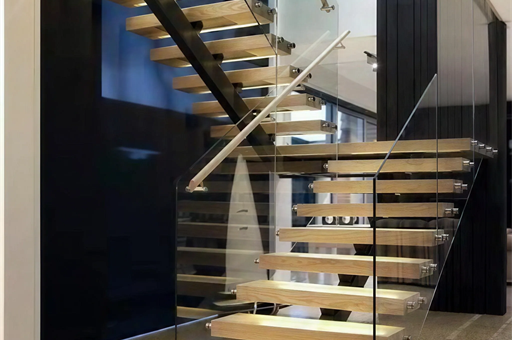
A mono-stringer staircase with a glass railing we built — tap to play.
Safety, Height, and Code
A glass railing answers to the same guarding rules as any other balustrade, and the safety glass requirement then sits on top of those. Under common US references, residential guards commonly stand at least 36 inches tall and commercial guards typically reach 42 inches, while any infill opening must reject a 4-inch sphere so a small child cannot slip through. A glass panel meets that opening rule on its own because it is continuous, which is one quiet advantage of the material.
The load rules are where thickness earns its place. A guard must resist a point load at the top rail and a spread load across the infill, and the glass thickness must carry those forces without too much sway. A frameless balustrade has no top rail to share the load, so engineers study it most closely of all. These figures are common references drawn from IRC, IBC, ADA, and OSHA in the United States, while AS 1288 and the NCC apply instead in Australia. Your local adopted edition is what truly governs, so confirm the current version and the glass build with your local team before you order.
Choosing the Right Specification
Pulling the threads together, a sound glass railing spec flows from three questions in order. How tall must the guard stand for its setting? Which mounting suits the room, framed or frameless? And which safety glass build does the local code accept? Answer those three, and the thickness largely chooses itself, because the engineering follows the height, the mounting, and the load rather than personal taste.
Budget enters here too, because a thicker laminated panel and a frameless mount both add to the cost. A framed single-tempered railing is usually the most economical route to the glass look, while a tall frameless wall sits at the upper end. Every railing is made to order, so there is no single price, only drivers such as the glass build, the panel size, the mounting hardware, and the finish. We separate those drivers in the glass railing cost guide, using third-party market ranges rather than a quote. The wider material picture sits in the complete glass railing guide.
How We Build It
At Double Building Materials, a tempered glass railing begins as a drawing, not a catalogue part. We take your heights, your opening sizes, and your chosen mounting system, then turn them into a working shop drawing. That drawing fixes the glass build, the panel sizes, and every fixing before any glass is cut. Nothing is made until you approve it, because a glass panel cut to the wrong size cannot be trimmed on site the way timber can.
From there we cut, temper, and where specified laminate the panels, then fabricate the channels, spigots, or frames that carry them. We trial-assemble the railing on our Guangdong factory floor, a step that confirms the panel fit, the gaps, and the hardware line-up before anything ships. Once it passes, we crate the glass and the hardware for export in the order your installer needs them. Your own contractor fits the railing on site from our drawings, and we can help you find a local installer where that service is available. We do not install on site or sign off local code; that stays with your local team. To see the panel options and finishes, browse our glass balustrade systems.
Tempered Glass Railing FAQ
How thick should a tempered glass railing be?
It depends on the height and the mounting. Framed panels commonly use 10mm to 12mm single tempered glass, while frameless railings typically use laminated panels around 17.52mm or thicker, since the glass carries the load alone. The right thickness always follows the design load, so let the shop drawing confirm the figure for your project.
Is tempered glass safe for a balcony railing?
Yes, which is why codes class it as safety glazing. Tempered glass breaks into small blunt cubes rather than sharp shards, and laminated tempered glass also holds a cracked panel in place until it is replaced. For balconies and frameless railings, laminated tempered glass is the build most engineers and codes prefer for exactly that reason.
What is the difference between tempered and laminated glass railings?
Tempered means a single pane treated for strength and safe breakage, so it breaks into blunt cubes but the whole panel falls away. Laminated bonds two plies around an inner layer, so a cracked panel stays standing instead. Most railings use laminated tempered glass, which joins both traits for the highest safety margin.
Can a tempered glass railing break on its own?
Rarely, a single tempered panel can break on its own, from a tiny flaw trapped inside the glass. A laminated build guards against this, because the inner layer keeps the broken pieces in place so the panel does not collapse. This is one reason laminated tempered glass is preferred for tall and frameless railings.
How tall does a glass railing have to be?
Under common US references, residential guards commonly stand at least 36 inches and commercial guards reach around 42 inches, while any infill opening must reject a 4-inch sphere. A solid glass panel meets that opening rule on its own, since it has no gaps. Your local adopted code edition governs the exact height, so confirm it with your local team.
Read more across the glass cluster: the complete glass railing guide, the frameless glass railing look, and spigot versus channel mounting. Ready to specify? Browse our glass balustrade systems.
Double Building Materials draws, manufactures, trial-assembles, crates, and ships your tempered glass railing. Your own contractor or installer handles on-site installation and local code sign-off — we can help you find one where available. Glass thicknesses and code values above are common references, not project specifications; your local adopted edition governs, so confirm the current version and the engineered glass build with your local team.
Talk to us on WhatsApp →