

Wrought Iron Railing Ideas: Styles, Patterns & Finishes -Railing Guides
Wrought Iron Railing Guides · Complete Ideas Guide
Wrought Iron Railing Ideas: Styles, Patterns & Finishes for Stairs, Balconies & Exteriors
Wrought iron railing ideas range from ornate scrollwork and classic baluster patterns to clean modern geometry in matte black. The forged metal suits interior stairs, balconies, porches, and garden steps alike. You choose a pattern, a finish, and an infill that match your home, then a manufacturer turns that look into a precise, fabricated railing.
The strength of wrought iron is how far it stretches across styles. The same forged metal carries a Victorian scroll, a tidy picket run, or a stark modern grid with equal ease. This guide walks through the patterns, finishes, and settings worth considering, then gives an honest picture of cost, code, and how a custom railing actually gets made. Where a topic runs deep, we link to a focused guide so you can read further.
Why Wrought Iron Railing Ideas Still Work
Wrought iron has dressed stairs and balconies for centuries, and it has not aged out of fashion. The reason is simple. Forged metal is strong enough to hold a slim shape, so a railing can carry a fine, drawn-out pattern that lighter materials cannot. That gives wrought iron a hand-made feel, where every scroll and picket looks made on purpose rather than stamped out.
The metal also crosses eras with ease. A forged railing reads as period-true in an old home, yet the very same metal turns crisp and clean when you strip the ornament away. Designers reach for it because it bridges old and new, and it grounds a room without tying it to a single decade. A villa owner reviving a grand stair and a builder fitting out a modern flat can both use iron and get a result that fits.
Long life seals the case. Well-finished iron shrugs off knocks, scuffs, and the daily wear that softens timber, and a good powder coat takes years of handling in its stride. That stamina is why so many wrought iron railing ideas hold their value over time, and why the look keeps coming back with every wave of home trends.
Design Styles, From Classic to Modern
Most wrought iron railing ideas land in one of a few clear families, and naming them makes the choice far easier. The classic, ornate style leans on flowing scrollwork, leaf shapes, and turned balusters, and it suits an old staircase or a grand entrance. The mid-way style keeps a hint of curve but tidies the spacing, so it settles in well in a home that mixes old bones with new furniture.
The modern style takes the other path. It drops the ornament, lets straight upright pickets or level bars do the work, and finishes the metal in flat matte black. The result feels clean and quiet, and it pairs well with concrete, oak, and large panes of glass. Between these poles sits an industrial style, which leaves heavier sections and bare joints on show for a workshop feel.
| Style family | Character and where it suits |
|---|---|
| Classic / ornamental | Flowing scrollwork, leaf motifs, turned balusters. Suits heritage stairs, grand entrances, and traditional villas. |
| Transitional | A gentle curve with tidier spacing. Bridges traditional and contemporary, so it suits a renovated period home. |
| Modern / minimalist | Straight pickets or horizontal bars, flat matte finish, no ornament. Pairs with concrete, oak, and glass. |
| Industrial | Heavier sections and visible joinery. A workshop character for lofts, conversions, and statement interiors. |
Pinning down a style first is the single most useful move you can make, because it narrows every later decision about pattern, finish, and proportion. Once you know whether the railing should whisper or speak, the rest of the choices fall into place naturally. Our deeper survey of forged options lives in the wrought iron railing designs and styles guide.
Pattern and Infill Ideas
The infill is the part you read at a glance, so it carries most of the character. A plain upright picket pattern is the quiet default, with evenly spaced bars that fade into the backdrop and let the design lead. Step up the detail and you reach the geometric family, where diamonds, circles, and repeating frets add movement without clutter. These shapes have proven themselves over the decades, and they stay a safe place to start.
For a richer effect, scrollwork and leaf patterns wind the metal into curves and curls that look hand-drawn. They flatter a curved or sweeping stair, where the pattern follows the rise of the flight. At the bolder end, a basket-weave twist or a central feature panel turns the railing into a true feature wall. The key is restraint, because one repeating idea always reads with more poise than several rival ones.
How dense the pattern is also drives how open or solid the railing feels. Widely spaced pickets keep a balcony airy and save the view; a tighter scroll panel offers privacy and presence. We weigh that openness against the safety spacing your code calls for, so the pattern looks planned rather than squeezed. On a stair, that same logic runs along every turning tread.
Finishes and Colours
Finish is where a railing earns both its looks and its longevity, and the choice is wider than many owners expect. Matte black remains the most specified colour, because it anchors a space without overpowering it and partners well with wood, stone, and concrete. A satin or gloss black reads a touch more formal, while a hand-rubbed bronze or aged-pewter finish suits a classic, ornamental scheme that wants warmth rather than contrast.
Recent palettes have pushed warmer metals into the conversation, and champagne gold and antique bronze now appear on feature stairs where a softer, jewel-like accent is wanted. Whatever the colour, the more important question is how it is applied. A factory powder coat, baked onto blasted steel, gives the toughest, most even surface and resists chips far better than a brushed-on paint. For exterior work, that coating sits over a corrosion-resistant base layer.
| Finish | Look and durability notes |
|---|---|
| Matte black powder coat | The most common choice. Tough, even, low-glare, and easy to pair with almost any interior. |
| Satin or gloss black | A more formal, reflective version of black. Suits polished interiors and feature stairs. |
| Bronze / pewter / antique | Warm, hand-rubbed tones for ornamental and heritage schemes that want character. |
| Champagne gold accent | An emerging warm-metal accent for statement stairs and modern-classic interiors. |
Ideas for Interior Stairs
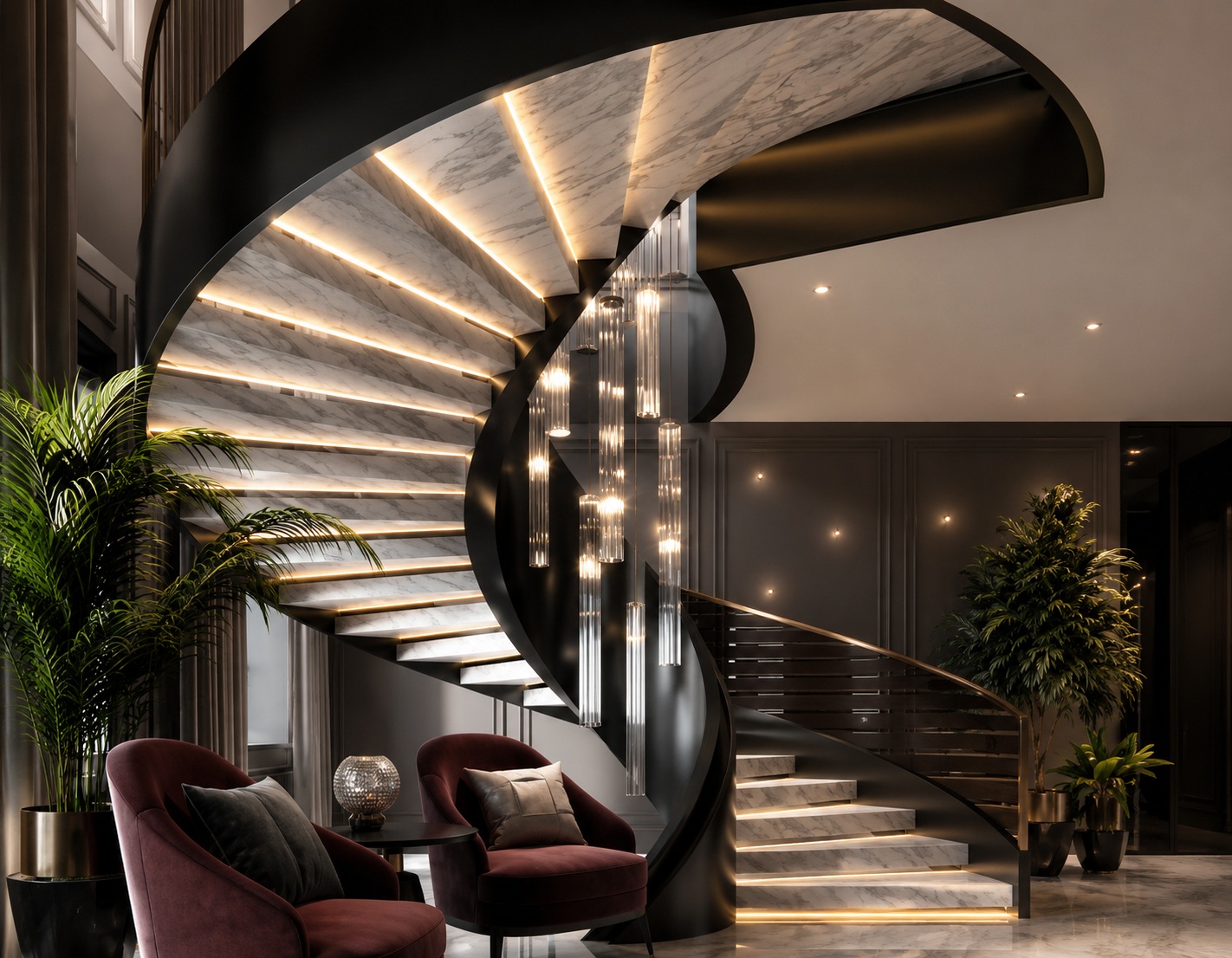
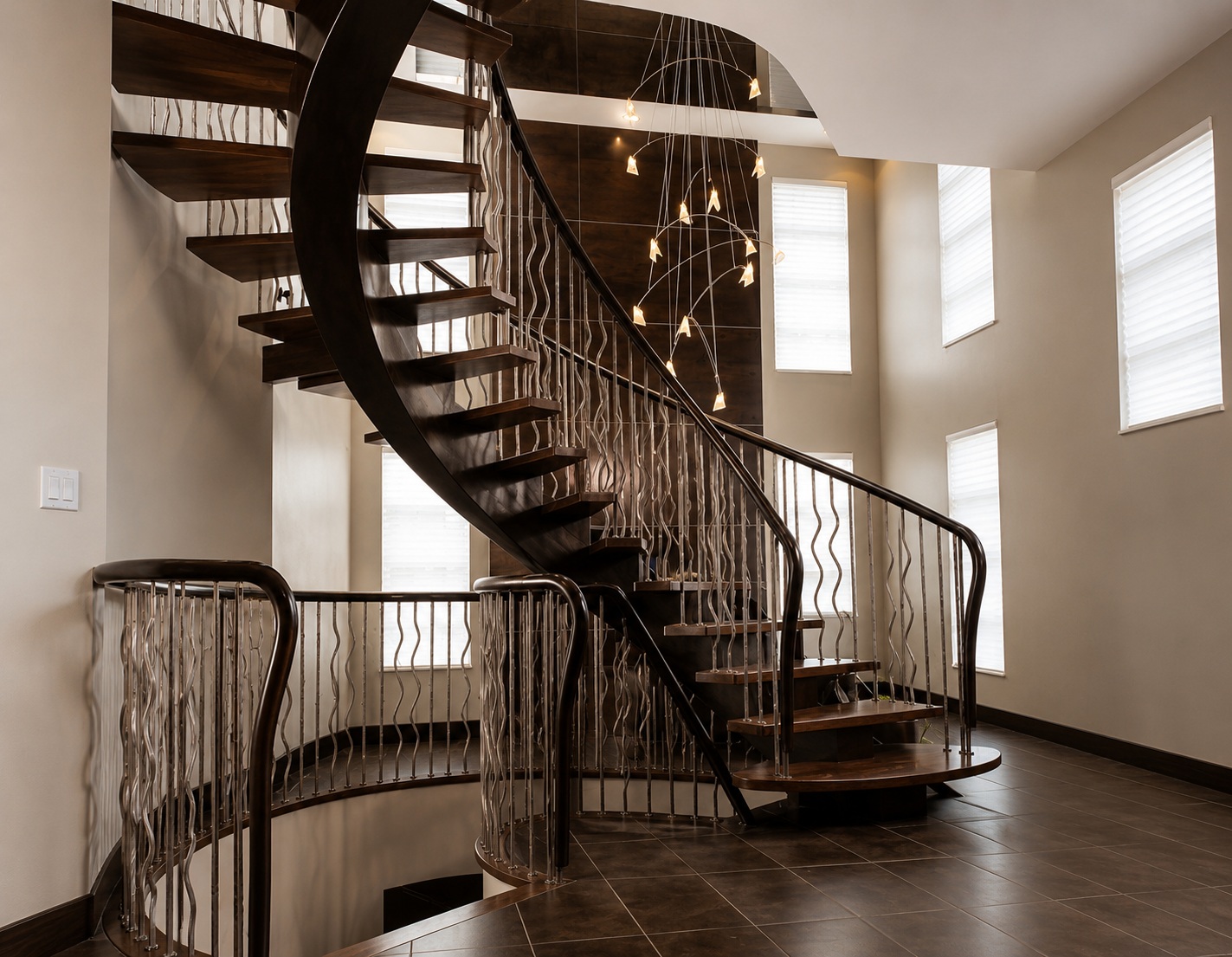
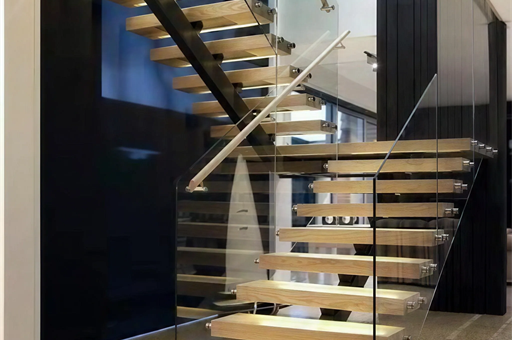
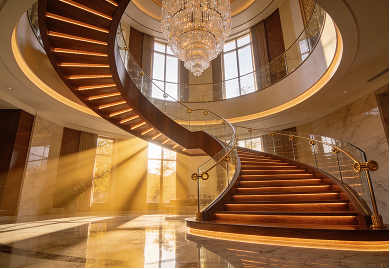
An indoor staircase is where wrought iron makes its boldest statement, because the eye travels the whole rising line. On a straight flight, evenly spaced pickets give a calm, even look that suits almost any home. On a curved or sweeping stair, scrollwork comes alive, since the pattern bends and grows as the flight turns, and the railing becomes a flowing ribbon that follows you up to the landing.
A timber handrail capping a black iron balustrade is one of the most loved pairings in home design. The warm wood meets your hand, the dark metal carries the pattern, and the two materials trade strengths in fine style. Many owners take that detail to a matching landing balustrade and a newel feature at the foot of the stair, which ties the whole staircase into one clear gesture.
Proportion is what separates a refined stair railing from a heavy one. Slimmer pickets and a generous gap keep the staircase feeling open and bright; thicker sections and dense scrollwork lend gravity and grandeur. We tune those proportions to the width of your flight and the height of your ceiling. For a focused walk-through, see our guide to the wrought iron stair railing.
Ideas for Balconies and Exteriors
Outdoors, wrought iron earns its keep on balconies, porches, terraces, and garden steps, where it frames a view and lifts the kerb appeal of a front wall. A Juliet balcony in slim forged bars gives a tall window a graceful guard without blocking the light. A wraparound porch railing in a matched pattern ties an old home together, and a terrace balustrade pulls the lines of the house out into the open air.
Exterior iron does ask for a tougher build, because the weather never lets up. A hot-dip galvanised base under a good powder coat is the common shield, and it lets a coastal or humid-climate railing last for many years with little upkeep. Drainage details matter too, so the design dodges pockets that trap water. These choices are quiet, but they decide whether an outdoor railing stays handsome or starts to streak.
Scale shifts outdoors as well. A garden balustrade can carry a bolder, more open pattern than an interior stair, because it is read from a distance against sky and planting. We work through climate, fixings, and weatherproofing in the exterior wrought iron railing guide, which is essential reading before any outdoor project.
An ornamental iron railing we built for an outdoor terrace and an indoor staircase, with the client’s feedback — tap to play.
Mixing Iron With Wood, Glass and Cable
Some of the freshest wrought iron railing ideas come from mixing the metal with another material rather than using it alone. A timber handrail over iron balusters is the long-standing classic, and it warms an otherwise cool palette at once. Glass infill set within an iron frame is the modern twin, since the frame gives the structure and the panels keep a balcony open to the view and full of light.
Cable infill threads a more industrial note through the same frame, where level stainless lines read as crisp and modern against the forged uprights. Each pairing lets you keep the strength and pattern of iron while you borrow a trait the metal alone cannot give, whether that is warmth, a clear view, or a sleek linear weave. The frame stays iron; only the fill changes.
Combining materials does add complexity to the fabrication, because two systems must meet cleanly at every joint. That coordination is exactly the kind of detail a shop drawing resolves before any metal is cut. If a comparison would help you weigh the trade-offs, our wrought iron versus aluminium and vinyl guide sets the materials side by side.
What Wrought Iron Railings Cost
Wrought iron sits toward the premium end of railing materials, and the design itself is the biggest reason. A plain picket run is the most economical pattern, because it uses simple repeated sections with little hand-forming. An ornamental scroll panel, by contrast, takes far more skilled labour per metre, so it carries a higher price. Because every railing is made to order, there is no single figure to quote; there are drivers.
The main drivers are the pattern complexity, the total length and height, the finish, and whether the run is interior or exterior. A long, simple straight balustrade costs less per metre than a short, intricate curved one. An exterior galvanised-and-coated finish adds a protective layer and therefore cost. We break each driver down, with attributed third-party market ranges rather than a quote of our own, in the wrought iron railing cost guide. As a made-to-order manufacturer, we price each project from its drawing.
Code and Safety Basics
A beautiful pattern still has to keep people safe, so a few code numbers shape every design. Under common US residential references, a guard along an open-sided floor, balcony, or landing is usually at least 36 inches tall. The classic safeguard is the four-inch sphere rule, which means the openings in the railing must be small enough that a sphere four inches across cannot pass through. That single rule governs how tightly your pickets or scrolls can be spaced.
| Common reference (verify locally) | Typical value |
|---|---|
| Residential guard height (IRC) | At least 36 inches above the walking surface |
| Baluster opening (IRC, 4-inch sphere) | No opening passes a 4-inch sphere |
| Stair triangle exception (IRC) | Tread-riser triangle limited to a 6-inch sphere |
| Commercial guard / handrail (IBC, ADA) | Taller guard plus a graspable handrail; ADA governs the rail profile |
Commercial projects answer to the IBC and to ADA accessibility rules instead, which call for a taller guard and a continuous, graspable handrail of a defined profile. Those figures are widely used reference values, and your local adopted code edition is what actually governs, so confirm the current version with your local team. We design the pattern to land within whichever spacing your jurisdiction requires, so the railing looks intentional rather than squeezed.
How a Custom Wrought Iron Railing Is Made
At Double Building Materials, a wrought iron railing starts as a drawing, not a catalogue item. We take your measurements, your chosen pattern, and your finish, then turn them into a working shop drawing. That drawing fixes the rail height, the picket spacing, every scroll, and each fixing point before any steel is cut. We cut nothing until you approve it, because a hand-forged pattern leaves little room to correct a mistake once the metal is shaped.
From there we forge and weld the sections, then trial-assemble the full railing on our Guangdong factory floor. That trial build is where we confirm the pattern, the spacing, and the fit of every panel before anything ships. Once it passes, we powder-coat the steel and crate the railing for export in the order your installer will need it. With more than 25 years behind the workshop and 800-plus projects delivered across 60-plus countries, that drawing-first, trial-assembly habit is how we keep a forged pattern true.
Your own contractor fits the railing on site from our drawings, and we can help you locate a local installer where that service is available. We do not install on site or sign off local code; that responsibility stays with your local team. You can see the range of forged railings we make, and start a project from your own drawing, on our custom wrought iron balustrade page.
Wrought Iron Railing FAQ
Is wrought iron railing outdated?
Not at all, because the material adapts to whatever style you ask of it. Ornamental scrollwork reads as traditional, while straight pickets in matte black read as thoroughly modern. The metal itself never dates; only the pattern carries a period feeling. Choosing a clean, simple design keeps a wrought iron railing looking current for decades.
Which finish lasts longest on a wrought iron railing?
A factory powder coat is the toughest finish, since it bakes a hard, even layer onto blasted steel and resists chips far better than brushed paint. Matte black is the most asked-for colour, though bronze and antique tones suit ornate schemes. Outdoors, a galvanised base layer under the coat adds vital rust defence.
How far apart should wrought iron balusters be?
Common US residential references apply the four-inch sphere rule, which means no opening between balusters may let a four-inch sphere pass through. In practice that keeps spacing fairly tight along the run. Your local adopted code edition governs the exact figure, so confirm the current version with your local team before finalising any pattern.
Is wrought iron stronger than aluminium for railings?
Forged iron is denser and heavier, so it carries a slim, ornate pattern that aluminium struggles to match in fine detail. Aluminium, however, resists corrosion naturally and weighs far less, which can suit some exterior runs. The right choice depends on your design, your climate, and your budget rather than on raw strength alone.
Can wrought iron railings be used outdoors?
Yes, and they are a popular exterior choice, provided the finish is specified for weather. A hot-dip galvanised base under a quality powder coat is the common defence, and good drainage details stop water pooling. With that specification, an outdoor iron railing typically lasts many years with only light upkeep, even in coastal air.
Go deeper into the cluster: wrought iron stair railing ideas, exterior wrought iron railings, cost drivers, designs and styles, and a head-to-head on iron versus aluminium and vinyl. Or browse the full wrought iron balustrade range.
Double Building Materials draws, manufactures, trial-assembles, crates, and ships your wrought iron railing. Your own contractor or installer handles on-site installation and local code sign-off — we can help you find one where available. Dimensions above are common references and code values are typical US figures (IRC / IBC / ADA, with AS 1170 / NCC where relevant); your local adopted edition governs, so confirm the current version with your local team.
Talk to us on WhatsApp →