

Floating Staircase Structural Design: How the Cantilever Is Supported
Floating Staircase · Structural Design
Floating Staircase Structural Design: How the Cantilever Is Supported
Floating staircase structural design routes the entire load through a concealed steel structure instead of visible stringers. Engineers cantilever each tread from a wall, a central beam, or a hidden stringer, then size the steel for both strength and stiffness, so the staircase feels solid and never springs underfoot.
Structural design is the part of a floating staircase you never see, and it is the part that matters most. Because the treads carry no visible stringer, the whole load travels through hidden steel, and a single weak link shows immediately on an open riser. This guide explains how floating stairs carry their load, the three structural systems, the cantilever action behind them, the loads they handle, how engineers control deflection, and where the engineering sign-off sits.
Floating Staircase Structural Design: The Three Support Systems
The treads carry genuine weight, so the structure has to move that load into something solid: a structural wall, a steel spine, or the floor framing. Engineers generally choose one of three systems, and each one changes what the surrounding building has to provide.
| System | How the load is carried and what it demands |
|---|---|
| Wall-anchored cantilever | Steel arms or a stringer embed into a structural wall, and each tread cantilevers out. It gives the purest floating appearance, but it demands a wall engineered to resist the bending moment, often reinforced or steel-framed. |
| Central mono-beam | A single steel beam runs underneath the centre and the treads bolt to it. It works without a side wall, so it suits an open position, but it demands solid anchorage at the top and bottom landings. |
| Concealed stringer | Cladding hides a conventional structural stringer. It demands the least special engineering, and the floating appearance is essentially cosmetic. |
The wall-anchored cantilever is the most demanding of the three, because the wall has to absorb everything the treads throw at it. The mono-beam moves that problem into a single spine and two strong landings. The concealed stringer is the safest fallback when the wall or the budget cannot support a true cantilever. Most projects settle on one of these after the first drawing, once the available structure is clear.
How the Cantilever Works
A cantilever is a beam supported at one end only. Picture a diving board: you stand on the free end, the board bends, and the fixed end holds everything in place. Each tread on a wall-anchored floating stair behaves exactly like that small diving board, and the wall plays the role of the fixed end.
The catch is the bending moment. When someone stands on the outer edge of a tread, the leverage at the fixed end is large, and it grows with the length of the tread. That is why a floating staircase uses heavier steel than it appears to need, and why the embedded end has to be gripped so firmly. The structure is not fighting the weight of a person so much as the leverage that weight creates. Understanding this is the whole of floating staircase structural design, and it explains every heavier section and deeper anchor on the drawing.
The Loads It Carries
We engineer a residential staircase to carry people, plus the occasional heavy or awkward load. In the United States, codes commonly set residential stairs to a 40 psf uniform live load, together with a concentrated load of around 300 pounds applied to a single tread to represent one heavy point load. The guard and handrail carry their own requirements, often a concentrated load near 200 pounds at the top rail. These are widely used reference figures, and your current local code edition is what actually governs, so confirm them with your engineer.
A floating staircase has to satisfy every one of those cases at once. The uniform load covers a crowd on the flight; the concentrated load covers one person landing hard on the outer edge of a tread; the guard load covers someone leaning or falling against the railing. We size the steel for the worst of them, then add a margin on top. The result carries far more than a household will ever apply, which is exactly the point.
Deflection and the Bounce Test
Strength is only half the job. A tread can be strong enough never to break and still feel springy if it moves too much underfoot. That movement is deflection, and controlling it is what makes a floating staircase feel reassuringly solid rather than nervous. A common serviceability target limits live-load deflection to about the span divided by 360, written as L/360, though designers often aim tighter on an exposed stair.
There is a second, subtler issue: vibration. An open flight with long treads can have a low natural frequency, which is the engineering way of saying it can feel bouncy even when it is perfectly safe. We tune the stiffness of the carrier and the treads to push that frequency up, so the stair feels firm the moment you step on it. This is why we size the steel for movement, not only for strength, and why a well-designed floating staircase never telegraphs each footstep to the rest of the house.
Connections and Anchorage
A floating staircase is only as good as the points where it grips the building. On a wall-anchored cantilever, steel arms or embedded plates reach deep into a reinforced wall, and the depth of that embedment is what resists the bending moment. A shallow fixing into a light partition wall will never hold a cantilever, which is why these walls are usually reinforced concrete or a purpose-built steel frame.
On a mono-beam, the two landings do the work. The beam transfers everything it collects into solid anchorage at the top and bottom, so those connections are detailed as carefully as the beam itself. Across every system, we draw each junction in full before fabrication, then bolt or weld the components to that detail. The connections are deliberately conservative, because they are the parts a floating staircase can least afford to underbuild.
How Tread Material Shapes the Structure
The structure and the treads are not separate decisions; one drives the other. A heavy tread asks more of the steel beneath it, so the material you choose shows up directly on the engineering drawing.
Stone and concrete treads are heavy, so they need a stronger carrier and deeper anchors. The steel grows to match the weight, and the wall or the beam grows with it. Solid timber sits in the middle, warm and solid but lighter than stone. Engineered wood is lighter still, which lets the carrier stay slim. A folded steel plate can be the lightest tread of all, and because steel carries its own weight, it sometimes lets us simplify the structure beneath.
This is why we fix the tread material early, before the steel is sized. Swap the tread from oak to marble late in the project, and the whole carrier has to be redrawn for the new weight. Decide the material first, and the structure follows cleanly. If you are still weighing the options, our guide to floating staircase tread materials compares them on weight, grip, and upkeep, each of which feeds back into the structure.
What We Need From Your Drawing
Good structural design starts with a few clear facts about your space. The more precise these are at the start, the less the design has to change later.
We need the floor-to-floor height, which sets the rise and the number of treads. We need the plan opening, which sets the length of the flight and whether it turns. We need to know the wall, whether it is reinforced concrete, blockwork, or a light timber partition, because that decides if a true cantilever is even possible. We need the tread material and thickness, since they set the weight. And we need the railing type, because a glass balustrade and an open edge load the structure in different ways.
With those facts, we can size the steel, detail the connections, and draw a staircase your local engineer can review and stamp. Without them, any design is a guess that will change. A clear, dimensioned drawing at the start is the one thing that keeps a floating staircase on programme and on budget.
Where Engineering Sign-Off Sits
At Double Building Materials we engineer the staircase itself. We size the steel, detail every connection, and produce a working drawing that shows how each tread carries its load. We then trial-assemble the full staircase on our Guangdong floor to prove the structure fits and behaves before it ships. What stays local is the building side of the work.
Confirming that your wall or slab can take the loads, and providing any engineer’s stamp required for a permit, sits with your local structural engineer and authority. Our drawings reference the load cases above so your engineer has what they need to review and stamp. We build to the drawing; your local team signs off the structure in place. You can see how the drawing becomes a finished flight in how a floating staircase is built.
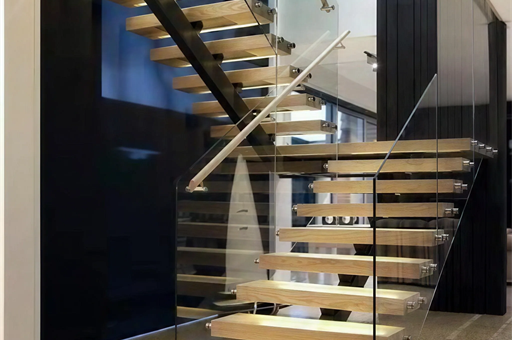
A square-tube floating staircase with glass railing we built for a Virginia home — trial-assembled in our workshop before crating.
Structural Design FAQ
How are floating stairs supported?
By a hidden steel structure rather than visible side stringers. The three common systems are a wall-anchored cantilever, a central mono-beam, or a stringer concealed behind cladding. We engineer each one so a single tread carries its load like a cantilever, then anchor it firmly into the wall or the landings.
How thick do floating stair treads need to be?
It depends on the material and the span, so there is no single number. Solid timber and stone treads are usually thicker than a steel plate, and a longer cantilever needs more depth to control deflection. We set the exact thickness on the working drawing once the material and the span are fixed.
How much weight can floating stairs hold?
We engineer them to the residential load your code requires, commonly a 40 psf live load in the US, plus a concentrated tread load, with a safety margin on top. We size the steel for that load and for low deflection. Always confirm the design load against your current local code edition.
Do floating stairs feel bouncy?
A well-engineered one does not. Bounce comes from low stiffness and a low natural frequency, so we tune the carrier and treads to raise that frequency. A staircase designed for movement as well as strength feels firm from the first step.
Can any wall support a floating staircase?
No. A true wall-anchored cantilever needs a wall that can resist the bending moment, usually reinforced concrete or a steel frame. A light timber or hollow partition cannot hold one. Where the wall cannot take it, we move to a mono-beam or a concealed stringer instead.
How far can a floating tread extend?
There is no single maximum, because it depends on the tread material, its thickness, and the steel inside it. A longer cantilever creates more leverage at the fixed end, so it needs a deeper, stronger section to stay stiff. We work back from the appearance you want to the steel it requires, and we tell you early if a span is pushing past what the structure can comfortably hold.
Background: our floating staircase guide. Related: how a floating staircase is built, what a floating staircase costs, and are floating stairs safe. See the staircase range.
Double Building Materials draws, manufactures, trial-assembles, crates, and ships your staircase. Your own structural engineer and installer handle on-site load sign-off and installation — we can help you find an installer where available. Load figures cite common code values; confirm your current local edition.
Send us your drawings on WhatsApp →