




Do Floating Stairs Meet Code? Risers, Gaps, Guards and Treads
Floating Staircase · Code
Do Floating Stairs Meet Code? Risers, Gaps, Guards and Treads
Yes, floating stairs meet code when an engineer designs them to the local requirements. The open risers, the guard, the handrail, and the rise and run all have rules a floating stair can satisfy. The most distinctive one is the open-riser gap, which must reject a 4-inch sphere. Your local authority signs off the result.
The open risers that make a floating stair look so light are also the feature that raises the most code questions. The good news is that none of those questions are dead ends. A floating staircase can be drawn to satisfy the same rules as any other stair, with one extra detail for the open gaps. This guide walks through the rules that matter, using common US residential reference values, and explains clearly where our work ends and your local engineer and authority take over.
Do Floating Stairs Meet Code? The Short Answer
Yes. Floating stairs meet code when they are designed to the rules in force where you build. There is nothing in a floating staircase that codes forbid, and the open risers that define the look are explicitly addressed in most modern residential codes. The job is to design for the rules from the start, rather than to bolt them on afterward.
The figures in this guide are common US residential values, drawn from the kind of rules the International Residential Code sets out. They are a useful reference, but they are not a substitute for your own jurisdiction. Codes are adopted and amended locally, so your current local edition is what governs, and your local authority has the final word. With that in mind, here are the specific rules that shape a floating stair and how we detail for each one.
The Open-Riser Gap Rule
The open-riser gap is the one rule unique to floating and open stairs, and it exists to protect small children. Under common US residential rules, the open space between treads must not allow a 4-inch sphere to pass through, where that gap sits more than 30 inches above the floor below. The 4-inch figure stands in for the head of a small child.
In practice this shapes how far apart the treads can sit, and it is easily handled at the design stage. Where a tighter limit applies, or where a client wants extra reassurance, a slim sub-rail or a glass infill between treads closes the gap entirely. We detail the tread spacing to the rule you provide, so the open look survives without leaving an unsafe gap. The same 4-inch logic returns on the guard, which we cover next.
Guards and Handrails
A floating staircase needs a guard along any open edge and a handrail to hold. These are not floating-specific rules; every stair faces them, and a floating stair simply has to meet them with a railing that keeps the open look. Common US residential values set the guard at least 36 inches tall, and the same 4-inch sphere rule applies to the openings in that guard.
The handrail has its own figures. It commonly sits between 34 and 38 inches above the tread nosings, and codes usually require a handrail once a flight has four or more risers. A frameless glass balustrade answers all of this neatly, because a solid panel has no gaps to fail the sphere test, while we detail cable or slim baluster infill to the spacing the rule allows. The guard and handrail are where most of a floating stair’s code work actually lives, and all of it has clean solutions.
Rise, Run and Nosing
The step geometry follows the same rule book as any stair. Common US residential values cap the riser near 7¾ inches and set a minimum tread depth of around 10 inches, so the climb stays comfortable and predictable. The code also asks for consistency: the risers and treads should match across the whole flight, because an odd step is where people trip.
Nosing is the small detail that often surprises people. Where treads would otherwise be too shallow, a projecting nosing adds effective depth for the foot, and the codes set a range for how far it can project. On a floating stair with thick timber or stone treads, the nosing is part of the look as well as the rule. We lock the rise, the run, and the nosing on the working drawing, which is also why every step in a finished flight matches the next. The comfort side of this is the 7-11 rule, covered in how a floating staircase is built.
Structural Load Rules
Code is not only about dimensions; it is also about strength. Common US residential rules set a stair to a uniform live load near 40 psf, together with a concentrated load of around 300 pounds on a single tread. The guard, in turn, has to resist a load near 200 pounds at the top rail. A floating staircase has to satisfy each of these, which is why the hidden steel is heavier than it looks.
We engineer the structure to the load cases your code requires and reference them on the drawing, so your engineer can review and stamp the design. The full picture of how the cantilever carries that load sits in our guide to floating staircase structural design. The point for code is simple: a floating stair is engineered to the same load rules as any other, with no allowance made for its lighter appearance.
How We Detail a Floating Stair to Code
Knowing the rules is one thing; building them into a staircase without losing the open look is another. This is where the design stage earns its keep, because every code requirement has a detailing answer that keeps the floating effect intact.
For the open-riser gap, we set the tread spacing to the limit, and where a project needs a tighter result we add a slim sub-rail or a glass infill that disappears against the treads. For the guard, a frameless glass panel satisfies the sphere rule with no visible gaps, while cable or baluster infill is spaced to the figure the rule allows. For the handrail, we run a continuous rail at the required height and return its ends as the code asks. For the rise and run, we hold every step identical across the flight, so the climb stays even underfoot.
None of these details fight the floating look; we simply draw them in from the beginning rather than add them as an afterthought. That is the whole reason a floating staircase is engineered to a drawing, and it is why the code questions that worry people on paper rarely cause trouble in a well-detailed build.
Who Signs It Off
This is where it is important to be precise about our role. We draw and build the staircase to the code requirements you give us, and we reference those requirements on the working drawing. We do not certify the design against your local code, issue an engineer’s stamp, or sign off the installation. Those steps belong to your local structural engineer and your local authority.
In practice the flow is straightforward. You or your architect tell us the code and the figures that apply. We design and detail the staircase to them and supply drawings your engineer can review. Your engineer stamps the design where a permit requires it, and your installer fits the staircase and arranges any inspection. We build to the rules; your local team confirms compliance in place. That division keeps everyone on solid ground, and it is the honest answer to who makes a floating stair pass.
Codes Vary by Region
Everything above leans on common US residential values, but stair rules differ around the world, and even between neighbouring jurisdictions. The broad ideas travel well: most codes care about the gap, the guard, the handrail, the rise and run, and the load. The exact numbers, though, change with the country and the adopted edition.
A project in Australia, the United Kingdom, or continental Europe will answer to its own standards, with its own figures for guard height and baluster spacing. Commercial buildings face stricter rules than homes almost everywhere. Because we ship to many countries, we are used to designing a floating staircase to whichever code a client provides, rather than assuming one. Tell us the standard that applies, and we draw to it. When in doubt, your local authority is the single source of truth for what your stair must achieve.
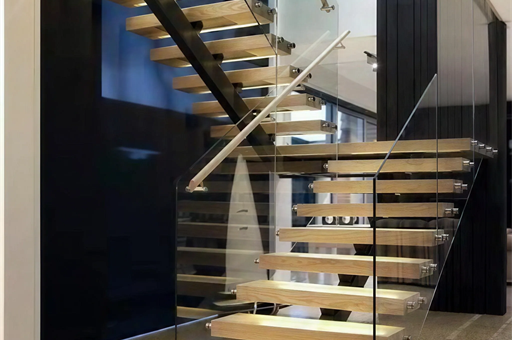
A floating staircase with a frameless glass railing we built for a Virginia home — the glass panel closes the open-edge gap cleanly.
Floating Stairs and Code FAQ
Are floating stairs up to code?
They can be, when they are designed for it. The open risers, the guard, the handrail, and the rise and run all have rules a floating stair can satisfy. The key is to design to the local requirements from the start. Your local engineer and authority confirm the result, since they hold the final say.
What is the gap rule for open stairs?
Under common US residential rules, the open space between treads must not let a 4-inch sphere pass through where it sits more than 30 inches above the floor. The figure represents a small child’s head. A sub-rail or glass infill closes the gap where a tighter limit applies. Confirm the exact rule with your local edition.
How tall does the railing on a floating staircase need to be?
Common US residential values set a guard at least 36 inches tall, with a handrail between 34 and 38 inches above the tread nosings. The same 4-inch sphere rule applies to gaps in the guard. These figures vary by jurisdiction, so confirm them with your local authority before the design is fixed.
Do you certify that the staircase passes code?
No. We design and build the staircase to the code requirements you provide and reference them on the drawing, but we do not certify compliance or sign off the installation. Your local structural engineer stamps the design where required, and your local authority approves it. That keeps the responsibility with the people who hold the legal authority.
Can floating stairs have completely open gaps?
Only up to the limit the code allows. Under common US residential rules the gap must reject a 4-inch sphere where it sits more than 30 inches up, so a completely open gap is fine only if it stays within that figure. Where the treads sit further apart, a sub-rail or glass infill closes the difference while keeping the airy look.
Do commercial floating stairs follow different rules?
Usually yes, and they are stricter. Commercial and public buildings answer to a different code, with tighter figures for width, guard height, and handrails than a private home. If your project is commercial, tell us the standard that applies, and we design the staircase to it rather than to the residential values in this guide.
Will a floating staircase pass inspection?
It can, when it is designed and installed to the local rules, but the inspection itself is carried out by your local authority, not by us. We supply a staircase drawn to the requirements you provide, with drawings your engineer can stamp. Your installer then fits it and arranges the inspection your jurisdiction requires.
Background: the floating staircase guide. Related: are floating stairs safe and structural design. Browse the staircase range and the glass balustrade options.
Double Building Materials draws, manufactures, trial-assembles, crates, and ships your staircase to the code requirements you provide. Your own structural engineer and local authority handle code sign-off, permits, and inspection — we can help you find an installer where available. Code values above are common US residential references; your current local edition governs.
Send your code requirements on WhatsApp →