




Floating Concrete Staircase: The Heaviest, Most Monolithic Look
Floating Staircase · Concrete
Floating Concrete Staircase: The Heaviest, Most Monolithic Look
A floating concrete staircase gives the most solid, monolithic look of any stair, with cantilevered concrete treads that appear to grow from the wall. There are two build routes: concrete cast in place around a steel frame, or precast and clad treads on a steel carrier. Concrete is heavy, so the structure has to carry serious weight.
Concrete reads differently from every other tread material. Where timber feels warm and glass feels light, concrete feels permanent, sculptural, and quietly powerful. A floating concrete staircase pushes that feeling furthest, with steps that seem carved from a single mass rather than assembled. It is also the heaviest and most involved floating stair to build, which makes the build route the first and most important decision. This guide explains the two routes, the weight and cost realities, the monolithic finishes, and exactly what we supply.
What a Floating Concrete Staircase Is
A floating concrete staircase carries cantilevered concrete treads from a concealed structure, so the steps appear to project straight out of the wall with nothing beneath them. It is the most monolithic version of the floating idea, because concrete reads as a single continuous mass rather than a set of separate parts. The effect is heavy, architectural, and unmistakably modern.
The principle is the same as any floating stair: hide the structure, open the risers, and let the treads seem to hang. What changes with concrete is the sheer weight involved, and the way that weight shapes every other decision. A timber tread can be bolted to a slim steel arm, but a concrete tread brings a mass the structure has to plan for from the very first line on the drawing. That is why the build route below matters more here than with any other material.
The Two Build Routes
There are two distinct ways to build a floating concrete staircase, and they lead to very different projects. Choosing between them early is the single most useful thing you can do.
| Build route | How it works and who does it |
|---|---|
| Cast in place | A contractor builds formwork and a reinforced steel cage on site, then pours the concrete in position. The stair becomes part of the building’s structure. This is structural work for your local team, not something shipped in a crate. |
| Steel carrier with clad treads | We fabricate a steel carrier and finish the treads in precast concrete or a concrete-look cladding. It keeps the monolithic appearance while moving the heavy work into the workshop, and it ships as a made-to-order unit. |
The cast-in-place route delivers the purest single-mass look, because the treads and the structure are literally one pour. The trade-off is that it is slow, heavy, and entirely a site operation, with formwork, reinforcement, and curing time. The steel-carrier route trades a little of that seamless purity for a staircase that can be engineered, trial-assembled, and shipped, with the concrete appearance carried by precast or clad treads. We work in the second route, and we are happy to supply the steel and treads that a cast-in-place design needs as well.
The Weight Reality
Concrete is heavy, and there is no way around it. A solid concrete tread weighs far more than the same tread in timber or steel, and a full flight of them adds up quickly. That weight has to go somewhere, which means the wall, the floor, or the beam that carries the stair must be planned for a serious load from the outset.
This is the practical reason the build route matters. A cast-in-place stair commits the building to carrying the full concrete mass, so it suits new construction where the structure can be designed around it. A steel carrier with precast or clad treads is lighter and more forgiving, which makes it a more realistic option in a renovation or an upper floor. Glass-fibre reinforced concrete, a thin, strong concrete-look cladding, can cut the weight further while keeping the finish. We size every part for the real load, a process we describe in our guide to floating staircase structural design.
The Monolithic Look
The reward for all that weight is a look no other material can match. Concrete can be finished smooth and polished, honed to a soft matte, or left with the texture of the timber boards used to form it. Each finish changes the character, from sleek and minimal to raw and tactile, while keeping the single-mass reading that defines the style.
Concrete also takes colour and aggregate. A pale mix reads calm and gallery-like, a dark mix feels grounded and dramatic, and an exposed-aggregate surface adds depth up close. Because the treads appear to grow from the wall, a floating concrete staircase becomes a piece of architecture in its own right rather than a way between floors. It pairs especially well with a frameless glass balustrade, which guards the edge without interrupting the mass, or with no visible railing at all where an open edge is allowed.
Cost
A floating concrete staircase sits at the premium end of the staircase range, and the build route drives the figure. Cast-in-place work carries the cost of formwork, reinforcement, on-site labour, and curing time, all of which happen at the building. A steel carrier with precast or clad treads moves much of that work into the workshop, which can make it the more predictable of the two on cost.
Third-party market figures for floating stairs run roughly $15,000 to $60,000 or more installed, and a concrete stair tends to sit high within that band because of its weight and labour. Those are industry estimates, not our quote; we price the steel and treads we supply from your drawings. Our cost guide breaks down the drivers, and our tread materials guide compares concrete with the alternatives.
What We Supply
It helps to be clear about our role on a concrete project, because concrete blurs the line between a manufactured stair and a building element. We design and fabricate the steel carrier, and we supply engineered concrete or concrete-clad treads to fit it. We trial-assemble that unit in our workshop and crate it for export, exactly as we would a timber or steel staircase.
What we do not do is pour concrete on your site or carry out cast-in-place structural work. That is the job of your local contractor and structural engineer, who build the formwork, place the reinforcement, and manage the pour and the cure. Where a project chooses the cast-in-place route, we can still supply the steel components it calls for. We build and ship the parts that travel well; your local team handles the work that has to happen in position, and signs off the structure where a permit requires it.
Upkeep
Concrete is durable, but it is also porous, so a floating concrete staircase rewards a little care. A penetrating sealer keeps stains and moisture out of the surface, and it is worth refreshing over the years, much like sealing a stone worktop. A polished finish needs the least attention day to day, while a raw or board-formed surface shows marks more readily and suits a relaxed, tactile interior.
Fine hairline cracks are part of concrete’s nature rather than a fault, and good design manages them with reinforcement and considered joints. On a precast or clad tread the controlled factory conditions keep the surface consistent, which is one more quiet advantage of the steel-carrier route. With a sealed surface and sensible cleaning, a concrete stair ages slowly and gracefully, and it tends to look better with a little wear rather than worse.
Is a Concrete Floating Staircase Right for You?
Concrete is a bold choice, and it is not the right fit for every home. It works best where the interior leans modern and the structure is genuinely strong. A new build can be designed around its weight, while a light upper floor often cannot. It also suits an owner who wants a raw, solid look rather than warmth.
Three plain questions help you decide. Does your room lean modern and minimal in style? Can the building carry a heavy stair, or can it be designed to? Are you content to seal the surface every few years? If you answer yes to those, concrete will reward you. The stair stops looking built and starts looking carved, and it becomes the anchor of the whole space.
If you answer no, that is no failure. A timber tread is warmer and far lighter. A steel tread is slimmer and sharper in line. A glass tread is the most open of all. Our floating staircase tread materials guide lays the options side by side. There is no wrong answer here, only the stair that fits your room and your budget. Concrete simply asks for the most commitment, and gives the most presence in return.
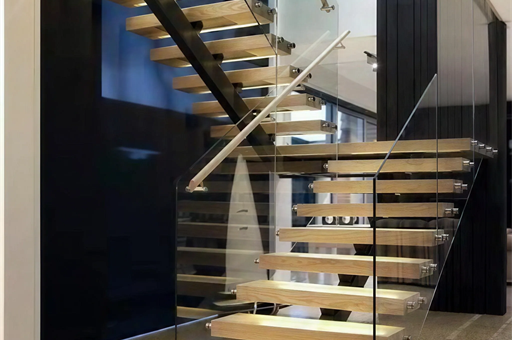
A floating staircase with a glass railing we built for a Virginia home — the same hidden-structure principle a concrete-clad flight uses.
Floating Concrete Staircase FAQ
Are concrete floating stairs heavy?
Yes, the heaviest of any tread material. A full flight of solid concrete treads is a serious load, so the wall, floor, or beam that carries it has to be planned for that weight from the start. A steel carrier with precast or clad treads is lighter, which makes it a more realistic option above ground level or in a renovation.
How is a floating concrete staircase made?
By one of two routes. A cast-in-place stair is poured on site around a reinforced steel cage, becoming part of the building’s structure. A steel-carrier stair uses a fabricated steel frame with precast or concrete-clad treads, built in a workshop and shipped. The first is a site operation; the second travels as a made-to-order unit.
Do concrete floating stairs crack?
Fine hairline marks are part of concrete’s nature rather than a defect, and good design manages them with reinforcement and considered joints. Factory-made precast or clad treads keep the surface more consistent than an on-site pour, which is one reason many projects choose the steel-carrier route.
Does a concrete staircase need sealing?
Yes. Concrete is porous, so a penetrating sealer keeps stains and moisture out, and it is worth refreshing over the years, much like a stone worktop. A polished finish needs the least day-to-day attention, while a raw or board-formed surface shows marks more readily.
Can you put a concrete staircase on an upper floor?
Sometimes, but the weight is the deciding factor. A solid cast-in-place stair is heavy, so an upper floor has to be designed to carry it from the start. A steel carrier with precast or clad treads is much lighter and easier to support. Above ground level, that lighter route is usually the wiser choice, and your engineer confirms what the floor can safely take.
How long does a concrete staircase last?
A very long time. Concrete is one of the most durable surfaces a stair can use. Sealed and cleaned occasionally, it can comfortably outlast the rest of the fit-out. It does not warp like timber or scratch like a soft metal. If anything, a little age tends to suit concrete rather than spoil it.
Is a concrete staircase noisy to walk on?
Not especially. Concrete is solid and dense, so it does not creak or ring the way a hollow tread can. The mass that makes it heavy also makes it quiet and stable underfoot. A slip-resistant finish keeps the surface sure, and the stair feels planted rather than springy.
Background: the floating staircase guide. Related: tread materials and structural design. Browse the staircase range and the glass balustrade options that pair with a concrete flight.
Double Building Materials designs and fabricates the steel carrier and supplies engineered or concrete-clad treads, then trial-assembles and crates them for export. Cast-in-place concrete and on-site structural work are handled by your local contractor and engineer — we can help you find an installer where available. Cost figures are third-party market estimates, not a DBM price.
Ask about a concrete-look stair on WhatsApp →