

Curved Staircase with Step Lighting, Crawfordville FL | DBM
Home / Project / USA / Crawfordville Curved Staircase
Project · Crawfordville, Florida, USA · Curved Staircase with Step Lighting
A Curved Staircase That Lights Every Step — Crawfordville, Florida
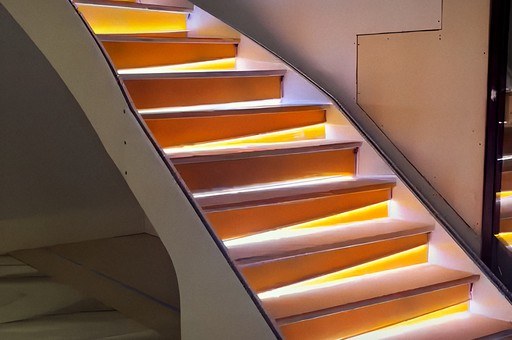
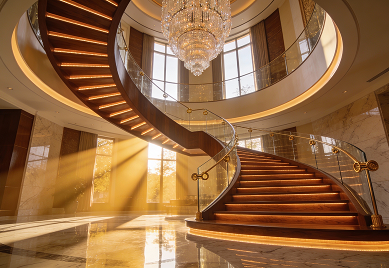
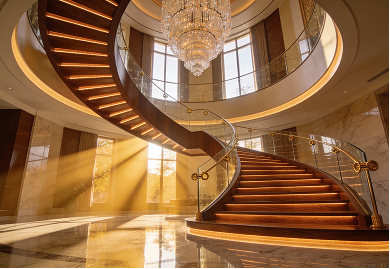
One white curve, closed along its whole sweep, with Jazz White treads and a line of light on every step. The site team filmed it in Crawfordville before the house was finished and sent the clip back to us.
By Double Building Materials — the staircase & railing manufacturer in Guangdong, China that drew, built and crated this curved staircase. Written from our project notes and the site video sent back from Florida. Published October 2026.
The Project at a Glance
A curved staircase for a home under construction in Crawfordville, Florida, USA. It has closed risers, Jazz White treads, a white closed side that follows the curve, and RGB LED step lighting. Double Building Materials drew, made, trial-assembled and crated it in Guangdong, China, then shipped it to Florida for fitting on site.
The Challenge
A brief like this one pulls in three directions. The first is geometry. On a curved staircase every step turns a little, so each tread and riser is a slightly different shape. A closed side has to follow that turn as one smooth surface, and the light on each step has to line up with the next one all the way to the top.
The second is the look. A white stone finish shows every joint and every chip, and a line of light makes any uneven step easy to spot. The stair has to read as one clean sweep in daylight and as a calm, even glow after dark, without glare in the eyes of someone walking down.
The third is daily life. This is a family staircase, not a showpiece behind a rope, so it has to be easy to clean, comfortable to walk on and clear to see at night.
The Brief: Closed, White and Lit
On paper the brief was short: a curved staircase with closed risers, Jazz White treads and RGB step lighting. Each of those three choices changes how the stair looks in the room, and how we have to make it.
Closed risers turn the curve into one solid band, a white finish keeps it light in the room, and the lighting traces the curve step by step after dark. That marks every edge clearly, which helps on curved stairs, where the steps turn as they climb.
Jazz White: Marble or Sintered Stone?
Jazz White is a look: a bright white ground with soft grey veining. We can make it in two materials, natural marble or sintered stone, and we choose between them with the client, based on how the family will use the stair. Both sit in our tread range, and both suit a curved staircase. They simply behave differently over the years.
Natural marble
Marble is quarried stone, so every slab is different and the veining runs through its full depth. That gives each tread a natural depth that a printed pattern can only imitate. Marble is also softer, and it reacts with acids. The Natural Stone Institute notes that etch marks come from acids left on the surface, so a spilled drink or a citrus cleaner can dull a polished step. Owners who choose marble usually seal it, clean it with a pH-neutral stone cleaner, and accept a gentle patina over time.
Sintered stone
Sintered stone is made from natural minerals that are pressed and fired at very high heat into a dense slab. It absorbs very little water; leading makers publish rates of 0.1% or less under the ISO 10545-3 test, so spills stay on the surface and wipe away. It is hard to scratch, and its pattern is consistent, so we can match the veining closely from step to step around the curve. The slabs are thin, so we usually build up each tread, with mitred edges that read as solid stone.
| Jazz White marble | Jazz White sintered stone | |
|---|---|---|
| Look | Every slab unique, natural depth | Even pattern, easy to match step to step |
| Spills | Sealed; acids can etch the surface | Very low absorption; wipes clean |
| Wear | Softer; wear shows as patina | Harder surface, resists scratches |
| Edges | Solid stone, edge can be shaped | Thin slab, mitred to look solid |
| Upkeep | Reseal from time to time | Everyday cleaning |
Finish, grip and light
Whichever stone you choose, the finish matters on a stair. A high polish reflects the line of light sharply and makes the white look brighter, but it can feel slick underfoot. A honed or matte tread, or a fine anti-slip groove near the nosing, gives better grip and softens reflections. Families with young children or pets often lean toward sintered stone; owners who want a one-of-a-kind natural surface often lean toward marble.
Closed Risers vs Open Risers on a Curved Stair
Open risers make a stair feel light, because you can see through the steps. Closed risers do the opposite: they turn the stair into a solid sculpture, and they give the light a face to sit on. On this stair, the warm glow you see on each step is on the riser face, which only exists because the risers are closed. Closed risers also stop toys, dust and dropped items from falling through to the floor below.
US homes may have open risers, with a limit. The Florida Building Code, Residential (8th Edition, 2023) sets it in Section R311.7.5.1. Where a stair is more than 30 inches above the floor below, the gap between treads must not let a 4-inch sphere pass through. A closed-riser stair leaves no gap to measure. Our drawings reference these stair rules so your engineer or building department can review them; the final sign-off stays with them.
From Drawing to Site
The process in motion
Drawing-First Coordination
Drawing-First Coordination means we draw the whole stair, and you approve it, before we cut a single part. On a curved staircase each step has its own shape, so we draw the curve, the rise of every step, the closed side and the chosen stone as one set. On a lit stair the drawings also show where the light runs and where the power comes in, so the electrician is not guessing later. For Florida homes, the drawings reference the stair rules in Section R311.7 of the Florida Building Code, Residential.
Trial Assembly Before Packing
Trial Assembly Before Packing is our standard for every stair. We stand the staircase up on our workshop floor in Guangdong and check the line of the curve and the rise of each step. Then we take it apart and label each part. If a step sits wrong or a joint shows a gap, we fix it in the workshop, where the tools are, rather than on a Florida job site.
Export-Ready Crating
Export-Ready Crating means we pack each part in braced crates built for the sea crossing to the United States. Stone treads travel with their edges protected. We label every crate to the assembly order, so the parts reach the site in the sequence the crew will need them.
Double Building Materials draws, makes, trial-assembles, crates and ships. In the US, our installation team or your own contractor fits the stair on site; a licensed electrician connects the lighting.
Installation in the US
In the United States, we can also install the stair for you. Our installation team fits the labelled parts in the order we tested them in the workshop. If you prefer your own contractor, we send the assembly drawings and a step-by-step guide with the crates. Either way, a licensed electrician connects the step lighting. Tell us the project location with your drawings, and we will confirm the options for your site.
What the Site Video Shows
The clip is short, about ten seconds, and the site team shot it while the house was still a work site. Floor protection is down, the walls are not finished, and scaffold still stands outside the high windows. It is an honest look at the stair itself, before furniture arrives.
Three things stand out. First, the outer side is one smooth white panel that follows the curve from the floor up, so the stair reads as a single closed form. Second, each riser glows a warm amber. Third, a thin bright line runs under every nosing, so you can see exactly where each step ends.
The light holds the same warm tone through the whole clip; it does not cycle through colours. Because the lighting is RGB, that warm amber is a setting the owner can change later. Under that warm light the steps read amber on camera, so the clip shows the lighting rather than the true Jazz White colour. There is no railing on the open side in the clip.
Planning Light into a Curved Staircase
If you like this stair, settle four questions early, ideally before you approve the drawings. Each one is much easier to solve on paper than on site.
- Where should the light sit? It can sit on the riser face, under the nosing, or both. This stair uses both: a glow on the face and a line at the edge.
- Fixed warm white or RGB? Warm white is the simpler choice. RGB lets you change the colour later, as the owner can on this stair.
- Where do the power and the driver go? Plan a spot you can reach for the LED driver, so someone can service it later without opening up the finished stair.
- Who wires it? A licensed electrician connects the lighting on site. The drawings should show them the cable route before anyone closes the walls.
Want to see how the curve itself is set out? Our guide on how a curved staircase is built covers the stringer, the radius and the fabrication steps. For shapes and layouts, see curved staircase design and plans.
Frequently Asked Questions
Is a curved staircase the same as a spiral staircase?
No. A spiral staircase winds tightly around a centre post. A curved staircase follows a wider arc with no centre post, like this one in Crawfordville. We compare the two in curved vs spiral staircase.
Should the treads be marble or sintered stone?
It depends on how you will use the stair: marble for a one-of-a-kind natural surface that ages with a patina, sintered stone for an even pattern that resists stains and scratches. We make the Jazz White look in both.
What drives the cost of a curved staircase?
Mostly the size of the curve, the number of steps, the stone you choose, and extras such as lighting and the railing. We price each stair from its drawings, so we do not publish a price list. Our guide to curved staircase cost explains the main price drivers.
Can step lighting be added after the stair is built?
It can, but it is harder. Light you plan in the drawings can sit in a neat line under each nosing. If you add it later, it often has to sit on the surface instead. If you might want lighting, decide before you sign off the drawings.
Planning a curved staircase with light built in?
Send Us Your Plans for a Drawing Review →Related Projects
Related Products
See all our custom curved staircases — each one drawn, trial-assembled and export-crated the same way.
Other Products
More from the same factory — drawn, trial-assembled and export-crated the same way.