




Curved Double Stringer Staircases in Travertine, Miami | DBM
Home / Project / USA / Miami Curved Staircases
Project DBM24052702 · Miami, Florida, USA · Curved Staircases
Brass, Travertine and Glass: Two Curved Staircases for Miami
Brass-tone stringers sweep up through a glass-walled room, carrying travertine treads with open risers and glass that bends with the curve. What these photos show is a curved double stringer staircase: two curved stringers, inner and outer, with an open centre.
By Double Building Materials — the staircase & railing manufacturer in Guangdong, China that drew, made and crated the curved staircases for this project. Written from our project record and site photos. Published October 2026.
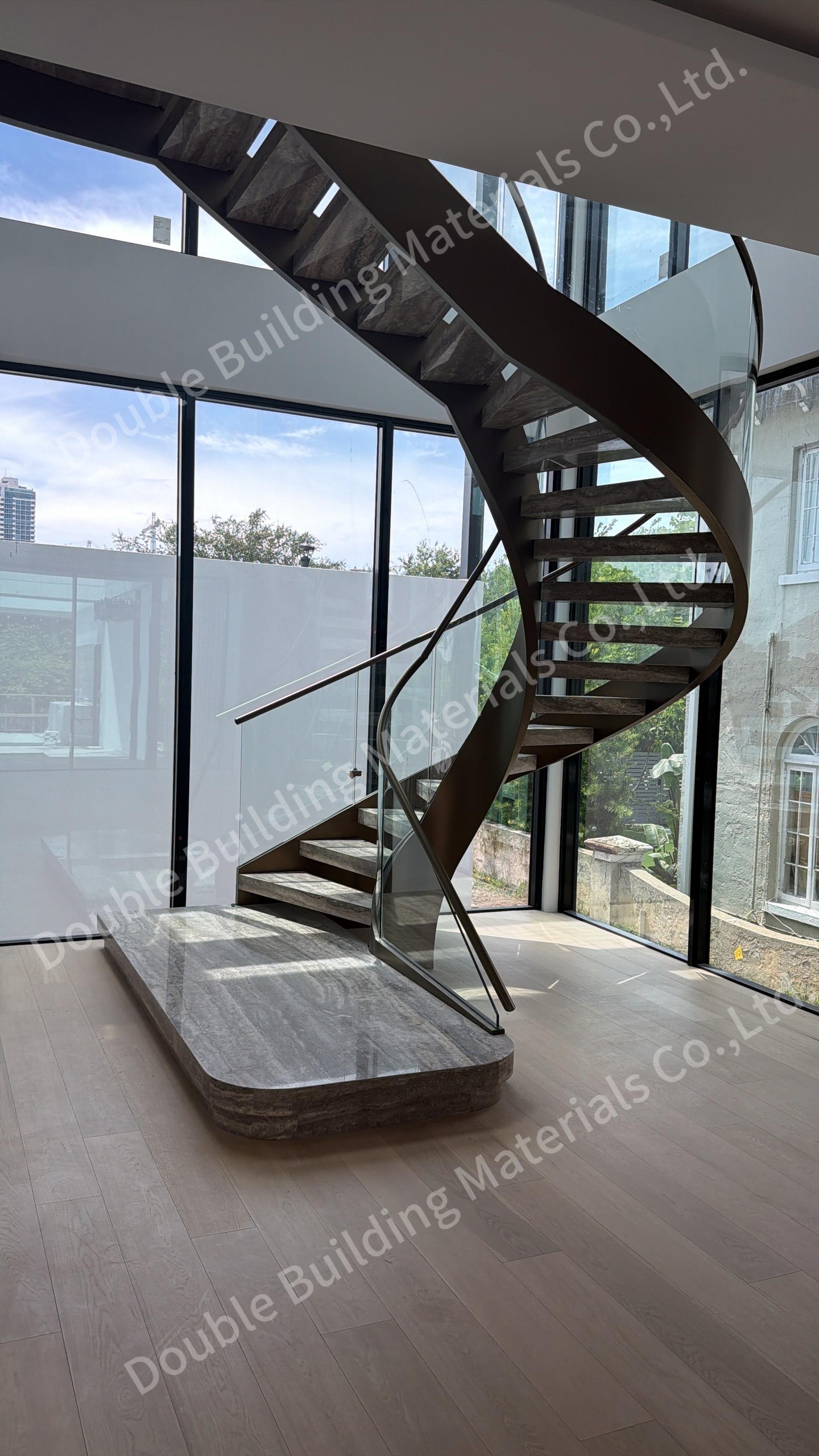
The finished stair: brass-tone stringers, travertine treads and glass that follows the curve, starting from a low stone plinth. Miami, Florida.
The Project at a Glance
Two matching curved staircases for a project in Miami, Florida. Each has an inner and an outer stringer, travertine treads with open risers, and glass balustrades with a slim handrail. Both are finished in a brass tone and start from a low stone plinth. Double Building Materials made the stairs in Guangdong, China.
The Challenge
A curved stair with two stringers is really two curves that have to climb together. The outer stringer runs on a wide radius and the inner one on a tight radius. That makes every tread between them a wedge, wider at one end than the other. If the two curves drift apart, the treads stop sitting level, and the error shows all the way up.
The second test is the look. Stone and brass-tone metal are both honest finishes that hide nothing. Travertine shows its bands, so the treads have to line up from step to step, and a long curved stringer shows every join. In a room walled with glass, daylight falls across all of it.
The third is the build and daily life. The stair goes in while the building is still under construction, long before the floors and walls are done. Later, people walk on stone with open risers every day, so the treads need grip and the glass needs easy cleaning.
The Design
The finished stair pairs a warm brass tone with soft, banded travertine. Open risers let light pass between the treads, and glass follows the stringers around the turn under a slim handrail. At the foot, a low plinth in matching stone gives the climb a broad, solid start.
What a Curved Double Stringer Staircase Is Made Of
From across the room, a curved stair looks like one sweeping ribbon. Up close, a curved double stringer staircase is six parts, each with a job. The diagram takes a typical one apart from the floor up, lights each part in turn, then puts it back together.
Inside a curved double stringer staircase
Taken apart from the floor up, then put together.
A typical curved double stringer staircase, for illustration. The radius, stringer section, tread fixing and glass on any project come from its own drawings.
- Stone plinth. The base the stair starts from. Here it is a low plinth in stone that matches the treads.
- Outer stringer. The long curved side plate on the wide side of the turn. It carries the outer end of every tread, and it is the face you see most from the room.
- Inner stringer. The tighter curve on the narrow side. With a stringer on each side, the stair needs no centre post, so the middle of the curve stays open.
- Travertine treads. Stone treads span from stringer to stringer, with open risers between them. The drawings set how each tread is fixed.
- Glass balustrade. Safety glass panels follow the stringers around the curve, so the edge of the stair stays open to the light.
- Handrail. A slim rail along the top of the glass, curving with it, gives the hand a guide all the way up.
Our guide on how a curved staircase is built walks through the radius and the stringers in more detail.
Going In: The Curve Before the Finish
This photo was taken while the building was still a shell, with bare concrete, steel framing and scaffolding all around. A curved stair already stands in the open space, its stringers sweeping up between the floors. There is no glass yet, so you see the structure on its own: two curves rising together, with the steps set between them.
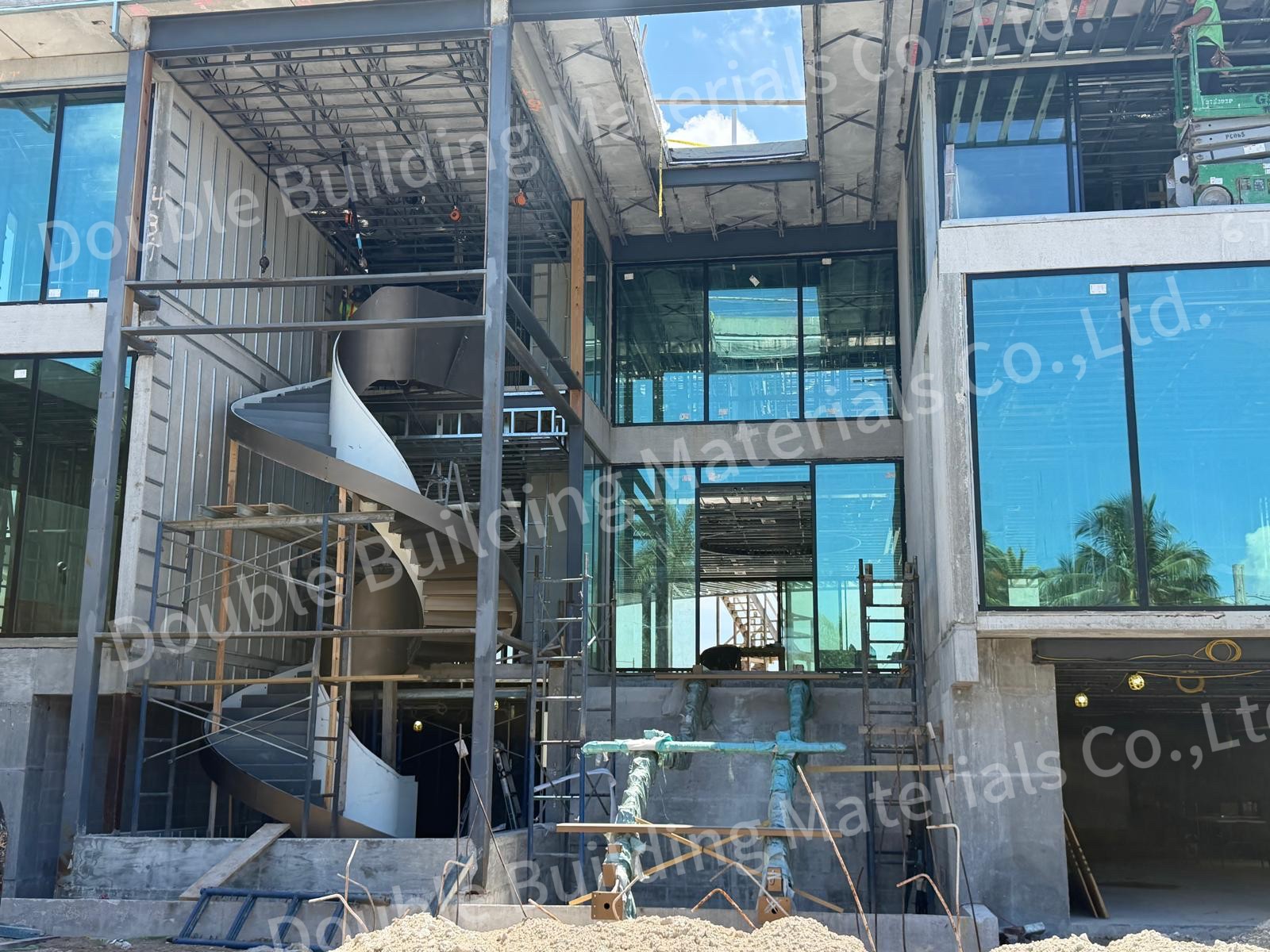
During construction: a curved stair in the open shell of the building, before its finished brass look.
In this photo the stringers still show two different tones, dark outside and pale inside. That is not the final look: on the finished stairs both stringers carry the same warm brass tone, as the photos further down show. This is the stage where the curve has to be right: once stone and glass go on, the line of the stringers is what everyone sees.
Travertine, Marble or Granite for Stair Treads?
Travertine is a natural stone made of calcite, the same mineral found in marble and limestone. The Natural Stone Institute explains that it forms where mineral-rich spring water deposits calcite, which leaves the stone full of small pores. Those pores can be left open for texture or filled for a smoother surface. Cut across its layers, travertine shows long, parallel bands; cut along them, it shows a softer, cloudy pattern. The treads here show long bands in soft greys.
On a stair, that warm, matte stone sits well beside brass-tone metal and pale wood. It also asks for some care. Like marble, travertine reacts to acids, so lemon juice, wine or a harsh cleaner can leave a dull etch mark. The Institute notes that etching does not weaken the stone, but it does show. Many owners seal their travertine and clean it with a pH-neutral stone cleaner.
| Travertine | Marble | Granite | |
|---|---|---|---|
| Made of | Calcite | Calcite | Quartz and feldspar |
| Look | Soft bands, natural pores | Bold veins | Speckled grain |
| Acids | Can etch | Can etch | Not affected by household acids |
| Care | Seal; pH-neutral cleaner | Seal; pH-neutral cleaner | Less sensitive to spills |
The finish matters as much as the stone. In slip tests reported by the Natural Stone Institute, polished stone did not reach the 0.42 wet-friction benchmark on average, in any stone type. A honed or textured finish is a common choice for treads. If you are weighing marble against sintered stone instead, our Crawfordville curved staircase compares the two.
Curved Stairs and the Code
On a curved stair every tread is a wedge, so the code measures it along a walkline. For homes, US residential codes place this line 12 inches in from the narrow side of the treads. Along it, each tread must be at least 10 inches deep, and no part of a tread inside the stair's clear width may be under 6 inches. Open risers are allowed, but where a stair is more than 30 inches above the floor below, the gaps must not let a 4-inch sphere pass. Glass in a stair guard counts as a hazardous location, so it must be safety glass. Our guide to tempered glass railing explains the main safety glass types.
In Florida, these rules sit in the Florida Building Code, Residential. The 8th Edition (2023) is in force today, and a 9th Edition takes effect on December 31, 2026, so ask which one covers your permit. Our drawings reference these rules so your engineer or building department can review them; the final sign-off stays with them.
From Drawing to Site
Drawing-First Coordination
Drawing-First Coordination means we draw the stair, and you approve it, before we cut anything. On a curved double stringer staircase, the drawings fix both radii, the walkline and the rise of every step. They also set the shape of each stone tread and the points where the glass panels meet. The stone plinth and how the first tread meets it go on the same set.
Trial Assembly Before Packing
Trial Assembly Before Packing is our standard for every stair. We stand the stringers and treads up in our Guangdong workshop and check the curve, the level of each tread and the line of the glass. Then we take it apart and label every part to its place in the flight.
Export-Ready Crating
Export-Ready Crating means the curved stringers travel braced in crates built for the sea crossing. Stone treads and glass panels travel with their edges protected, and every crate is labelled to the assembly order.
Double Building Materials draws, makes, trial-assembles, crates and ships. In the US, our installation team or your own contractor fits the stair on site.
Installation in the US
In the United States, we can also install the stair for you. On a curved double stringer staircase, the crew typically sets and fixes the stringers first and checks the curve and level. Then they set the treads, the glass and the handrail. If you prefer your own contractor, we send the assembly drawings and a step-by-step guide with the crates. Tell us the project location with your drawings, and we will confirm the options for your site.
The Finished Stair
The finished photos show a tall room walled with floor-to-ceiling glass, over a pale wood floor. Daylight comes in from two sides. It passes between the open risers and through the glass, so the stair throws soft bands of shadow across the stone plinth instead of a heavy block of shade.
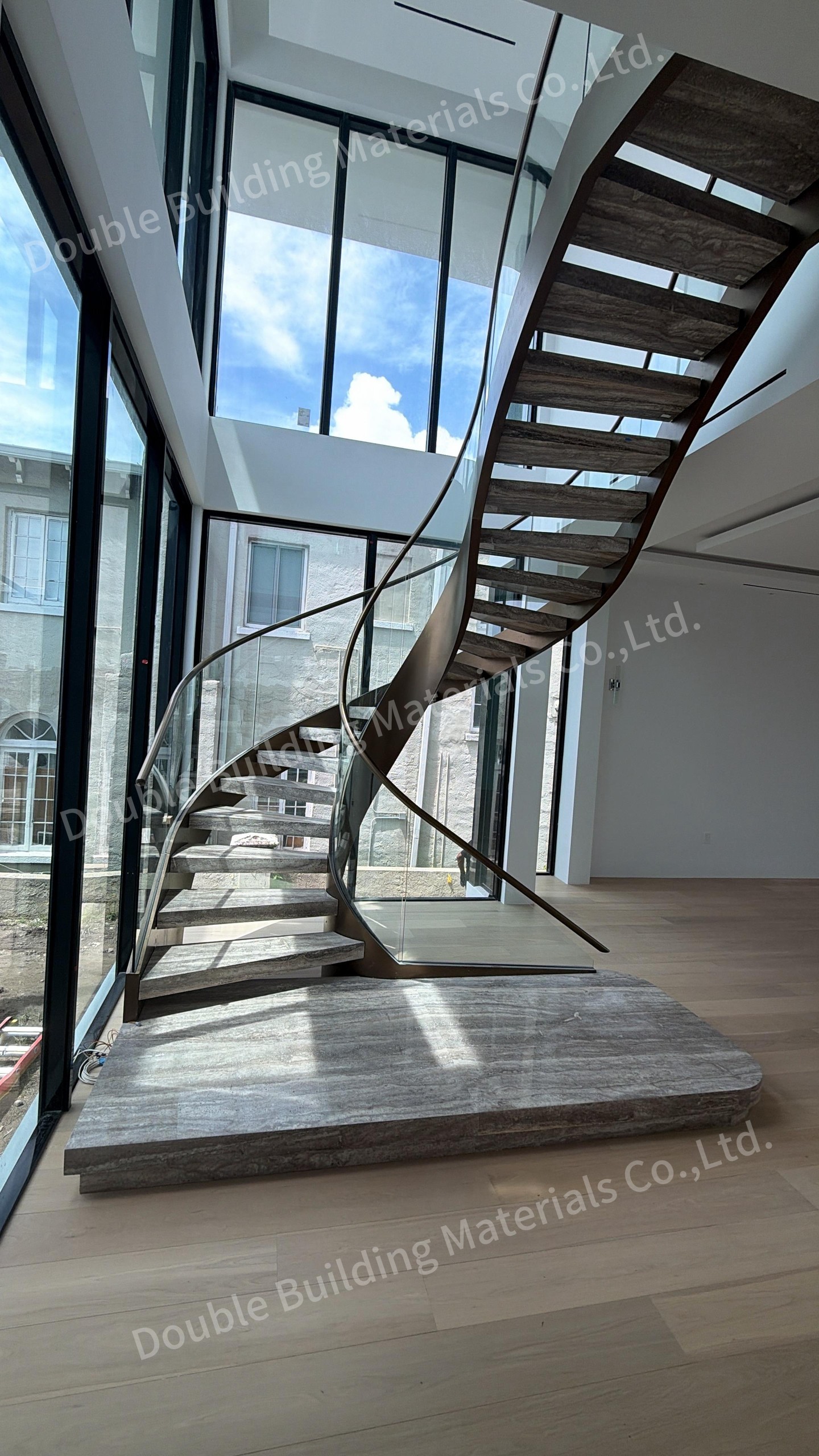
Another angle on the finished stair: the glass bends with the stringers, and daylight falls through the open risers onto the stone plinth.
From the room, the two brass-tone stringers read as ribbons, one inside the other, turning as they climb. The travertine treads sit between them in soft grey bands. The glass bends with the stringers, so the edge stays clear, and the slim handrail traces the same curve above it.
In daily use, the stair starts on a broad stone base and the handrail stays within easy reach. Glass in a bright room shows fingerprints, so plan on regular wiping; our guide on how to clean glass railings goes step by step.
Frequently Asked Questions
What is a double stringer staircase?
It is a stair carried by two stringers, one at each end of the treads. On a curved double stringer staircase, one stringer follows the inner curve and one the outer, so the centre stays open. Our guide to steel stair stringers compares the main types.
Is a curved staircase the same as a spiral staircase?
No. A spiral stair turns tightly around a central column and takes little floor space. A curved stair sweeps along a wider arc, like the stair here, and needs no column. Our guide to curved vs spiral staircases goes deeper.
Is travertine a good choice for stair treads?
It can be, with a honed or textured finish for grip, a good sealer and a pH-neutral cleaner. Keep acids such as citrus and vinegar off it, because they can etch the surface.
What drives the cost of a curved staircase?
Mostly the size and turn of the curve, the number of steps, the stone, the glass and the finish. We price each stair from its drawings and do not publish a price list. Our guide to curved staircase cost sets out the main price drivers.
Planning a curved staircase in stone, metal and glass?
Send Us Your Plans for a Drawing Review →Related Projects
Other Products
More from the same factory — drawn, trial-assembled and export-crated the same way.