

Staircase Design Ideas for 2026: Types, Materials & Inspiration-Staircase Guides
Staircase Design · The Complete Ideas Guide
Staircase Design Ideas for 2026: Types, Materials & Inspiration for Modern Homes
Good staircase design ideas begin by matching the stair to your space, your light, and the way your home is used. The two big choices are the type — straight, floating, spiral, curved, or mono-stringer — and the materials, from warm wood and steel to open glass. The right pairing turns a staircase into a centrepiece.
A staircase is the one piece of joinery you see from almost every room, so its design sets the tone of the whole home. This complete guide gathers staircase design ideas the way an owner actually decides them: first the shape, then the materials, the railing, and the light. Every type below links to a focused guide and to the real stairs we make, so you can move from inspiration to a buildable plan without losing the thread.
How to Approach Your Staircase Design
Useful staircase design ideas are not picked from a gallery first; they follow three honest questions about your home. How much floor do you have to give the stair? How much natural light do you want it to pass through? And who climbs it every day, from young children to grandparents? Your answers narrow the field before you ever choose a single material.
Space decides the shape more than anything else. A generous hallway can carry a sweeping curved flight, while a tight corner calls for a spiral that folds the climb into a small circle. Light decides how open the stair should feel, which is why glass and open risers suit a room you want to keep bright. The people who use it set the comfort, since a busy family stair wants a gentler rise than a feature stair seen more than it is walked.
Only then does style come in. Once the configuration and the comfort are settled, the materials and the balustrade transform the staircase into something that genuinely belongs to your home. The ideas below are grouped that way, by type first and finish second. That lets you move from a broad direction down to the small choices that make a stair feel considered rather than catalogue-bought.
Staircase Types at a Glance
Most staircase design ideas grow out of one of five fundamental configurations. Each has a natural home, a footprint, and a feeling, so the quickest way to start is to see them side by side. The table below sketches where each type suits, and the sections that follow take every one of them further.
| Type | Character and where it suits |
|---|---|
| Floating | Open treads that appear to hang, with a hidden support. The defining modern look for a bright, open-plan room. |
| Spiral | Treads winding around a central post in the smallest footprint of any stair. Suited to a loft, a corner, or a compact home. |
| Curved | A graceful sweeping arc with no sharp turn. The classic statement stair for an entrance hall with room to spare. |
| Mono-stringer | A single central steel beam carrying the treads, for a clean, minimal line that reads as light as a floating stair. |
| Straight | The simplest and easiest to climb, and the most flexible base for any material or railing you like. |
None of these is better than the others; each answers a different room. A floating or mono-stringer stair leans modern and minimal, a curved stair leans grand and traditional, and a spiral leans compact and sculptural. You can browse the full range we make on our custom staircase page, then read on for the design ideas behind each one.
Floating Staircase Design Ideas
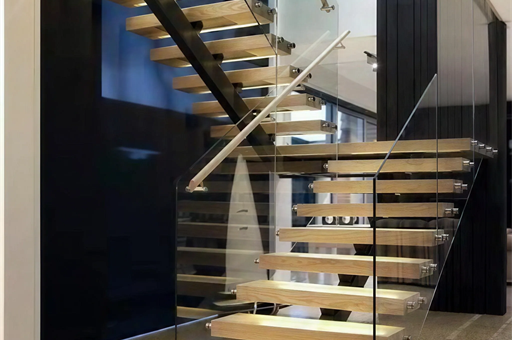
The floating staircase is the image most people picture when they think of modern staircase design. Its treads seem to hang in the air because the structure is hidden, either inside the wall or within a single slim stringer. The open risers let light and sightlines pass straight through, so the stair takes up visual weight without closing off the room behind it.
The most-loved version pairs thick timber treads with a matte black steel support and a frameless glass balustrade. That mix gives warmth underfoot, a crisp structural line, and a guard you can almost see through. Owners who want an even quieter look drop the glass for a slim cable infill, or anchor each tread into the wall so nothing but the timber shows. A floating flight relies on a carefully engineered support, which is exactly the part we draw and trial-assemble before anything ships.
Floating designs reward a feature wall, a double-height void, or a spot where you want the stair to read as sculpture. Start with our pillar guide to what a floating staircase is, browse more looks in our floating staircase ideas guide. Go deeper on the engineering in how a floating staircase is built and the floating staircase structural design. For a solid, monolithic version, see the floating concrete staircase. And if budget is your starting point, our guide to floating staircase cost breaks down what actually sets the price.
Spiral Staircase Ideas for Compact Spaces
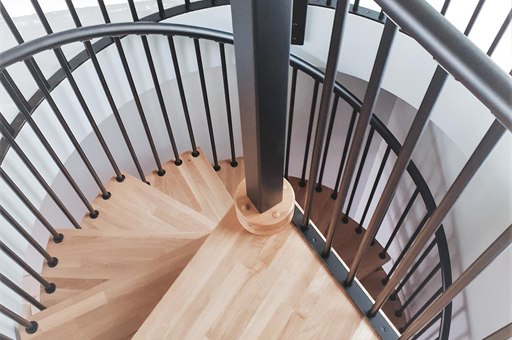
When floor area is tight, a spiral staircase is often the only design that fits without taking the room hostage. The treads wind around a central column in a circle as small as a few feet across, which frees the surrounding floor for living rather than for stairs. That is why a spiral suits a loft conversion, a mezzanine study, a basement, or a holiday home where every square foot counts.
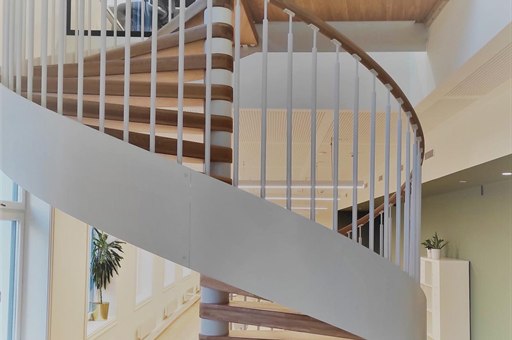
Compact does not mean plain. A spiral can be a quiet steel coil that disappears into a corner, or a forged-iron centrepiece with ornamental balusters that owns the room. Wooden treads on a steel column warm it for a living space, while open metal grating keeps an industrial look light. Choosing a generous diameter is the idea that helps most here, because it makes the climb easier and gives each tread more depth to stand on.
Read what a spiral staircase is for sizing and types, plan a tight footprint with our space-saving spiral staircase guide, and weigh the budget through the spiral staircase cost drivers. Browse models on our spiral staircase page — a loft spiral, a residential spiral, an indoor spiral, a wooden spiral, a metal spiral, or an exterior spiral.
Curved Staircases as a Centrepiece
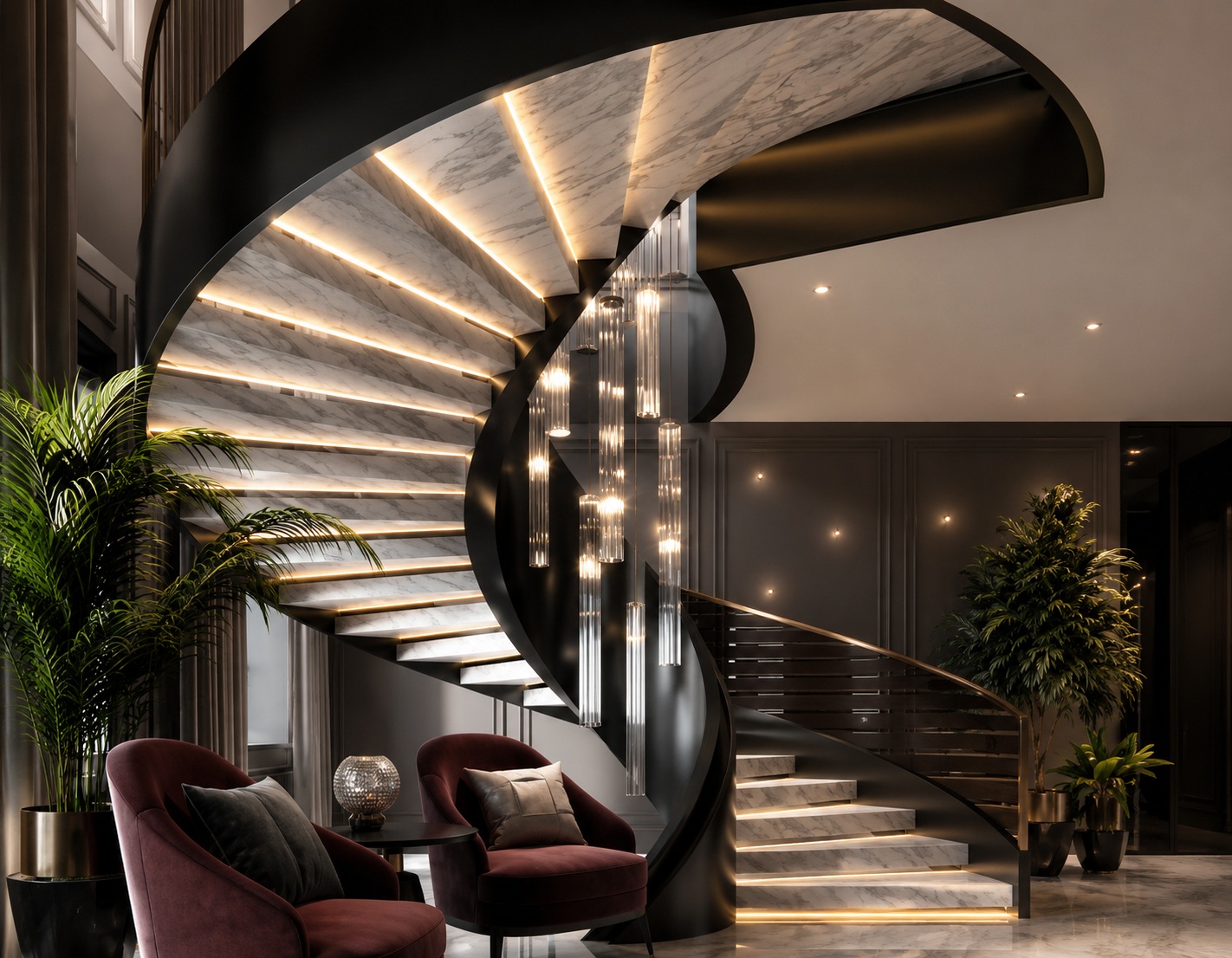
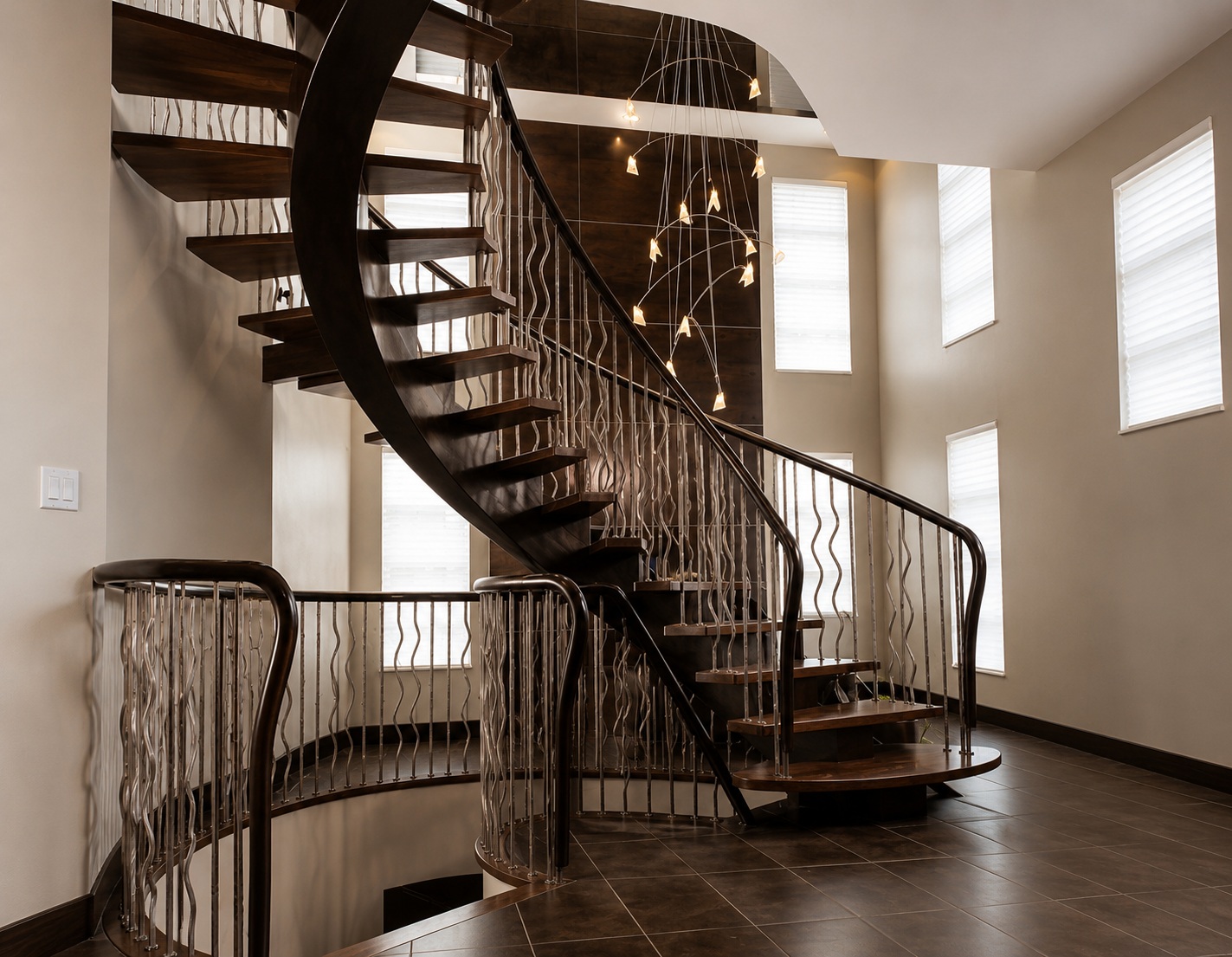
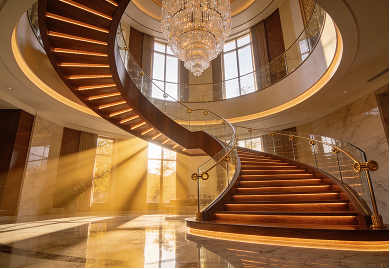
A curved staircase is the grand gesture of staircase design. Instead of turning at a sharp landing, it sweeps in a continuous arc, so the eye follows a smooth line from the floor to the storey above. That flowing shape feels generous and welcoming, which is why a curved flight is the classic choice for an entrance hall in a larger home.
The design ideas here are about proportion and material. A wide, gentle radius reads calm and elegant, while a tighter curve feels more dramatic and compact. Timber treads with a painted stringer keep it warm and traditional, and a steel-and-glass curve turns the same shape modern and light. The handrail is half the effect on a curved stair, since it has to flow in one unbroken sweep, which is a detail we set out on the drawing before fabrication begins.
See what a curved staircase is for the basics, go deeper on look and finish in our curved staircase design guide. Compare the shapes in curved vs spiral staircase, and budget it with the curved staircase cost drivers. View models on our curved staircase page, including a metal curved stair, an outdoor curved stair, and a deck curved stair.
Mono-Stringer and Open-Tread Designs
A mono-stringer staircase carries every tread on one central steel beam, so the sides stay open and the stair reads as a single clean line. It gives much of the lightness of a floating stair while keeping a visible, reassuring spine down the middle. For owners who love the minimal look but want the structure to show honestly, it is one of the most satisfying staircase design ideas available.
The beam itself becomes the design. A slim rectangular stringer in matte black is the modern default, paired with thick timber treads and a frameless glass or thin cable guard. A wider folded-plate stringer feels more industrial and architectural. Because the treads cantilever from one beam, the engineering of that spine matters, and it is the part we size and trial-assemble before the staircase leaves the factory.
Our mono-stringer staircase guide explains how it works and where it suits. Go further with single stringer stairs explained, tell the looks apart in monorail staircase vs mono-stringer, and compare the beam options in mono beam vs center stringer stairs.
Steel, Metal and Material Ideas
Once the shape is set, the materials carry the staircase design. The same floating flight feels rustic in oak or precise in steel and glass, so the finish is where a stair becomes personal. Most modern designs mix two or three materials rather than one, which is what gives them their warmth and depth.
| Material | The look it brings |
|---|---|
| Wood | Warm and tactile underfoot. Thick timber treads soften a steel or glass stair and match a wooden floor. |
| Steel | The structural backbone, often in matte black. Slim, strong, and the line behind most modern designs. |
| Glass | For treads or a balustrade, it keeps light and sightlines open. The brightest, most open-feeling choice. |
| Stone | Marble or stone treads read solid and luxurious, and pair well with a slim metal structure. |
| Cable | A horizontal cable infill almost disappears, keeping a guard nearly invisible for an open, airy look. |
The popular pairings are popular for a sound reason. Warm wood with black steel gives contrast without heaviness; steel with glass keeps a room bright; stone with a slim metal beam reads quietly luxurious. Steel sits behind most of these looks, so it helps to understand it. Read what a steel staircase is, weigh the two classics in metal vs wood staircase, and see the engine of the stair in our steel stair stringer guide. For pure inspiration, browse modern steel staircase design.
Railing and Balustrade Ideas
The railing changes a staircase more than almost any other choice, because it sits at eye level and runs the full length of the flight. The same set of treads can feel traditional behind turned timber balusters or sharply modern behind a single sheet of glass. Choosing the balustrade is really choosing how heavy or how open you want the stair to feel.
Frameless glass is the favourite for modern designs, since it guards the edge without blocking light or the view of the treads. A horizontal cable infill is even more discreet and suits a relaxed, open interior. Slim metal balusters keep a classic rhythm at a calmer budget, while forged iron brings ornament and character to a period or curved stair. The handrail on top then ties it together, in timber for warmth or metal for a clean line.
Because the railing carries so much of the look, it is worth designing it alongside the stair rather than after. You can see the glass, cable, stainless, and aluminum balustrades we make on our railing and balustrade page, and match one to the staircase you have in mind.
Lighting and Finishing Touches
Lighting is the finishing idea that many owners discover last and wish they had planned first. A staircase looks completely different after dark, and the right light can make a floating flight glow or pick out the grain of a timber tread. Because the wiring has to be planned into the structure, lighting is a design choice, not an accessory you add at the end.
The popular ideas are straightforward, and the most common is recessed strip lighting under each tread, which gives a soft, modern illumination and makes open risers feel reassuringly safe at night. Lights set into the side wall throw a gentle glow across the steps without glare. A pendant dropped into a curved or spiral void turns the stair into a lit sculpture. Each of these wants a channel or a cavity left in the right place. We mark it on the drawing before the steel is cut, so the wiring route is coordinated rather than chased in later.
Small finishing choices complete the design. A continuous handrail that feels good in the hand, a tread nosing that catches the light, and a finish colour tying the stair to the floor are the last details that count.
Indoor vs Outdoor Staircase Design
An outdoor staircase follows the same design ideas as an indoor one, but the weather sets harder limits. A roof terrace, a raised deck, or a garden split-level all want a stair that looks considered and survives rain, sun, and frost for years. So the shapes carry over, while the materials and finishes shift toward durability.
Galvanised or powder-coated steel resists corrosion, and open grating or slatted treads shed rain so the steps stay safe underfoot. A compact outdoor spiral gives a neat route up to a roof terrace, while a straight or curved exterior flight suits a generous garden. The design still matters outside, so a clean black steel stair with an open guard can look every bit as sharp on a terrace as it does in a hall.
Our outdoor staircase complete guide covers it in full, with outdoor stair materials compared and the popular metal vs steel outdoor staircase question. Browse weather-ready models on our outdoor staircase page, including a custom outdoor curved staircase and an exterior prefab stair.
Prefab and Made-to-Order Stairs
A prefab staircase is not a lesser design; it simply means the stair is engineered and built in the factory, then delivered ready to install. For a custom project that matters, because the precision of a controlled workshop beats cutting and welding on a dusty site. Almost any of the looks above, from a floating flight to a curved sweep, can be made this way.
The design freedom is the same; the difference is how the stair reaches you. We draw it to your exact opening, fabricate and finish it indoors, trial-assemble it to confirm the fit, then crate it so your installer can put it up quickly and cleanly. That route travels especially well for export, which is most of what we do, since a stair that was test-built before shipping arrives ready rather than improvised.
Learn how the approach works in what a prefab staircase is, and see how a factory-made stair handles the rules in are prefab stairs up to code.
Choosing and Specifying Your Staircase
Turning a design idea into the right order is its own small skill. The biggest early decision is custom versus stock: a stock kit is quick and cheap but fixed in size, while a made-to-order stair fits your exact opening and your chosen look. For a feature staircase in a home you care about, the tailored route almost always wins on fit and finish.
When you do reach out to a maker, a little preparation saves weeks. Your floor-to-floor height, the size of the floor opening, the materials you like, and a reference photo are enough to start a real conversation. The clearer your brief, the closer the first drawing lands, and the fewer rounds it takes to reach a stair you are happy to approve.
Weigh the routes in custom vs stock staircases, follow the steps in how to buy a staircase. Prepare your brief with what to send a staircase manufacturer, and vet a supplier using how to choose a custom staircase manufacturer.
Safety and Code Basics
A beautiful staircase still has to be a safe one, so a few rules shape every design. Riser height, tread depth, handrail height, and headroom all sit within common references such as the IRC and IBC in the United States, with similar standards elsewhere. These figures keep the climb comfortable and predictable, whatever the shape of the stair.
The values differ a little by stair type and by where you build. A spiral, for example, has its own minimum width and tread rules, and a commercial setting adds requirements a home does not. We design to common references and note them on the drawing, but your local adopted code edition is what actually governs, so confirm the current version with your local team before you build.
For the owner-relevant essentials, read ADA stair requirements explained, the spiral-specific rules in spiral staircase code requirements. For a project build, see the commercial staircase code design guide and IBC stair width and egress guide.
A custom staircase we drew, fabricated, and trial-assembled before crating — tap to play.
2026 Staircase Design Trends
Staircase design in 2026 keeps moving toward the feature stair, where the staircase is treated as architecture rather than a way between floors. Floating and open-tread designs remain the clearest expression of that idea, prized for the light and the sense of space they bring to an open-plan home. The mood is refined rather than flashy, with clean lines softened by warmth.
A few directions stand out this year, and mixed materials lead them, with thick wood treads against a matte black steel stringer forming the signature pairing. Frameless glass balustrades stay popular for the way they guard an edge without blocking light. Warm timber tones balance the cooler metal, so the stair feels inviting as well as modern. Integrated lighting and a quiet, sculptural form round out the look. None of this is about novelty for its own sake; it is the same goal owners have always had, which is a staircase that feels naturally part of the home.
The reassuring part is that these trends sit on shapes that last. A well-proportioned floating, curved, or mono-stringer stair will read as current long after a passing colour fades, because the form, not the fashion, carries it.
Designing a Made-to-Order Staircase
A design idea only becomes a real staircase once someone draws it precisely and builds it to fit your opening. At Double Building Materials, that is the whole of what we do. We are a Guangdong factory with 25+ years behind us and more than 800 projects shipped to over 60 countries. Every staircase starts as a shop drawing rather than a kit off a shelf.
The sequence is the same whatever the design. We take your floor-to-floor height, your opening, and your chosen look, then turn them into a working drawing you approve before any steel is cut. We fabricate the structure and the treads, then trial-assemble the whole stair on our factory floor to confirm the rise and the fit. We crate it for export in the order your installer needs. Your own contractor fits it on site from our drawings, and we can help you find one where local installation is available. We do not install on site or sign off local code; that stays with your local team.
That drawing-first method is why an ambitious design idea travels safely from a screen to your home. Browse the full range on our custom staircase page, or send us your space and the look you want and we will draw it.
Staircase Design Ideas FAQ
How do I choose the right staircase design?
Start with your space, your light, and who uses the stair, not with a picture. The floor area you can give it points to the shape, the brightness you want points to open treads or glass, and the people who climb it set the comfort. Once those are settled, the materials and railing turn the chosen shape into your design.
What is the most popular staircase design in 2026?
The feature staircase leads, and the floating design is its clearest form. The signature look pairs thick wood treads with a matte black steel support and a frameless glass balustrade, which keeps a room bright while making the stair a centrepiece. Curved and mono-stringer stairs are close behind for owners who want a different character.
Which staircase design saves the most space?
A spiral staircase has the smallest footprint of any type, folding a full flight into a circle a few feet across. That makes it the usual answer for a loft, a corner, or a compact home. A straight or curved stair is easier to walk but needs noticeably more floor, so the spiral wins where space is the priority.
How do I make my staircase a feature?
Treat it as architecture rather than a route between floors. Open risers, a sculptural shape such as a floating or curved flight, a frameless glass guard, and integrated lighting all push a stair toward a centrepiece. Mixing two materials, commonly warm wood with black steel, adds the depth that makes a staircase worth looking at.
Can you design a staircase to match my home?
Yes. Every staircase we make is drawn to your space and your chosen look rather than picked from stock, so the shape, the materials, and the railing all follow your design. Send us your floor-to-floor height, your opening, and a reference of the style you like, and we turn it into a working drawing for your approval before fabrication.
Explore every type in depth: floating, spiral, curved, mono-stringer, steel, outdoor, and prefab staircases. Or browse the full custom staircase range.
Double Building Materials draws, manufactures, trial-assembles, crates, and ships your custom staircase. Your own contractor or installer handles on-site installation and local code sign-off — we can help you find one where available. Design directions above are common industry references; the materials and proportions of your stair are set on your approved drawing.
Talk to us on WhatsApp →